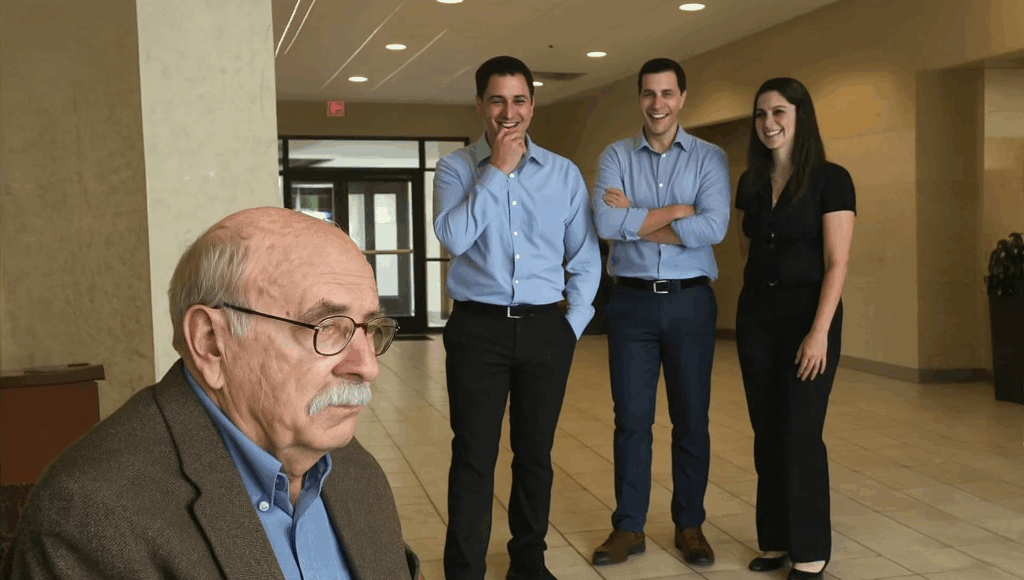
He came in wearing a wrinkled coat and well-worn shoes. No badge. No assistant. A man in his late seventies carrying a folder and humming a Sinatra tune.
“Excuse me, sir,” the receptionist said, glancing nervously. “This lobby is for clients and staff only.”
“Oh, I know,” he smiled. “I’m here for a meeting.”
A group of junior employees passed by and snickered.
“Probably another confused retiree,” one of them whispered.
“Maybe he’s here to fix the coffee machine,” another joked.
No one offered him a seat.
The receptionist called upstairs, then hung up and looked startled. “They said… to send you right up.”
The laughter stopped.
He took the elevator alone.
Ten minutes later, a high-ranking executive burst into the lobby, eyes wide. “Where did he go? Was he just here?”
They pointed upstairs. “Room 14C.”
He muttered something under his breath and ran.
Because the man they laughed at?
Was the founder.
The majority shareholder.
The reason the company existed.
And now the door to the boardroom was closed.
And the quiet man was about to decide who stayed… and who didn’t.
His name was Silviu. Most of the staff didn’t know it.
They only saw his portrait in the hallway once a year during the company’s anniversary party, draped in balloons and LED lights, like a mascot.
The younger employees, especially in marketing, thought of him more like a relic than a real person.
They never expected him to actually show up.
In that boardroom, behind the closed door, ten directors sat upright, their backs straighter than ever. They hadn’t seen Silviu in person in almost five years. Some thought he’d sold his shares.
Others assumed he had retired completely, playing chess in a park or traveling the world with whatever money was left after the IPO.
But no.
Silviu had been watching.
From a distance, yes, but always keeping track.
The folder he carried was thin but organized. Inside were notes, printed emails, and handwritten memos. Not about finances. Not about the stock price. About people. About behavior.
He’d spent the last six months talking to former employees. Janitors. Middle managers. Even some interns. Quietly, without fanfare. Just conversations over coffee or long walks. He listened more than he spoke.
And what he heard worried him.
His once modest, close-knit company had turned into a machine. Profitable, yes. But cold. Arrogant. There were whispers of disrespect, of toxicity in the lower ranks. Promotions based on charm instead of contribution. Layoffs disguised as “optimization.” And at the core of it—pride without purpose.
He sat down at the long oak table.
No one dared speak.
Finally, Silviu opened the folder.
“Who approved the firing of the maintenance team last December?” he asked, casually.
There was a shuffle. The COO, a polished man in his forties named Dorian, cleared his throat.
“That decision was made by Facilities and signed off by myself. We outsourced for efficiency.”
“Hmm,” Silviu nodded. “I met your outsourced cleaners last week. They missed the mold under the fifth-floor sink. The old crew never would have.”
No one spoke.
“And who decided to remove the scholarship fund for employees’ children?”
Again, Dorian spoke. “It was low ROI, given the numbers. HR recommended reallocating the funds.”
Silviu looked up. “Do you have kids, Dorian?”
“Yes, sir.”
“Then you’ll understand why I reinstated the fund yesterday.”
A few directors glanced at each other. No one said a word.
“And one more thing,” Silviu said, his voice calm but clear. “There’s a receptionist named Irina. She’s been here four years. She was the only one who offered me a glass of water today.”
A pause.
“She stays. Gets a raise. And from what I read in her file, she’s due for a promotion.”
Silviu closed the folder and leaned back.
The room was still.
And then he smiled. Not with malice, but like a grandfather finally speaking to grandchildren who’d forgotten their manners.
“You’ve made this company rich. That’s true. But you’ve also made it shallow.”
He looked around the table.
“I built this place on purpose. On kindness. We knew each other’s names back then. We celebrated births, mourned losses together. Now it’s all numbers and titles.”
The CFO, a stern woman named Madalina, spoke up. “With all due respect, sir, times have changed. Culture has to evolve to stay competitive.”
Silviu nodded. “You’re right. But culture should evolve, not dissolve. There’s a difference.”
Then he opened a second folder, thicker than the first.
“This is a list of employees who left in the last two years. I called twenty of them. Seventeen cried on the phone. They left not because of money. Not because of workload. But because they felt invisible.”
He slid the folder to the middle of the table.
“And I won’t let this company become a place where good people vanish quietly.”
Another pause.’
“Some of you will stay. Some of you won’t.”
He stood up slowly. “I’ve asked Legal to prepare new contracts. I’ll be back in this room tomorrow morning. If your name is on the list, you’ll be part of this company’s next chapter.”
And with that, he walked out, folder in hand, humming Sinatra once more.
The next day, the mood in the building was strange. People were quiet in the elevators. HR avoided eye contact. Dorian sat in his office, pacing. Madalina hadn’t returned any calls.
When the new list came down, there were surprises.
Dorian was not on it.
Neither was Madalina.
Instead, some of the most vocal, high-profile execs were quietly asked to step down.
And in their place? People from the ground up. A logistics coordinator who always stayed late. A product designer known for mentoring interns. Even the cafeteria manager—who once found Silviu’s lost phone on a random Tuesday—was asked to join a new leadership council.
Irina, the receptionist, became Office Manager within the month.
Silviu didn’t return to the boardroom again, but his presence lingered.
He installed a new policy called “Coffee Chats”—every employee, regardless of rank, was encouraged to take an hour each month to talk with someone from a different department. No agenda. Just listen.
He also brought back the Founder’s Fund—an annual award for kindness, voted by peers.
The first winner? A junior developer named Andrei, who once spent three nights helping a sick coworker finish a project so she wouldn’t lose her bonus.
The change wasn’t overnight. But it was real.
People noticed.
Resumes stopped flowing out. Internal referrals increased. Anonymous employee surveys started to show a strange trend—people said they felt proud again.
And Silviu?
He returned to his small home on the outskirts of town. A modest house with an overgrown garden and a sleepy cat. He didn’t need applause. He never had.
But every once in a while, the company would send him a newsletter. With photos. With names.
And always, in the corner, a thank-you note signed simply: “To the man who reminded us that people come first.”
A few months later, Irina, now running her own team, walked past the lobby where it all began. She noticed a young man in a suit helping an older woman with the elevator buttons.
He wasn’t loud. He wasn’t trying to be noticed.
But he looked familiar.
Later, when reviewing a list of new interns, she paused at a name: Sebastian Voicu.
Silviu’s grandson.
He’d joined the company—quietly, without using his name.
And like his grandfather, he started not with a speech, but with a smile.
Life has a way of reminding us what truly matters.
Titles fade. Bonuses get spent. But the way we treat people? That leaves a mark.
If you’ve ever been underestimated or overlooked—remember, the quiet ones sometimes hold the loudest truths.
And if you’re in a position to lift someone up, don’t wait.
Start now.
You never know whose story you’re helping rewrite.