The morning I stepped into the office carrying a tall stack of carefully labeled folders, nobody in the open-plan space had any idea that I had spent the entire night wide awake inside an intensive care unit. My son lay there after a sudden, terrifying accident, hooked to monitors that filled the room with steady electronic pulses.
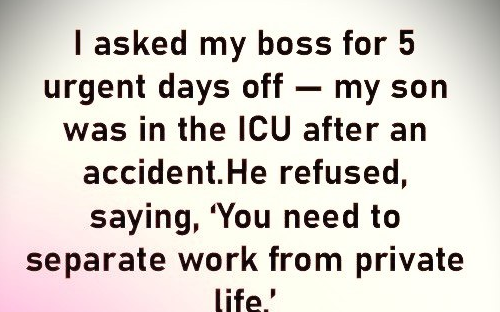
When I had approached my boss the previous afternoon and requested five urgent days off to stay with him, he refused without hesitation, delivering his standard line about keeping work and private life in completely separate compartments. In that moment, a wave of raw emotion surged through me—I wanted to raise my voice, demand understanding, or simply turn around and leave forever. Yet deep exhaustion has a remarkable power to clarify what truly matters. So I nodded, returned home only long enough to gather my laptop, and went straight back to the hospital.
The following day, I walked through the office again, moving steadily between the rows of desks. Colleagues glanced up from their screens, bracing themselves for an outburst, a tearful scene, or at least some visible sign of breakdown. They saw none of that.
What I carried in my arms represented every active project finished to the last detail, every report printed and bound, every upcoming deadline covered with clear instructions so the team could move forward smoothly in my absence. I had completed the work from a plastic chair beside my son’s bed, typing during the quiet stretches between nurse visits, proofreading while holding his hand as machines recorded his heartbeat.
I entered the conference room earlier than anyone expected and set the heavy stack directly in front of my boss. He arrived moments later, coffee in hand, clearly annoyed at the unscheduled interruption. His irritation faded the instant he understood what lay on the table.
These folders contained solutions, not complaints. Calmly, without the slightest edge in my tone, I explained that I had honored his instruction to separate the two worlds. From the hospital room I had managed both—caring for my critically ill child and making certain every professional obligation remained fulfilled. “Here is everything the team needs,” I said. “Every task is complete, every file is updated, every handover note is written. Now I will focus entirely on the part of my life that cannot wait.”
A heavy silence settled over the room. My boss opened the first folder, then the second, turning pages with growing concentration. For months he had moved through meetings like a machine—rapid instructions, clipped responses, zero pause for anything personal. That morning he slowed down. He studied the meticulous organization, the timestamps showing work done at 2:17 a.m., 3:45 a.m., 5:12 a.m.—hours when any normal person would have been asleep or breaking down. Something in his expression softened, the hard lines around his mouth easing for the first time anyone could remember.
He closed the final folder, stood up, and asked me to step into the hallway. Away from the others, he spoke in a low voice that carried genuine regret. Immense pressure from upper management had turned him into someone he didn’t particularly like, he admitted. In his effort to keep the department running at full speed, he had lost sight of the human beings who made it possible.
He told me I never should have felt forced to choose between my son’s life and my livelihood. “Take all the time you need,” he said. “The work is covered because of you, not in spite of you. Go be with your family.” There was no dramatic speech, no theatrical apology—just a quiet acknowledgment that leadership requires more than meeting targets.
I returned to the hospital carrying a lighter heart than I had known in days. The antiseptic smell, the constant beeps, the anxious waiting—they all remained, but the crushing weight of divided loyalty had lifted. I could sit beside my son, hold his hand without guilt, and focus completely on his recovery. Weeks later, when he finally came home and I walked back into the office, the atmosphere felt different in subtle yet unmistakable ways.
Colleagues greeted me with genuine warmth instead of cautious glances. Morning meetings now began with brief, caring check-ins about life outside the building. My boss made a point of asking about my son’s progress and listened to the answer.
That difficult season taught me a lasting lesson about influence and change. Raising voices or issuing ultimatums rarely shifts hearts that have grown rigid. Demonstrating grace under pressure, fulfilling responsibilities even when no one would have blamed me for walking away—those actions spoke with a clarity that words alone could never achieve.
Calm determination, paired with unwavering commitment to both family and duty, opened doors that anger would only have slammed shut. Strength wrapped in quiet resolve has a way of reshaping perspectives, reminding everyone watching that true professionalism includes space for humanity, and real leadership recognizes the irreplaceable people behind every task.