We believed we understood everything about Grandma Esther. At 84, her mind remained razor-sharp, her passion for crossword puzzles unmatched, and her command of Thanksgiving dinner an annual tradition. Yet, a few weeks ago, a sudden fall in her garden landed her in the hospital with a fractured hip.
Our family devised a straightforward plan: rotate visits, supply her with puzzles and jelly beans, and ensure she didn’t overwhelm the nursing staff. But on the third day, we entered her room and stopped in our tracks.
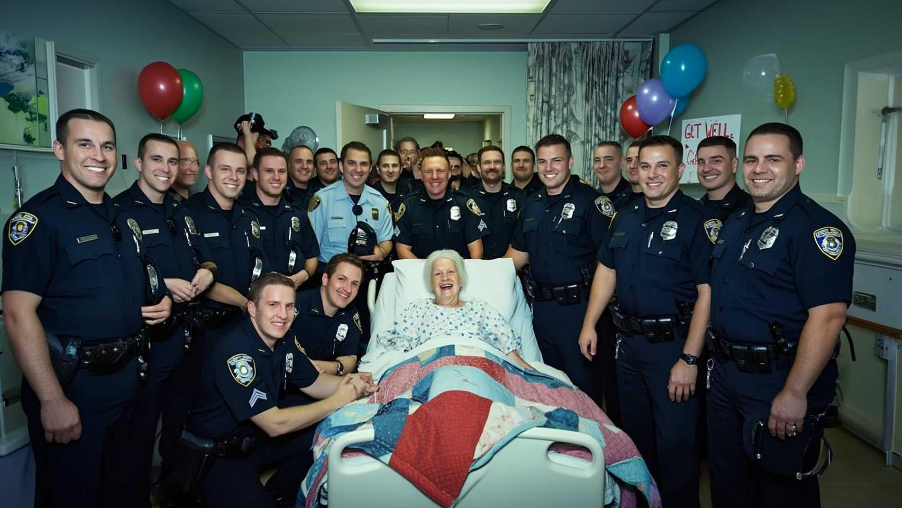
Police officers filled the space.
Not merely a handful. Dozens stood there, dressed in full uniforms, badges gleaming, hats in hand, smiling like children on a holiday morning. Grandma Esther? She presided from her hospital bed like royalty, tossing out quips and waving as if leading a grand procession.
A tall officer, likely a sergeant, gripped my hand warmly. “You must be her grandson. Your grandma’s a legend,” he said.
I wondered if he’d mistaken the room. Then I noticed the poster on the wall: “GET WELL, GRANDMA!” adorned with badge numbers.
Perplexed, I glanced at her. She merely shrugged, as if this were routine.
“I trained most of these folks,” she said casually. “Back when they allowed women to lead at the academy.”
It turned out Grandma Esther wasn’t simply a police officer. She was among the county’s first female instructors, a fact she’d kept under wraps, dismissing it as “just work.” Yet, her influence had clearly shaped countless lives.
Then the sergeant leaned close, murmuring something to her.
Whatever he said brought tears to her eyes.
In all my years, I’d never seen Grandma cry—not when Grandpa passed, not when Uncle Steve totaled her Camry, not even during the house fire in ’98. Naturally, I grew alarmed.
“What did you tell her?” I demanded.
The sergeant met my gaze. “We need her expertise for a case. One final time.”
I chuckled, incredulous. “She’s 84 and bedridden.”
But Grandma dried her tears, sat up as tall as her injury allowed, and declared, “I’m ready to hear it.”
I assumed it was a symbolic gesture, perhaps a mock case to honor her. But they were entirely serious.
The case centered on a series of burglaries targeting retired officers in the region. The culprit knew too much—names, schedules, even security codes. Some speculated it was an insider, possibly a former recruit turned rogue. The only link? Every victim had been trained by Grandma Esther.
“They’re using knowledge only your grandma would have,” the sergeant explained. “Old anecdotes, strategies, or maybe the drills she taught.”
Grandma closed her eyes, breathing deeply. Then she spoke, her words sending a shiver through me.
“Look at the notebooks,” she said.
The room fell silent.
“Which notebooks, ma’am?” an officer asked.
“I had a practice,” she explained. “I recorded details on every cadet—strengths, weaknesses, family backgrounds, who I trusted… and who I didn’t. They’re in my basement, in a cedar chest, hidden under the floorboards.”
I stared, stunned. “You never mentioned this.”
She grinned slyly. “Didn’t want anyone snooping.”
That night, my cousin Aaron and I, accompanied by two officers, went to her house and pried up the floorboards beneath the laundry room. There it was—a dusty, sealed cedar chest brimming with weathered leather notebooks, spanning the 1960s to the early ’90s.
We delivered them to the precinct.
Over the following days, Grandma—still confined to her bed—helped pinpoint suspects. Her memory retained details most would have lost to time. One name surfaced repeatedly: Mitchell Rainer.
“He was a standout in ’84,” she recalled. “But something was off. Too cunning, manipulative. Failed psych evaluations twice but slipped through on his third attempt.” She’d noted him in her records but lacked concrete evidence then. He left the force within a year.
“He called me ‘the fossil,’” she added. “Claimed I was wasting time training people who’d never succeed.”
The police soon located him.
Living under an alias in a nearby county, he’d retired early, citing back issues. A raid on his home uncovered floor plans, security codes, and stolen academy files from years past.
The burglaries ceased immediately.
Grandma received a special medal for “lifelong service and continued contributions to justice.” She brushed it off as “a bit much” but kept the medal by her bedside.
What truly moved her, though, was a visit from one of her former recruits, now the precinct captain, who brought his teenage daughter.
“She’s applying to the academy next spring,” he said. “She wanted to meet the woman who trained her father.”
The girl was awestruck. Grandma’s demeanor softened.
They spoke for over an hour. Grandma shared insights, warned her of challenges, and advised her on navigating doubt. She concluded, “Being underestimated is your greatest asset. Wield it carefully.”
After the girl left, Grandma leaned back and sighed. “I thought I’d been forgotten,” she admitted.
We were speechless.
She turned to me. “You never know how far your impact reaches, kid. You do your best and hope it counts someday.”
Weeks later, she returned home, recovering slowly. She insisted on overseeing Thanksgiving stuffing, directing us from her recliner rather than the kitchen.
Then, on Christmas Eve, an unexpected letter arrived. Handwritten, with no return address.
Grandma read it silently, then handed it to me.
It was from Carla, a woman who, as a teenage runaway in 1972, had been arrested for shoplifting. Scared and defiant, she believed no one cared. But a female officer—the first she’d ever seen—sat with her and said, “You’re not broken. You’re just lost. And lost things can be found.”
That officer was Grandma.
Carla went on to finish school, become a counselor, and now ran a shelter for troubled teens. She wrote, “You changed my life with one sentence. I wanted you to know.”
Grandma wept again, unashamed this time.
For all the years she stayed silent, believing her work had faded, here was evidence—tangible, living proof—that her spark still glowed.
I began to see her anew.
No longer just the quick-witted matriarch who corrected our grammar and reigned over holidays, but a woman who shaped lives quietly, without seeking praise.
Months later, Grandma started something new.
She began writing letters.
Detailed ones, to those she’d trained, arrested, or hadn’t spoken to in decades. She called it “tying up loose ends.” She wanted them to know what she saw in them, for better or worse.
“I’m not seeking closure,” she told me. “I just want to leave a clear path behind.”
One letter stood out.
It was to Mitchell Rainer.
She didn’t absolve or forgive him. But she wrote that, during his training, she saw potential beneath his resentment. “You let it fester,” she wrote. “But I hope you find something worth redeeming.”
She never received a reply.
Yet the act of writing it, of confronting it directly, seemed to bring her calm.
By the next fall, Grandma was back in her garden, moving slowly with a cane. She began sharing stories we’d never heard—about botched undercover operations, bar fights she defused, and the time she smuggled a kitten into the precinct in her coat.
It was as if she’d finally permitted herself to be known.
And perhaps that’s the takeaway.
We think we know those who raised us, assuming we’ve seen their full story. But everyone holds chapters they keep private, whether for pain, modesty, or because no one asked.
When we truly listen, we discover they were heroes all along.
If someone in your life fits that mold, ask them their story.
Before time runs out.
Grandma’s still here, crossword in one hand, black coffee in the other, teasing the nurses when they check her vitals. She’d never call herself courageous. But every officer who drops by with donuts and calls her “ma’am” certainly does.
That, I believe, is her true legacy.
Not awards or recognition, but the quiet respect earned by showing up, doing the work, and never demanding gratitude.
Has someone in your life revealed a hidden past? Or left a deeper mark than you ever knew?
Share this story if it resonated—and remind others that our quiet heroes might be tending their gardens, waiting for someone to ask.