The Padlock Behind the Rain: Why I Checked My Son-in-Law’s Detached Garage After Seven Days of Silence
The sound wasn’t a scream. It was worse.
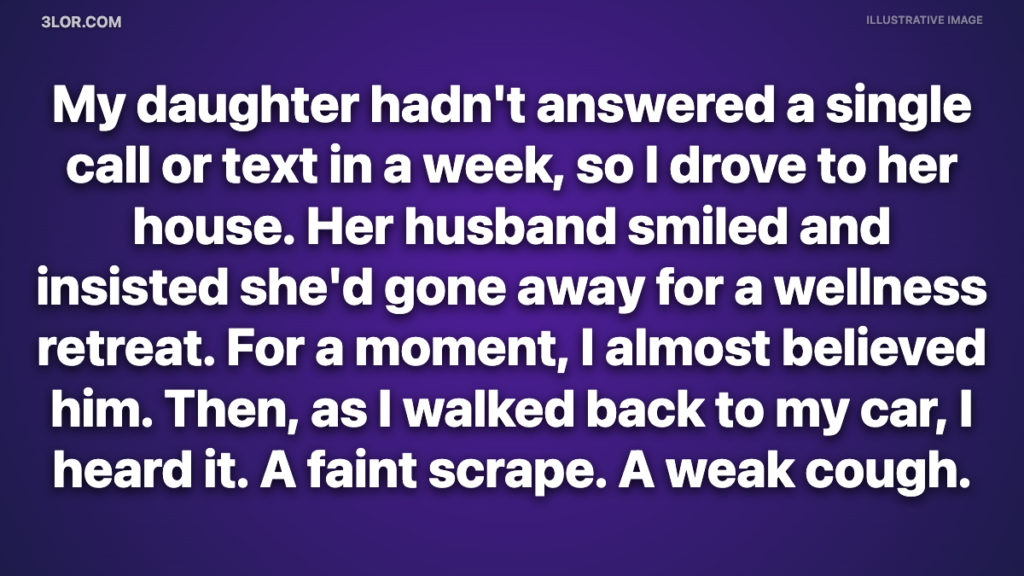
It was a weak, metallic scrape against wet concrete, followed by a cough so paper-thin it barely cut through the steady November downpour. Anyone passing down the muddy service alley would have dismissed it as an old detached outbuilding groaning under the wind.
A former felony prosecutor wouldn’t. And a mother certainly wouldn’t.
For seven straight days, my thirty-one-year-old daughter, Rachel, had vanished. Not off the map, but out of my reach. In eight years of marriage to Nolan Pierce, Rachel had never gone twenty-four hours without checking in. If her caseload as a high school counselor ran late, she texted. If she drove into the hill country, she sent blurry snapshots of diner pies and highway markers. Every single night ended with the exact same four words: Love you, Mom.
When forty-eight hours passed in total silence, I called her high school. The front desk told me Nolan had phoned in a sudden personal leave of absence on her behalf.
When five days passed, I reached out to her two closest college friends. Neither had heard from her.
By the seventh morning, thirty-four years of prosecuting domestic violence cases screamed at me that every “reasonable explanation” was a lie. I got into my sedan and drove four hours through driving rain to the cedar-sided house she shared with Nolan outside Marble Falls.
The Sister’s Cardigan
The exterior lights were blazing when I pulled into the asphalt turnaround.
Nolan opened the heavy front door before I even made it up the porch steps. His smile appeared instantly—smooth, polished, and entirely skin-deep.
“Elaine,” he said, extending a dry hand. “I wasn’t expecting you in this weather.”
“Rachel isn’t answering her phone, Nolan. Where is she?”
He offered a sympathetic sigh, resting one forearm against the door jamb. “She needed a hard reset. She booked a ten-day silent wellness retreat up near Sedona. You know how overwhelmed she’s been with the district audits.”
“What is the name of the retreat facility?”
He blinked once, his expression sliding into that practiced, patronizing warmth he used whenever he wanted to paint Rachel as unstable. “I honestly don’t recall the specific ranch name, Elaine. She wanted zero digital contact. It wasn’t my place to hover.”
“Show me the text message where she confirmed her arrival.”
“I cleared my inbox two days ago.”
Before I could press him, footsteps sounded on the hardwood runner behind him. Nolan’s twenty-four-year-old sister, Tessa, appeared in the foyer holding a mug of herbal tea.
Draped over her shoulders was an oversized, cornflower-blue cable-knit sweater.
My breath caught in my throat. I had spent three weeks embroidering tiny white jasmine buds along the cuffs of that exact cardigan for Rachel’s twenty-ninth birthday. Rachel wore it almost daily; she never lent it to anyone, least of all a sister-in-law who routinely mocked her behind her back.
Tessa caught me staring at the embroidery. Her fingers twitched against the wool. “Rachel let me borrow it before she left town,” she offered airily. “Said she wouldn’t need heavy knits in the desert.”
I looked back at Nolan. His jaw was tight, his smile frozen in place.
“Thank you for clarifying,” I said evenly. “Have a good evening.”
I walked down the steps, started my engine, and drove out of the cul-de-sac.
The Torn Envelope
I didn’t head for the highway. I drove three blocks west, tucked my car beneath the dead canopy of an unlit live oak on a residential side street, killed the running lights, and waited.
Cruelty rarely shows its hand while an audience is watching. It waits until the audience drives away.
Twenty-five minutes later, armed with a pocket flashlight and heavy dark waterproofs, I slipped through the overgrown utility easement behind the Pierce property line.
The main house was quiet, curtains drawn. At the far corner of the quarter-acre lot stood Nolan’s two-car detached workshop. The overhead ventilation turbine, which Rachel once told me ran constantly to clear lacquer fumes, sat completely dead. The exterior door was secured with a brand-new, hardened-steel Master Lock shackle.
Then, through the sound of rain drumming against the corrugated steel siding, came that faint, dragging scrape.
A plastic water jug rolling across raw cement.
Then a muffled, rattling cough.
I pulled a pair of nitrile gloves from my pocket and knelt near the foundation. Trapped beneath the wheel of an overturned recycling container by the side door was a sodden, torn manila document.
I smoothed the wet paper against my knee. It was an official appointment confirmation notice from the Burnet County Clerk’s Office:
SPECIAL WARRANTY DEED TRANSFER — MANDATORY IN-PERSON NOTARIZATION REQUIRED
Scheduled Hearing: Monday, 10:00 AM
The legal description listed the sixty-acre lakefront parcel my late husband had deeded solely to Rachel before he died—a prime parcel of shoreland developers had been offering four million dollars for over the past eighteen months. Rachel had refused every dollar. “Dad taught me to track deer on that ridge,” she had told Nolan at our last family dinner. “Some soil isn’t for sale.”
Now the pieces fell into place with terrifying clarity.
Nolan couldn’t forge the deed conveyance; the county required personal physical appearance with biometric thumbprinting. He hadn’t sent Rachel to a retreat. He was starving her in an unheated garage until she agreed to walk into that courthouse on Monday morning and sign away her father’s legacy.
I stepped back into the cedar brush, shielded my phone from the downpour, and dialed Detective Isaac Monroe’s direct line.
Fourteen Minutes
Monroe had handled homicide and domestic warrants for my division for nearly two decades before I retired from the district attorney’s office. He answered on the second ring.
“Elaine?”
“Isaac,” I said, keeping my breathing level. “My daughter is being unlawfully imprisoned inside a locked garage behind 412 Ridgecrest. I need a rapid-entry team on-site with bolt cutters. Now.”
He didn’t ask if I was certain. He didn’t tell me to file a missing persons report.
“Unmarked units are rolling from the substation,” Monroe replied instantly. “Fourteen minutes. Do not approach the structure.”
At 9:14 PM, two black Interceptors killed their lights and coasted to the curb in front of the Pierce residence. Monroe and three tactical deputies moved through the gravel breezeway like shadows.
Monroe leaned on the front doorbell, ringing it three times in rapid succession. When Nolan opened the door in sweatpants, holding a glass of bourbon, Monroe didn’t step back.
“Welfare check on Rachel Pierce,” Monroe announced, his badge gleaming in the rain.
“I already told her mother, Rachel is in Arizona—”
“We have an active distress report originating from your detached structure,” Monroe interrupted, stepping shoulder-first past him into the foyer. “Deputy Miller, clear the garage.”
“You need a search warrant for that building!” Nolan snarled, his polite veneer shattering into sheer, cornered fury. “Tessa, call our attorney right now!”
Behind the house, the thirty-six-inch industrial bolt cutters bit into the shackle.
A loud, metallic CRACK echoed through the trees.
The steel door groaned open. A wave of damp, freezing air rolled out into the night.
Deputy Miller’s halogen beam swept across bare concrete, past paint cans, stopping at a soiled foam mattress wedged between an old workbench and the rear wall.
“Detective!” Miller shouted, his voice cracking. “Get the medic unit back here!”
I pushed past Nolan’s outstretched arm and ran through the mud.
Rachel was curled on her side on the bare foam, shivering so violently her teeth chattered audibly in the dark. A six-foot heavy-gauge transport chain was looped around her left ankle, padlocked to an eye-bolt anchored into the foundation slab. Beside her lay three empty water bottles and a half-eaten sleeve of stale saltine crackers.
She lifted her head, squinting against the flashlight glare. Her face was bruised, her lips cracked and bleeding, her wrist raw where she had clawed at the metal links.
“Mom?” she rasped, her voice barely a thread in the cold air.
I dropped to the wet floor, pulled off my coat, and wrapped it around her shoulders, pulling her skeletal frame against my chest.
“I’ve got you, baby,” I wept into her hair. “I’ve got you.”
Out in the driveway, Monroe’s voice cut through the rain like an iron blade: “Nolan Pierce, Tessa Pierce—you are under arrest for aggravated kidnapping, unlawful restraint, and felony extortion.”
The Tackle Box
The emergency room staff at Seton spent forty-eight hours treating Rachel for severe hypothermia, acute dehydration, and ligament damage to her ankle.
By Sunday morning, while Rachel slept under heated blankets, Detective Monroe brought a legal pad to the hospital waiting area.
“His computer showed the whole design, Elaine,” Monroe said, laying out crime-scene prints. “Nolan ran up six hundred and forty thousand dollars in offshore sports-betting markers over the last two years. The collectors gave him until the end of the month. But that wasn’t the worst of it.”
Monroe slid a certified document across the vinyl table: a newly executed commercial term life insurance policy on Rachel Pierce, valued at three million dollars, naming Nolan Pierce as the irrevocable beneficiary.
“If she signed the deed on Monday, he took the four million,” Monroe said grimly. “If she refused, he was going to stage a carbon monoxide accident in that garage on Tuesday night. He had the propane heater loaded in the trunk of his car.”
When Rachel woke that afternoon, she reached for my hand. Her voice was cracked, but her gaze was stone-clear.
“There’s an old green metal tackle box on the top shelf of Dad’s boathouse at the lake,” she whispered. “Look under the plastic crankbaits.”
Two hours later, Monroe’s investigators opened the tackle box.
Inside was a high-capacity Olympus digital voice recorder. For six months, after catching Nolan moving her keys and secretly altering her digital calendar to convince her family she was losing her mind, Rachel had quietly recorded their private conversations, slipping the files to the lake cabin during her weekend runs.
The audio files obliterated any possible defense.
The jury heard Nolan chuckling with Tessa as they practiced forging Rachel’s signature on mortgage notes. They heard Tessa agreeing to wear Rachel’s clothes in public to trick neighbors into thinking Rachel was still coming and going.
And most damning of all, they heard Nolan’s flat, sociopathic voice from the night before she vanished:
“One week in the cold without water, and she’ll beg to put her thumbprint on that transfer deed. If she still wants to be stubborn, we use the propane tank and collect the policy.”
The Broken Shackle
The trial in Burnet County lasted four days.
Nolan sat at the defense table in a navy bespoke suit, trying to project the image of a grieving husband overwhelmed by debt. But when Rachel took the stand—clear-eyed, composed, holding the scarred ankle chain in her bare hand for the jury to see—his lawyers had nowhere to hide.
The jury deliberated for eighty minutes.
Guilty on all counts: Aggravated Kidnapping with a Deadly Weapon, Attempted Capital Murder, Conspiracy, and Wire Fraud.
The judge showed zero mercy, handing Nolan Pierce forty-eight years in the Texas Department of Criminal Justice with no eligibility for parole until he serves at least thirty. Tessa received fourteen years for conspiracy and facilitation.
A year later, Rachel and I stood on the wooden dock at the lake cabin.
The morning mist was lifting off the water, revealing the live oaks and limestone bluffs her father had spent forty years protecting. The old property hadn’t been sold. Instead, Rachel had converted the guest lodge into The Jasmine House—a private, secure recovery haven for women escaping domestic coercion and psychological isolation.
On the mantle inside the main cabin sits a heavy glass case containing the cut Master Lock from the garage door, its shackle severed in two.
Below it, carved into polished cedar, is a single line:
Silence is not peace. It is the moment you start looking.
Rachel walked down the dock, wrapped her arm through mine, and leaned her head against my shoulder.
“How did you know, Mom?” she asked quietly, watching a blue heron lift from the reeds. “How did you know I hadn’t just walked away?”
I squeezed her arm, feeling the warmth of her pulse through her sleeve.
“Because a mother doesn’t need to hear a scream to know her child is in the dark,” I said. “She only needs to know which doors to break.”
Note: This narrative is an original work of dramatic fiction produced for storytelling and editorial purposes. Names, characters, businesses, and incidents are entirely products of the author’s imagination.