Every morning, Calvin would shoot out the front door like a firecracker—yelling goodbye to the dog, waving his toy dinosaur, and racing toward the bus like it was the best part of his day. He was six, full of life, and grinning like he had a secret to share with the world.
But then, things began to dim.
At first, it was subtle. A missing smile. A quiet “good morning” barely whispered. Then came the stomachaches with no cause. Sleepless nights. The hallway light left on. And eventually… the drawings stopped.
Calvin, who once filled entire walls with dinosaurs and dragons, now handed me blank pages—or worse, angry black scribbles crumpled into balls.
I tried to tell myself it was just a phase. But deep down, I knew better.
So one morning, I didn’t just watch from the porch—I walked him all the way to the bus.
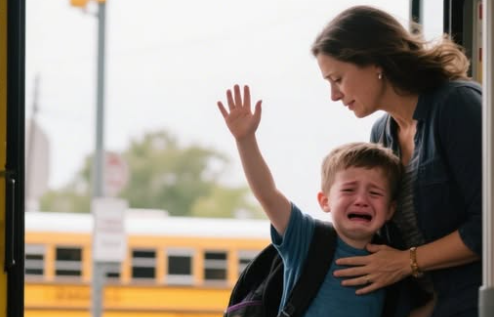
He clung to his backpack straps like they were the only solid thing he had. No smile. No wave. When the bus doors hissed open, he hesitated like he was stepping into something dangerous.

“Go ahead, sweetheart,” I said softly. “You’ve got this.”
He nodded, eyes full of storm clouds, and stepped aboard.
That’s when I saw it.
He headed toward the front, but a kid in the back made a comment—something I couldn’t hear but didn’t need to. There was a smirk. A nudge. A finger pointing.
Calvin pulled his hat low, turned to the window, and wiped his cheek with his sleeve.
He was crying.
And then—something unexpected.
The bus didn’t move.
Miss Carmen, our longtime driver, still holding the wheel with one hand, reached back with the other. She didn’t say a word.
She just offered her hand.
And Calvin took it like it was a lifeline.
They stayed like that—silent, still—for a long moment. Just her hand wrapped around his, holding him steady.
Later that day, the bus pulled up and parked—but Miss Carmen didn’t just wave goodbye.
She climbed out, walked straight over to the waiting parents, and said what no one else would.
“Some of your kids are hurting other kids,” she said. Calm. Clear. Unapologetic.
Some parents looked confused. Others offended.
She continued, “This isn’t harmless teasing. It’s bullying. Targeting. Scaring a child so badly, he cries every single morning. That’s not just ‘kids being kids.’ That’s something we fix.”
Then she looked at me. “I’ve seen your son shrink into his seat for three weeks. I saw him tripped in the aisle. I heard him called a ‘freak.’ And nobody said a word.”

I felt the guilt hit like a wave. I hadn’t seen it. Not fully.
And then Miss Carmen delivered the line I’ll never forget:
“We fix it now. Not next week. Not when it’s easier. Today. Or I start naming names. And trust me—I know every one of them.”
She climbed back onto her bus and drove away like it was just another day.
But for us, it wasn’t.
That night, I finally asked Calvin what was going on. And this time, I really listened.
He told me everything—the names, the insults, the girl who threw his hat out the window. He stopped drawing because they said his pictures were “baby stuff.”
I felt like I’d failed him.
But from that moment, things started to change.

The school got involved. Teachers stepped up. Apologies were made. Calvin was moved to the front of the bus—Miss Carmen’s “VIP section,” complete with a little sign.
Two weeks later, I found him at the kitchen table with his markers again—drawing a rocket ship. At the front of it sat a bus driver steering through space, with a boy smiling in the first seat.
Months passed. The tears faded. And one morning, I overheard him talking to a nervous new kid at the stop.
“Hey,” Calvin said. “Wanna sit with me? I’ve got the best seat.”
And they climbed on together.
I later wrote Miss Carmen a handwritten letter to say thank you. To tell her how much her kindness meant.
She sent one back.
“People forget how heavy backpacks can be,” she wrote. “Especially when you’re carrying more than books.”
I carry her words with me still.
Because sometimes, the smallest gesture—a hand reaching back—is what changes everything.