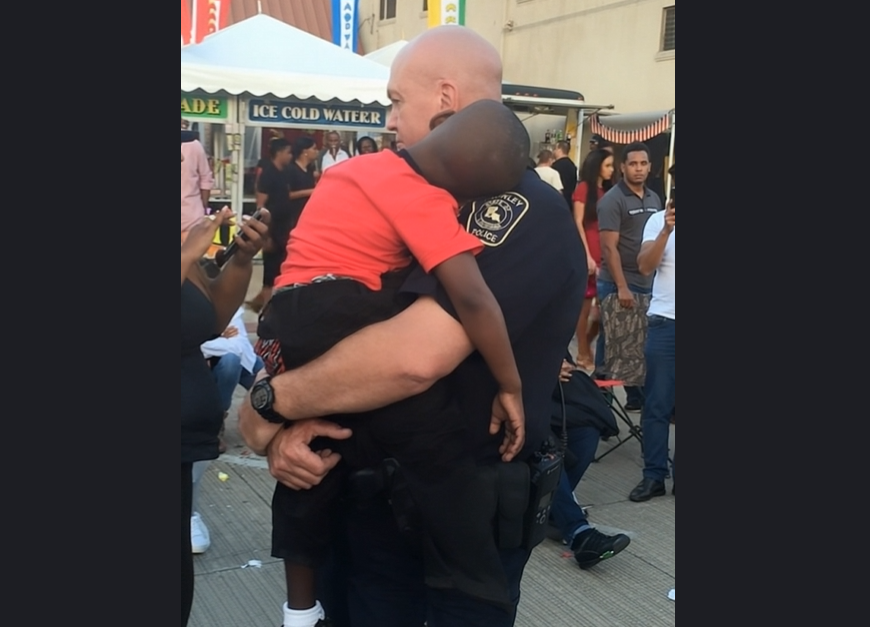
We were at the Juneteenth festival—music, food trucks, kids running wild, the whole neighborhood packed into the streets.
I’d only looked away for a second to pay for a funnel cake, but when I turned back, my nephew Zavi was gone.
Panic hit me like a wave. I dropped everything and started shouting his name, checking every bounce house, every face in the crowd.
I was two seconds from calling 911 when I spotted him—curled up, dead asleep, in a police officer’s arms.
The officer was standing off to the side, calm like this wasn’t even the first time something like this had happened.
He gave me a little nod when I rushed up, breathless and shaking. Said Zavi wandered off near the snow cone truck and got tired. “Didn’t want to leave him alone,” he said, like it was nothing.
I thanked him, took Zavi back, and tried to brush it off. But I noticed people whispering behind me, phones out.
Some were smiling, but others weren’t. One woman near the food stand shook her head and muttered, “Must be nice to get that kind of response.”
At first I didn’t get it. Then it clicked.
They weren’t talking about Zavi falling asleep.
They were talking about who was holding him—and what it would’ve looked like if things were even slightly different.
And now I can’t stop wondering…
Would he still be safe if he didn’t look so small, so harmless, so tired?
The question hung in the air, heavy and unsettling.
It burrowed into my thoughts, replaying the scene in my mind.
Officer Davies, that was his name, had been genuinely kind, a reassuring presence in my moment of sheer terror.
He’d handed Zavi over with a gentle smile, a brief explanation, and that was it. End of story, right?
But the whispers, the glances, the comments – they painted a different narrative, one layered with the complexities of race and perception.
What if Zavi had been older, taller? What if he hadn’t been asleep, but just wandering, maybe a little confused or scared?
Would the interaction have been the same? Would Officer Davies have approached him with the same calm demeanor? Or would suspicion have colored his actions?
That night, sleep was elusive. Every time I closed my eyes, I saw Officer Davies holding Zavi, but the image kept shifting.
Sometimes, Zavi was giggling, reaching out to touch the officer’s badge.
Other times, he was fidgeting, his small hands moving in a way that could be misinterpreted.
And in those darker imaginings, the officer’s face was harder, his grip tighter.
The next day, I couldn’t shake the feeling. I talked to my sister, Zavi’s mom, about it.
She’d heard the whispers too. We’d both seen the looks.
And we both knew, deep down, that the color of Zavi’s skin played a role in how that moment was perceived.
We decided to do something. Not out of anger, not to cause trouble, but to open a dialogue, to maybe even spark a little change.
We posted about the incident on social media, carefully recounting what happened, praising Officer Davies for his kindness, but also acknowledging the undercurrent of racial tension that had rippled through the crowd.
The post went viral. Comments poured in, a mix of support, anger, and denial.
Some people accused us of making something out of nothing, of being overly sensitive.
Others shared similar stories, their own experiences of how race had shaped their interactions with law enforcement.
One comment stood out. It was from Officer Davies himself. He thanked us for acknowledging his actions but also admitted that he understood the underlying concerns.
He said it was a reminder of the work that still needed to be done, the conversations that needed to be had.
That led to an unexpected twist. The local police department reached out to us.
They wanted to use our experience as a training opportunity, a way to discuss implicit bias and community relations.
They invited us to speak at a town hall meeting, to share our story and our perspectives.
It was nerve-wracking. Standing in front of a room full of people, including several police officers, and talking about something so raw and sensitive.
But we did it. We talked about our fear when Zavi went missing, our relief when he was found safe, and the unsettling realization that the narrative could have been so different.
Officer Davies was there that night. He spoke too, sharing his own thoughts and experiences.
He talked about wanting to be a positive presence in the community, about understanding the historical context that shaped people’s perceptions.
The conversation wasn’t easy. There were tense moments, disagreements, and uncomfortable truths.
But there was also a sense of genuine listening, a willingness to engage. It felt like a small step, but a step nonetheless, towards bridging the gap between the community and the police force.
The rewarding conclusion wasn’t about finding a simple solution or erasing years of systemic issues.
It was about finding a way to connect, to humanize each other, to start a conversation that needed to happen.
It was about turning a moment of fear and uncertainty into an opportunity for growth and understanding.
Officer Davies became an unexpected ally.
He continued to participate in community forums, advocating for more training on implicit bias and de-escalation tactics.
He even started a youth outreach program, organizing events that brought kids and cops together in positive settings.
My sister and I stayed involved too. We didn’t become activists overnight, but we found our voices.
We shared our story with other community groups, hoping to inspire similar conversations.
And Zavi? He’s still a happy, energetic kid, oblivious to the complex layers of the day he fell asleep in a police officer’s arms.
But as he grows older, we’ll tell him about it.
We’ll tell him about Officer Davies’ kindness, and we’ll tell him about the whispers, about the conversations that followed.
We’ll teach him to be aware of the world around him, both its beauty and its biases, and to always stand up for what’s right.
The life lesson here is that even in moments of fear and uncertainty, there’s an opportunity for connection and change.
It’s not about ignoring the difficult truths, but about facing them head-on, with honesty and a willingness to listen.
And sometimes, the most powerful change starts with a single conversation, sparked by an unexpected moment.