He didn’t say much on the drive out. Just stared out the window, his hand resting lightly on the armrest like it was holding onto something I couldn’t see. I asked him a few things—half-hearted questions about the old place, about what he expected to find—but he just gave this small, quiet smile. The kind people wear when they’ve packed too many words into a suitcase they haven’t opened in a long time.
We hadn’t talked much before this. Not really. He was my biological father, but we met just a few months ago. I was 24 when I found out my “dad” wasn’t actually my dad. A half-accidental DNA test at a family barbecue had turned into a spiral of hushed conversations, broken truths, and then a phone number written in shaking cursive on the back of an old receipt: Nathan Boyd.
I called him twice. The first time, I hung up before it rang. The second time, he answered with nothing but a “Yeah?” that sounded more like a challenge than a greeting.
Somehow, we ended up here.
It wasn’t until we turned down the gravel road that his whole posture changed. His shoulders drew tight, his jaw clenched like he was chewing on memories. The barn came into view—still standing, but barely, like it was held together more by nostalgia than nails. The fence looked newer, probably replaced by someone who still believed in maintenance. The fields, though, were just as I imagined they’d been back then. Wild and honest.
“Stop here,” he said suddenly. First words in thirty minutes.
I pulled the truck to the side, tires crunching over gravel. He stepped out before the dust even settled, then just stood there with his arms hanging loose at his sides. He took a deep breath like he was trying to inhale a decade.
Then he walked up to the fence.
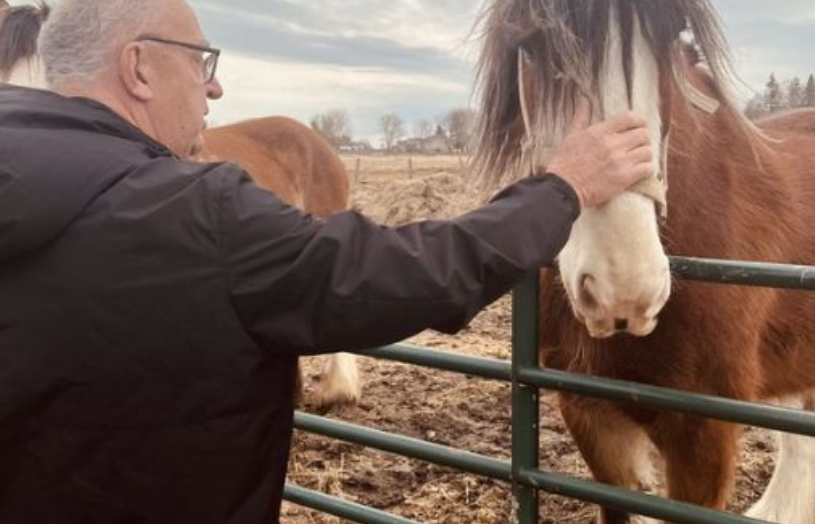
A few horses were grazing in the field beyond, their heads bobbing up with mild curiosity. One of them—a huge Clydesdale with feathered legs and a black mane that looked like it had been through a war—lifted her head and started toward him. Her steps were steady, deliberate.
He didn’t flinch. Didn’t move. Just held his hand out, and I noticed it was shaking.
“She was a foal when I left,” he whispered. “Couldn’t have remembered me.”
But the horse pressed her nose into his palm like she’d been waiting for him this whole time.
And just as his voice cracked, barely above a breath, he said—”I named her after your mom.”
I froze.
Not the woman who raised me. The other one. The one I only knew from a high school yearbook photo and a death certificate that said she’d passed two weeks after I was born.
“You left,” I said slowly, “after she died.”
He nodded, still stroking the horse’s face. “It broke me. I couldn’t hold you, look at you, without seeing her. So I left.”
I wanted to say something. Anything. But the wind filled the silence for me, curling around us with the smell of hay and soil and something old enough to be sacred.
“She died because of me,” he added.
I turned sharply. “What?”
He didn’t look at me. “Pregnancy complications. Doctor said we should’ve waited longer between kids. She was tired. But we were so happy when she got pregnant with you. So damn happy. And then… it went bad. Fast. I held her hand until she went cold.”
I hadn’t expected this. Not the rawness, not the weight. I always thought he left because he didn’t want to be a dad. Because some men just don’t. That was easier to swallow than this—than a man haunted by love and loss and guilt so strong he ran from his own blood.
“She would’ve loved you,” he whispered. “She had a laugh that could fix bad days. You have her eyes, you know that?”
I swallowed hard.
We stood in silence for a while longer, watching the horse nudge his chest like she was trying to comfort him. Her name was Maggie, he told me. Same as my mother.
“She used to run out into the field barefoot, hair flying, arms up like she was hugging the wind. God, she loved it here.” He chuckled, sad and warm. “We were gonna teach you to ride together.”
Then he turned to me. “I know I don’t get to ask for forgiveness. I know I don’t deserve your time. But thank you for bringing me back. I think… I needed to see this before it all went.”
“What do you mean?”
He gestured to the barn. “It’s all being sold. Developers. Someone in the family finally gave up on it. This is probably the last summer these fields will be fields.”
My chest ached. I didn’t know this place, but I felt the loss like it belonged to me, too. Like it was woven into my DNA.
“Unless…” he hesitated, then shook his head. “No. Never mind.”
“Unless what?”
He sighed. “Unless someone in the family steps up to keep it. But I haven’t been ‘family’ in a long time. I signed away my rights when I left. I gave it all up. There’s a clause—if I’m gone longer than a decade, it goes to my cousin and his kids.”
I thought about that all the way back to the city. Thought about it as I pulled into my apartment’s parking lot and sat in silence long after he went inside. The next morning, I found myself staring at that same dusty envelope—the one with the photo of my mom, the old deed, the newspaper clipping about the Boyd Farm from 1997.
That was the day I made my decision.
It took two weeks, three lawyers, and one extremely awkward brunch with Nathan’s cousin to work out the legal details. Turned out, the clause had wiggle room. Even more so if I was interested in keeping the land—and I was.
Not because I knew how to run a farm.
Not because I had some romantic idea of living off the land.
But because there was something powerful about reclaiming the place where I began. About honoring the woman who gave me life and the man who, though broken, came back to face it.
Nathan and I started going out there every weekend. He showed me how to saddle a horse, how to walk through a field without spooking the animals, how to read the wind. We didn’t talk about the lost years much. But we talked. And that was enough.
Sometimes, when the sky turned pink and the barn creaked like it was whispering old secrets, Maggie would walk right up to him and nudge his shoulder, like she was making sure he was still here.
He always was.
And for the first time in both our lives, that was finally enough.
If this story moved you even a little—share it. Like it. Someone out there might need to know it’s not too late to go home.