The Man in My Husband’s Coffin: Why I Drove All Night to Querétaro to Uncover My Sons’ Final Deception
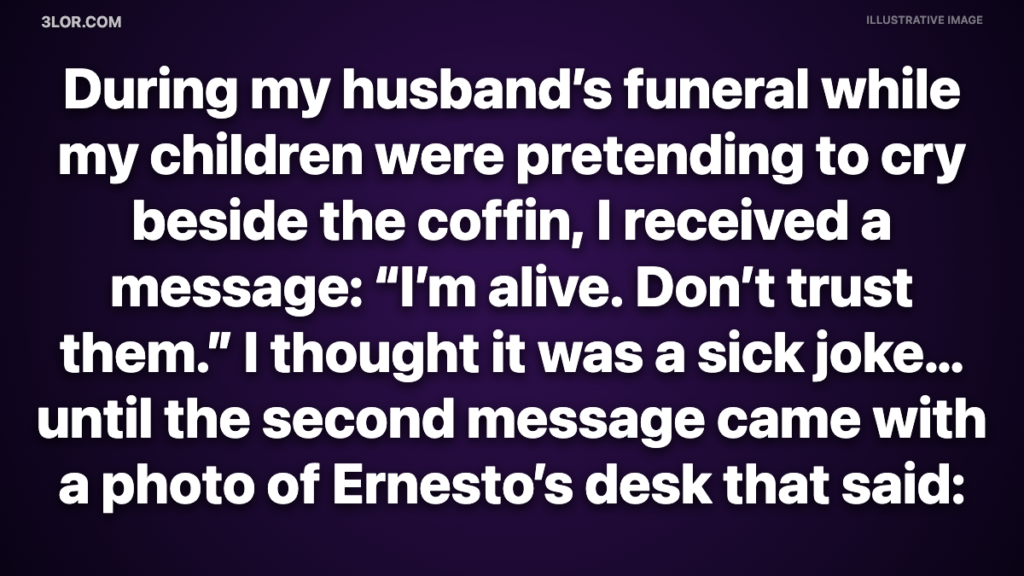
“If you want to know who died in my place, go to the ranch in Querétaro and ask about the son Carlos and Héctor thought they buried as a newborn.”
I read the text message three times in the back of the taxi.
My hands shook against the worn fabric of my mourning dress. Outside, the headlights sliced through the drizzle leaving Mexico City behind: the affluent mansions of Las Lomas, the quiet cemetery, and the mahogany casket I had spent the afternoon weeping over.
Beside me in my bag were four items: a USB drive, a handwritten letter, an empty bottle of liquid sedatives found hidden in my husband’s private study, and a loaded revolver.
“Don Aurelio,” I whispered to the driver, our family’s chauffeur of thirty years. “Is Ernesto truly alive?”
The old man met my gaze in the rearview mirror.
“Yes, Señora Teresa.”
My breath caught in my throat. It wasn’t relief. It was a sickening collision of fury, terror, and four decades of marriage suddenly dissolving into an impossible question.
“Then whose body did we just lay in that chapel?”
Don Aurelio kept both hands locked on the wheel. “Don Ernesto must tell you that himself.”
The Courtyard in Querétaro
We drove straight through the night, pushing past the industrial sprawl of Santa Fe, the winding mountain roads, and the desolate diesel stops smelling of stale rain and burnt coffee.
At dawn, the dry scrubland of Querétaro opened before us under a pale, sharp sky. Don Aurelio turned the car down a rutted dirt road framed by nopales and crumbling stone walls, pulling into a modest whitewashed ranch house surrounded by vibrant bougainvillea.
Sitting in a weathered wooden chair beside the stone well was my husband.
Ernesto.
Alive. He had an unkempt silver beard, a thick white bandage wrapped around his left forearm, and eyes hollowed out by raw guilt.
I climbed out of the taxi. My joints burned with exhaustion, but my spine was completely rigid. Ernesto stood up slowly, his voice cracking.
“Teresita…”
I walked straight up to him and struck him across the face.
It wasn’t a hard blow. It was just enough to remind him that forty-three years of marriage does not give a man permission to fake his death, let his wife sob over a corpse, and expect an embrace.
“I cried for you in front of a church,” I said, my voice dangerously level. “I wept before your sons in front of a closed coffin. Start talking.”
We walked into the cold ranch kitchen. A local woman brought over a clay pot of black coffee, but nobody touched a cup. Ernesto laid a heavy legal folder onto the wooden table.
“Carlos and Héctor were drugging me, Teresa,” he began, his hands trembling. “Small, daily doses slipped into the evening coffee Carlos brought to my study. Sedatives meant to make me look clumsy, confused, senile. They already had a corrupt physician on retainer prepared to sign an emergency declaration of cognitive incompetence.”
I opened my purse and pulled out the glass bottle I had recovered from the library desk. “With this?”
He nodded grimly. “They intended to seize control of our commercial accounts, liquidate the Las Lomas estate, and register a forged power of attorney. I discovered the draft petition two weeks ago. My original plan was simply to file criminal charges and get you out of the house. But then… Rafael died.”
The name struck me like a physical blow.
Rafael.
My firstborn. The boy I had been told died forty years ago, barely two days after I gave birth in a private clinic. Back then, they had pumped me full of tranquilizers. When I finally woke up, Ernesto was weeping at the edge of the mattress, and my mother-in-law had already arranged for a sealed infant casket. I never saw his face.
“Don’t speak that name,” I whispered, backing away from the table.
Ernesto closed his eyes, tears cutting tracks through the dust on his cheeks. “My mother gave him away, Teresa.”
The air left my chest. “She what?”
“She claimed the child was born with a severe cardiac defect. She told me we would spend our entire lives bankrupt in hospital wards, that you were too fragile to endure it. I was young, weak, and utterly terrified. I believed the lie she engineered. Rafael grew up believing we abandoned him. Eight months ago, he tracked me down.”
I slammed both palms against the table. “You knew our son was alive for eight months and you hid him from me?”
“He wouldn’t let me tell you!” Ernesto cried out. “His heart was already failing. He was dying, Teresa. He was terrified that appearing on your doorstep would only break your heart twice. He didn’t want you to watch him die.”
The Boy in the Frame
Ernesto led me down a narrow stone hallway into a small back bedroom.
On a plain wooden nightstand sat a lit candle, a folded denim shirt, and a framed photograph.
The man in the portrait was nearly forty years old. He had Ernesto’s deep-set brow, but his mouth and the slight tilt of his head were unmistakably mine.
I collapsed beside the bed, pulling the frame against my chest, mourning four decades of stolen milestones: the first steps I never saw, the scrapes I never bandaged, the voice I never heard.
Beside the frame lay a handwritten letter addressed to Mamá Teresa:
Forgive me for arriving so late. All my life, I was told you gave me away because I was born broken. When I finally found Dad, I learned that we were both robbed by pride and silence. I didn’t want to bring you pain when my time was already running out. If you read this, please know I never died without a mother. I carried your imagined face with me every single day.
I wept until my throat was raw. When I finally found my footing, I turned back toward the doorway where Ernesto stood watching in silence.
“Whose body was in that coffin?”
Ernesto swallowed hard. “Rafael passed away in this room three days ago. The attending doctor signed the death certificate under his true legal name. But that same night, Carlos and Héctor broke into the city study. They found Rafael’s body—who bore an uncanny resemblance to me—and assumed the sedatives had finally caused a fatal cardiac arrest. They never checked his identity. They rushed the body to a private mortuary to schedule an immediate cremation before an autopsy could be demanded.”
“You let our sons prepare to burn their own brother under your name?”
“I let them walk into their own trap,” Ernesto answered. “They had already scheduled the cremation for ten o’clock this morning. They wanted the evidence turned to ash.”
I wiped my face dry. The sorrow was still there, but beneath it, forty years of maternal instinct turned into iron.
“Call the notary,” I said. “We are going back to Mexico City. And this time, you aren’t sending cryptic messages from the shadows. You’re walking through the front door with me.”
The Funeral Home Confrontation
Before noon, Licenciado Montalvo, a veteran notary from Querétaro, arrived with certified filings, DNA test results, and our authentic estate directives.
We drove back into the capital as dusk settled over the city. I stepped out of the vehicle at the mortuary in Las Lomas, standing tall, the black lace veil tucked securely inside my coat.
In the viewing chapel, Carlos was aggressively cornering the funeral director.
“The casket must be moved to the crematorium immediately,” Carlos barked. “My mother is medically unstable and incapable of making rational decisions.”
Nearby, Héctor was pacing with his phone pressed to his ear. “Yes, Doctor. The moment she steps through the door, have the sedative ready. She is severely delirious.”
“Delirious about what, Héctor?” I asked, stepping into the room.
Héctor froze mid-sentence. His face drained of color as the phone slipped an inch from his ear.
Carlos turned on his heel, flashing a rehearsed look of panicked concern. “Mom! Where have you been? You had us terrified!”
Then the heavy double doors opened wider, and Ernesto stepped into the light behind me.
Carlos stumbled backward, his mouth working silently. Héctor backed straight into a massive floral arrangement, knocking white lilies across the marble floor.
“Dad…?” Héctor gasped.
Ernesto looked at his surviving sons with cold, unbroken disgust. “You were in quite a hurry to burn me, weren’t you?”
Licenciado Montalvo entered behind us, accompanied by two plainclothes fraud investigators. The immediate cremation order was rescinded on the spot. Within moments, the funeral home staff, who had spent the last twenty-four hours taking orders from my sons, demanded formal identification and court clearances.
The physician Carlos had bribed attempted to slip out through a side exit, but Don Aurelio blocked the corridor. Inside the doctor’s briefcase, officers discovered pre-signed medical evaluations bearing my name: Severe cognitive decline. Total incapacity. Immediate conservatorship recommended.
Carlos lunged forward, his voice cracking with desperation. “Mom, you don’t understand! Dad was going to cut us out for a complete stranger!”
The sound of my hand striking his cheek echoed off the high chapel ceilings.
“Rafael was not a stranger,” I said, staring into his eyes. “He was your brother. And you were ready to incinerate him to protect your greed.”
The Authentic Succession
Rafael was laid to rest two days later under the mesquite trees of Querétaro, bearing his true name on a clean stone marker.
There were no high-society wreaths, no fake condolences from Las Lomas, and no cameras. Only the cool mountain wind, Don Aurelio, Licenciado Montalvo, Ernesto, and me.
Then the legal consequences landed.
Criminal indictments were unsealed against Carlos, Héctor, and their colluding physician for fraud, falsification of public documents, administration of illicit substances, and attempted unlawful conservatorship.
At the formal estate reading in Polanco, Licenciado Montalvo sat before my two sons and read the exclusionary clauses Ernesto had drafted months earlier:
Any heir who attempts to coerce, chemically incapacitate, intimidate, or unlawfully manipulate the legal capacity of my wife, Teresa Morales de Ramírez, shall be instantly and irrevocably disinherited from all familial trusts, shares, and properties.
Carlos sat with his jaw clenched, staring at the floor, while Héctor buried his face in his hands, weeping openly.
A substantial portion of the commercial portfolio was permanently transferred to establish the Rafael Ramírez Morales Foundation, dedicated to providing pediatric cardiac care and mobile clinics to underserved communities across rural Querétaro.
Carlos never sought redemption; he spent the following years sending bitter legal motions from a rented apartment, all of which were dismissed. Héctor returned once, months later, standing on my driveway with a convenience-store bouquet, begging for forgiveness.
I received him on the front porch, leaving the heavy front door locked behind me.
“Forgiveness does not return the keys to this house, Héctor,” I told him gently. “Start by understanding what you did, not what you lost.”
The Drawer in the Study
Ernesto and I lived out the rest of our days in separate rooms.
Forty-three years of marriage cannot be erased by a single betrayal, but neither can they be restored by a delayed confession. He had saved my life from our sons, but he had also stolen forty years of motherhood by keeping Rafael a secret until death was already at the door.
When Ernesto passed away five years later, there was no subterfuge, no closed casket, and no theatrics. I said goodbye to him with a quiet, clean grief, placing a single white rose on his grave before walking across the grass to place another on Rafael’s.
Today, at eighty years old, I still reside in the home in Las Lomas.
The locks have long been replaced. The mahogany desk in the private study remains where it always stood. In the hidden compartment behind the wood molding, I no longer keep legal titles or emergency bank balances.
I keep three letters: Rafael’s, Ernesto’s final plea for peace, and my own testament, written for whoever enters the house when my time comes:
To whoever seeks to govern my affairs when my voice is quiet: Teresa was never a confused widow, an easily erased mother, or a woman awaiting permission to exist.
A woman can weep beside a sealed coffin and still possess the strength to dismantle a lie, confront her blood, and reclaim her dignity. When people ask how I survived that dark morning, I offer the only truth that matters:
It was not because my husband returned from the dead. It was because I finally refused to remain asleep.
Note: This narrative is an original work of dramatic fiction produced for storytelling and editorial purposes. Names, characters, businesses, and incidents are entirely products of the author’s imagination.