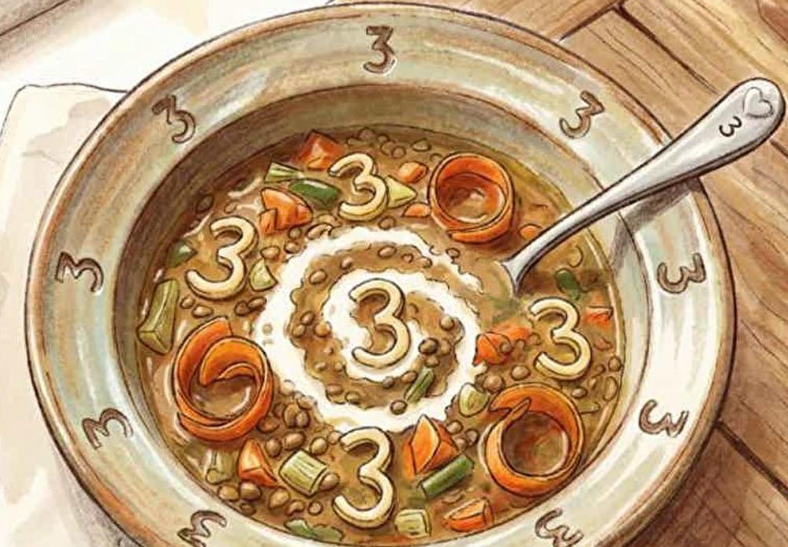
At first glance, the picture looks like nothing more than a simple bowl of soup resting on a wooden table. It appears ordinary, warm, and familiar. Yet the longer you study it, the more unexpected details begin to emerge. Shapes that once looked random suddenly take on new meaning. Curves begin to resemble symbols. And then it becomes almost impossible to ignore the pattern forming before your eyes—the image is filled with the number three.
For some people, only a handful of threes stand out. Others begin seeing them everywhere, feeling as if the picture keeps revealing more each time their eyes move. What started as a normal bowl of soup quickly becomes a visual puzzle.
According to a wave of viral psychology posts circulating online, the number of threes you identify is supposed to reveal something unsettling about your personality—specifically, hints of narcissistic traits. The claim has captured attention across social platforms, inviting both curiosity and concern. Before anyone draws conclusions, it helps to understand how the illusion works and why people react to it so differently.
This particular image is designed to overwhelm perception. The number 3 is hidden in several areas throughout the scene: in the curvature of the bowl’s rim, in the reflections on the surface of the soup, in the shapes created by vegetables or pasta pieces, and even in the placement of the spoon or background lines. Some of these numbers are sharply visible. Others blend softly into shadows, highlights, or subtle textures. There is no confirmed total—only what your mind discovers.
Online explanations break interpretations into three categories.
If you notice 1–5 threes, the viral claim suggests that you tend to be grounded and practical. You focus on what stands out and feel comfortable moving on without needing to dissect every detail. This category is said to reflect a big-picture mindset that values simplicity and efficiency.
If you find 6–9 threes, the typical explanation is that you possess strong observational skills and solid self-awareness. You see patterns when they matter, yet you avoid getting absorbed by them. This group is said to reflect balanced confidence and a thoughtful, steady approach to problem-solving.
If you count 10 or more threes, the internet’s dramatic interpretation begins. The claim states that this level of scrutiny points to a heightened focus on details and a strong internal drive to identify everything hidden in the image. Some posts label this as a sign of narcissistic tendencies or an inclination toward control. These descriptions are often exaggerated for effect, yet they create strong reactions among viewers.
Here is the important truth: none of these claims are diagnostic or scientific. Narcissism cannot be measured through an optical illusion or a number. Personality traits are layered, shaped by environment, experience, and behavior—not by how many hidden symbols you spot in a picture. What these illusions actually reveal is how your attention works. They highlight how your brain handles ambiguous information, how persistent you are when solving a challenge, and how motivated you feel when presented with a puzzle.
Images like this go viral because they combine curiosity, self-reflection, and friendly comparison. People enjoy asking one another, “How many did you see?” It becomes an experience that blends entertainment with the illusion of personal insight. The effect is powerful enough to draw people in, yet harmless enough to remain lighthearted and fun.
In the end, whether you saw three threes or thirty, it does not define your personality. What it truly reveals is something far simpler: the human brain loves patterns. Once the mind begins searching for something, it continues until it feels satisfied—and sometimes long after.
So now the question remains: how many threes did you notice?