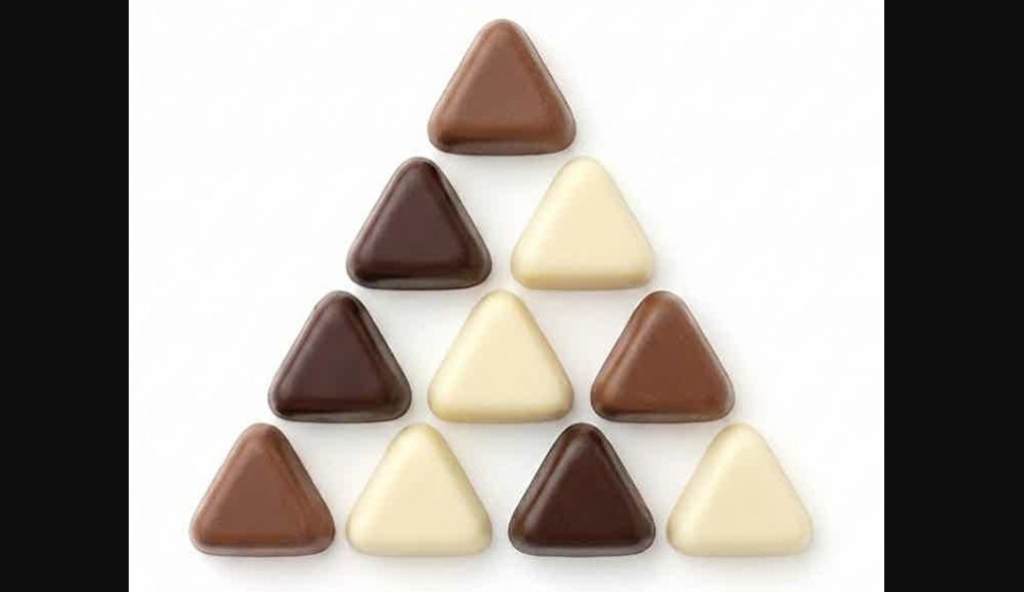
At first glance, the image appears simple and orderly: several chocolate-colored triangles arranged carefully to form a larger triangular figure. Everything looks symmetrical and easy to understand. Many people glance at it for a second and assume they already know the answer.
Yet this type of visual puzzle has a surprising way of slowing people down. What seems obvious at first quickly becomes more complex the longer someone studies it. Lines begin to overlap, shapes combine in unexpected ways, and suddenly the simple image becomes a challenge that tests observation and patience.
The task is straightforward: count how many triangles you can see.
There are no complicated rules or time limits involved. All you need to do is look closely and decide how many triangular shapes appear within the design. Once you have a number in mind, it can be interesting to reflect on what your answer might reveal about the way you approach problems and process visual information.
Puzzles like this do not measure intelligence or determine personality with scientific certainty. Instead, they highlight patterns in perception. The way a person scans an image, notices details, and organizes information can say something about their thinking style.
Many people enjoy comparing answers because each perspective reveals something slightly different.
If You Notice Around 6–7 Triangles
People who identify a smaller number of triangles often focus on the most visible shapes first. Their attention naturally moves toward clear outlines and simple structures.
This approach often reflects a practical and grounded mindset. Individuals in this category usually prefer direct solutions and efficient decision-making. In everyday situations, they tend to focus on what is immediately relevant instead of searching endlessly for hidden possibilities.
This way of thinking can be very useful. Practical thinkers often excel at completing tasks, organizing projects, and keeping situations manageable. They appreciate clarity and tend to avoid unnecessary complications.
At the same time, concentrating on the most visible elements can occasionally mean overlooking subtle details hidden within the larger picture. When given time to slow down and observe more carefully, many people discover additional shapes they did not notice at first.
Strength often associated with this perspective: clarity, reliability, and decisiveness.
A helpful habit to develop: taking a moment to explore deeper layers of information before reaching a final conclusion.
If You Count Around 9–10 Triangles
People who arrive at this range often balance two different ways of thinking. They notice the obvious shapes quickly while also scanning the image for combinations that create new triangles.
This suggests a mind that comfortably shifts between broad perspective and detailed observation. Individuals who think this way often approach problems with both logic and creativity. They analyze situations carefully without losing sight of the overall picture.
In daily life, this balanced thinking style often appears in people who are good at solving complex challenges. Friends and colleagues may rely on them when calm judgment and thoughtful decision-making are needed.
Adaptability is one of the greatest strengths associated with this perspective. These individuals often move smoothly between analytical reasoning and intuitive understanding.
Strength often associated with this perspective: insight, flexibility, and balanced reasoning.
A helpful habit to develop: trusting intuition when the mind begins to analyze a situation too deeply.
If You Discover 12 or More Triangles
People who notice a larger number of triangles often examine the image very carefully. They naturally look for hidden patterns, overlapping shapes, and combinations formed by smaller pieces.
This style of observation reflects a highly analytical mindset. Individuals in this group often enjoy puzzles, patterns, and complex challenges that require patience and attention to detail.
Rather than stopping after identifying the most obvious shapes, they continue scanning the image until every possible structure reveals itself. This type of thinking frequently appears in people who enjoy research, strategy, design, or problem-solving activities.
Their curiosity often drives them to explore deeper layers of information in many areas of life.
However, intense analysis can sometimes lead to mental fatigue if the mind continues searching for answers long after the main question has been solved. Learning when to pause and step back can help maintain balance.
Strength often associated with this perspective: observation, creativity, and persistence.
A helpful habit to develop: recognizing when a solution has been reached and allowing the mind to rest.
Why Visual Puzzles Feel So Meaningful
Visual puzzles capture attention because they engage several parts of the brain simultaneously. The brain analyzes shapes, patterns, and spatial relationships while also making quick judgments about what it sees.
Even though these puzzles do not provide scientific personality evaluations, they highlight interesting aspects of cognitive habits. For example:
How quickly someone processes visual information.
Whether a person focuses first on structure or detail.
How patient someone feels when exploring a challenge.
Because these habits influence how people approach everyday problems, the results of puzzles often feel surprisingly accurate or relatable.
The Power of Perspective
One of the most fascinating aspects of puzzles like this lies in the diversity of answers. Two people can study the same image and arrive at different totals. Neither person is necessarily wrong; they are simply observing different patterns within the design.
Perspective shapes perception. The way the brain organizes visual information can vary widely from person to person.
That variety makes these puzzles enjoyable to share with friends or family. Each answer opens a conversation about how individuals see the same picture in unique ways.
Final Reflection
At its core, this puzzle offers a reminder that perception is rarely identical for everyone. A single image can hold multiple layers, and each observer may notice something different.
Taking a moment to look carefully, explore possibilities, and appreciate different viewpoints can turn even a simple picture into a meaningful exercise for the mind.
So the real question remains: how many triangles did you discover?