I submitted my resignation letter clearly and professionally. Two weeks’ notice, no fuss, just a simple statement about moving forward with my career. I had already secured a new position, one that was closer to home and promised a healthier work environment.
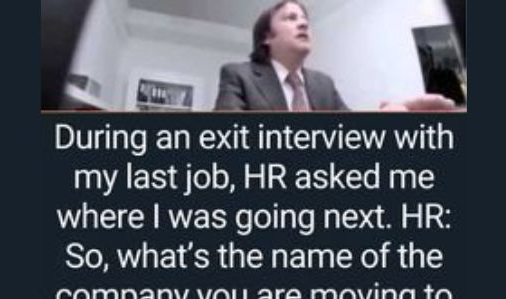
On the day of my exit interview, I met with Brennan, the HR representative. He was polished, overly courteous, and always tapping away at his keyboard. The conversation began with routine questions about feedback and company culture, but then he casually asked, “So, where are you headed next?”
I responded calmly, “I’d prefer not to disclose that, if that’s alright.”
His smile remained fixed. “Oh, it’s only for our planning and benchmarking purposes. Nothing personal.”
I held my ground. “I’d still rather keep that private.”
He pressed further, claiming it was “company policy” and that they “required” the information.
Required? That was new.
A sense of unease crept in. Brennan kept glancing at my badge and laptop, as if expecting me to reveal something by mistake.
Then he leaned closer and said, “If you’re joining Systar, you should know they’re under investigation. I’m only looking out for your best interests.”
My heart raced. I was, in fact, going to Systar, and that information wasn’t publicly available.
I stayed silent, staring at him, my mind racing.
He knew.
The only possible way he could have known was if someone had accessed my personal email.
The email I had checked just once. On my work laptop.
That’s when I noticed a faint red light near the keyboard.
It was recording.
Right during the moment I had typed my acceptance of Systar’s offer letter—the only time I had accessed Gmail on that device.
Carefully, I closed the laptop, keeping my expression neutral.
“Thanks for the advice,” I said, sliding my chair back. “I’ll consider it.”
His smile widened, all teeth. “Just looking out for you. Best wishes.”
Leaving the office, I felt a chill. It wasn’t paranoia—it felt like I had been watched for weeks.
Back at my desk, I stared at the laptop, the red light still faintly glowing, easy to overlook unless you were searching for it.
I opened the settings.
Nothing stood out at first. Then I checked the system logs.
A program I didn’t recognize had been running in the background for three months—starting right when I began my job search.
Suddenly, everything clicked. My manager’s strange questions. The sluggish network when I visited certain websites. Even the time the IT guy, Chris, had “borrowed” my laptop for updates without my knowledge.
They had been monitoring me.
I copied the logs to a flash drive and used my phone to photograph every suspicious entry.
Then I went straight to the Legal department.
That’s when things took a turn.
Priya, the in-house counsel, looked surprised to see me. She invited me to sit.
I was direct. “I believe my personal email was accessed through monitoring software on my work laptop without my permission. I have evidence.”
Her expression shifted from curiosity to concern. “Do you have that evidence with you?”
I handed her the flash drive. She plugged it in.
After five minutes, she locked her screen and looked at me. “Thank you for bringing this to my attention. I’ll escalate this immediately. Please keep this conversation confidential for now.”
I nodded, sensing I had uncovered something significant.
The next day, I was called into a meeting with two members of Corporate Security. They asked detailed questions about when I first noticed issues, what raised my suspicions, and whether I had additional evidence.
Then came an unexpected question.
“Did Brennan ever imply you could face legal consequences for joining another company?”
I paused. “Not directly. But he did mention that my new employer was under investigation, which wasn’t public information.”
One of them nodded. “That aligns with what we suspected.”
I wasn’t alone. Three other former employees had faced similar pressure to disclose their new employers, followed by misleading or privileged information to deter them.
Two of them had even withdrawn from excellent job offers.
This wasn’t mere curiosity—it was deliberate.
The company was losing talent to competitors and, instead of improving its workplace, someone decided to engage in illegal surveillance.
I felt a mix of anger, violation, and vindication.
They asked me to stay silent while they investigated. I agreed, but I made one thing clear: “I’m leaving after my notice period. I’ll return the laptop on my last day, but I’m erasing all personal data.”
They consented.
Weeks passed with no updates.
I started at Systar, and the role was everything I had hoped for—a supportive team, reasonable hours, and no overbearing oversight.
But I couldn’t shake the feeling that something might still surface.
A month later, an email arrived from Priya.
Subject: Update on Your Report.
It was concise.
Brennan and two others from HR and IT had been fired. They had been running unauthorized surveillance software, accessing personal emails, logging browsing histories, and even capturing screenshots.
It all traced back to a now-suspended VP obsessed with “intellectual property leaks” and “talent loss.”
Legal was preparing a case, with potential civil and criminal charges. They might contact me again if I was willing to testify.
I agreed.
This wasn’t about vengeance—it was about accountability and ensuring others wouldn’t face the same violation.
Weeks later, Tasha, another affected former employee, messaged me on LinkedIn.
She thanked me. She had lost a six-figure job opportunity due to the company’s tactics, but my actions led to an investigation. Systar had reached out, apologized, and offered her a new interview.
“I’m getting a second chance,” she wrote. “Because you took a stand.”
I didn’t know how to respond, but her words lifted a weight from me.
Six months later, a third-party investigator sent me a formal letter. My evidence had been critical in advancing the case. They were pursuing action against the company and offering free legal support to affected former employees.
It felt unreal.
I had gone from an ordinary employee to a key figure in exposing a corporate surveillance scandal.
What struck me most wasn’t the drama.
It was how many people had stayed silent. Hesitated to speak up because of fear, doubt, or the belief that it wouldn’t make a difference.
If I hadn’t trusted my instincts that day, nothing might have changed.
Sometimes, a small act—like saying, “I’d prefer not to disclose”—can reveal something much larger.
I don’t judge those who stay quiet. Not everyone can speak up without risk. But I hope more people recognize their ability to act, especially collectively.
My experience isn’t unique. It’s a reminder.
Guard your boundaries.
Stay alert for warning signs—both literal and figurative.
And never access personal email on a work device.
If this story resonates, share it with someone who might need the insight. You never know who might find the courage to act because of it.