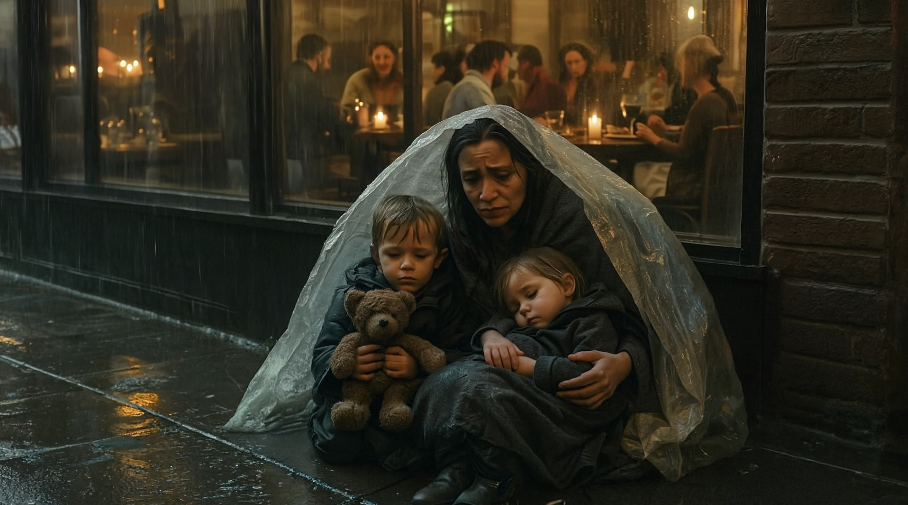
The little boy’s teddy bear gutted me. Soaked through. Pressed to his chest like it might still have some warmth left.
We were inside the restaurant, candlelight flickering, everyone leaning in over steaming plates. I was halfway through a glass of Syrah when someone at our table joked, “Cheers to shelter from the storm,” and everyone clinked glasses like it was nothing.
But then I looked past them—past the window—and saw her.
A mother, mid-thirties perhaps, holding two children under what looked like a ripped garment bag. One child asleep, the other wide-eyed and silent, clutching that bear as if it were a life vest.
Rain smeared down the glass. No umbrella. No coats. Only them, pressed against the wall as if they were trying to disappear.
She wasn’t crying. That’s what hit me most. She simply stared into the distance, jaw clenched, one hand locked around both children as if she were physically holding them together.
No one else in the restaurant turned to look. I watched a couple laugh so hard the woman had to dab tears from her eyes. Someone dropped a fork. Waitstaff floated past with tiramisu and espresso.
I couldn’t eat. I couldn’t even speak.
So I stood up. Reached for my coat. And as I opened the door and stepped into the rain, the little boy looked straight at me—and said something so soft I almost missed it.
“Are you an angel?”
I froze, rain slipping down my cheeks like tears. I bent down, squatted to his level, and said the first thing that came to mind.
“No, sweetheart. I’m someone who saw you.”
His lip quivered. His mom pulled him closer, eyes darting toward the restaurant behind me. I could feel her suspicion. Fear.
“I’m not here to bother you,” I said, keeping my hands visible. “I… would you like to come inside? To get warm?”
She hesitated. I could see her calculating. Every parent instinct on alert. But something in her shoulders dropped, and she nodded—once.
I led them to the door. Heads turned as we stepped in, dripping wet. A hostess started to speak, but I cut in.
“They’re with me,” I said. “Please—give us a corner table.”
They gave us the one by the fireplace. I asked for hot cocoa for the children and a pot of tea for her. She didn’t say much at first. She simply sat there, arms wrapped around them as if she still couldn’t believe they were allowed to sit inside.
“My name’s Rachel,” I said gently.
“Vanessa,” she replied, finally. “These are my children. Dylan and Tessa.”
Dylan was the older one, perhaps six. Tessa looked no more than three. She had a small pink rainboot half on, half off, and was too tired to care.
I asked if they were okay. Vanessa nodded too quickly.
“We’re passing through,” she said. “Waiting for a friend to call us back. Caught in the rain.”
I didn’t press her. I knew she was lying. But I also knew people tell lies when the truth is too heavy.
The waiter came back with cocoa and gave me a look like, “Really?” I ignored him. I let him think whatever he wanted.
When the drinks arrived, I asked if they were hungry. Vanessa shook her head—but Dylan’s eyes lit up at the smell of bread rolls on the next table.
I ordered anyway. A small pizza, soup, some fries. Nothing fancy. When the food came, the children devoured it so fast I had to remind Dylan to slow down.
Vanessa kept whispering, “Say thank you,” even though I told her it wasn’t necessary.
We sat there for almost an hour. The restaurant had quieted. My friends had gone back to their lives, their taxis, their dry homes. I stayed.
Finally, I leaned forward and said, “Do you have somewhere to sleep tonight?”
She looked away. Her hands clenched around her tea.
“We’ve been staying in the car,” she said quietly. “But it got towed yesterday. I’ve been calling shelters, but they’re all full.”
I nodded slowly. My chest felt tight.
“You don’t have any family around?”
“No,” she said. “We were in Colorado. Left after… things got bad with their dad. I thought I had a job lined up here, but it fell through. Everything just—”
She stopped herself. Took a breath. “I didn’t want to ask for help. I thought I could figure it out.”
“I understand,” I said. “But no one figures it out alone.”
She looked at me then—truly looked. Her eyes were bloodshot and tired, but somewhere in there, there was still a spark.
“I don’t know what to do,” she said.
I pulled out my phone. I wasn’t rich, but I had enough for a motel room. I found one nearby, clean enough, family-owned.
“Come on,” I said. “Let’s get you dry and sleeping somewhere with heat.”
She hesitated again. But then Tessa leaned her head against her chest and whimpered.
Vanessa nodded.
I paid the bill, asked for a box for the leftovers, and we stepped back into the night—less rain now, only a soft drizzle.
We drove in silence. Dylan fell asleep in the backseat. Vanessa kept whispering, “Thank you. I’ll pay you back,” but I shook my head.
At the motel, I helped them carry the bags—a plastic sack with some clothes, a broken phone charger, a crumpled coloring book.
I paid for three nights. Told her she didn’t owe me anything. Only to rest. Regroup.
That night I lay awake in my own bed, thinking about them. I didn’t know why it affected me so profoundly, but it did.
Perhaps it was the bear. Perhaps it was the silence.
The next day, I texted her. Asked how they were. She said the children slept for twelve hours straight.
“I haven’t seen them smile like this in weeks,” she wrote.
We kept in touch. I helped her look for more shelters, called some nonprofits. A friend of mine worked at a women’s center and managed to get her on a priority list.
Within a week, she had a spot at a transitional housing program. A month later, she had a part-time job at a bakery.
Three months in, she was taking community college classes, studying early childhood education. The children were enrolled in daycare, and Dylan started kindergarten.
She never asked me for more money. In fact, she tried to buy me lunch a few times.
“I owe you everything,” she said once.
“No,” I said. “You don’t. You only needed one door to open. You did the rest.”
And it was true. Vanessa was one of those people who only needed a crack of daylight to push through. She didn’t want handouts—she wanted an opportunity.
It’s been over a year now. We still meet up once a month. The children call me “Auntie Rachel.”
Dylan gave me a drawing last Christmas—stick figures under a roof, with the words “Thank you for the warm.”
And here’s the twist I didn’t expect.
That restaurant? The one where I first saw them?
Vanessa now works there.
A new manager took over and revamped the staff. I told her they were hiring, and she applied. She’s a host now. Elegant, calm, always with a warm smile.
Last week, I stopped in for dinner. She was there, holding the door open for a young couple with a baby.
It had started to rain again. Light, but cold.
A woman walked past, soaked and shaking, holding a thin blanket around herself. People averted their eyes.
Vanessa stepped out, offered her a dry towel from behind the counter, and invited her in for a coffee—on the house.
I watched it unfold and got chills.
I realized then: kindness echoes. It doesn’t vanish. It roots somewhere deep and grows.
That one rainy night changed more than their evening—it changed their future.
And perhaps mine too.
Because sometimes we’re the one inside with wine and warmth, and sometimes we’re the one huddling under plastic, trying to survive.
But always, always—we can choose to see each other.
To truly see.
So the next time you’re warm and dry, and you notice someone isn’t—look closer. You might be the angel they need, even if you don’t wear wings.