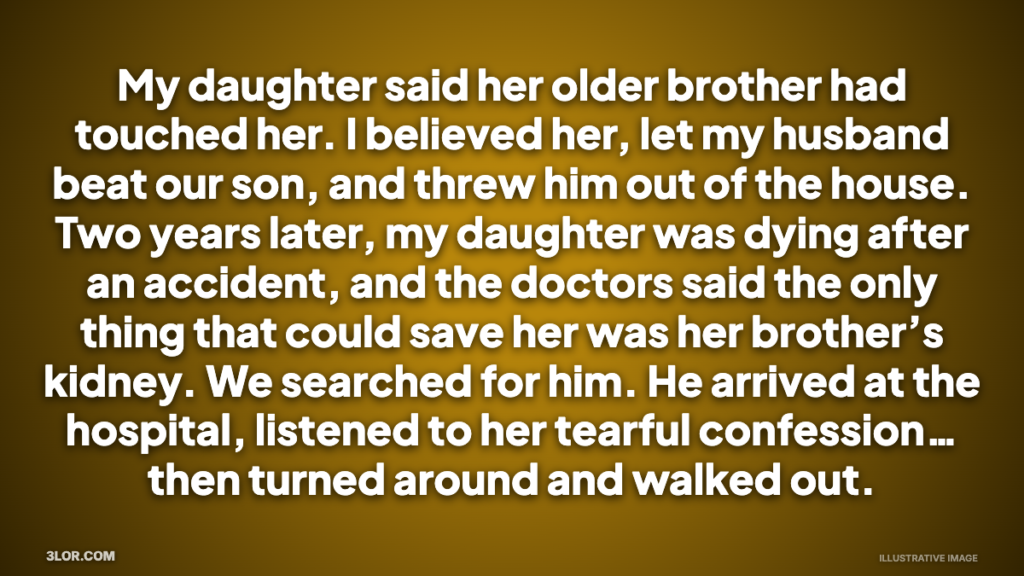
As far as we knew, Marcus was twenty years old and gone.
Then, on a Tuesday in October, my phone rang with a number I didn’t know, and a woman from County General said the words no mother survives hearing in any order: accident. Your daughter. Critical.
Bella had been in the back seat of her friend’s mother’s car when a truck ran the light. The friend walked away with a broken arm. Bella’s seat took the side of it.
I will not give you all the medical words. I held them in my head for nine days and they never got lighter. What matters is this: the crash destroyed one of Bella’s kidneys, and the other — the one she’d been born with, the one every doctor assumed was doing the work of two — had been underdeveloped her whole life. Nobody knew. It was failing under the strain. Dialysis was buying days, not weeks.
She needed a transplant. Ernest was ruled out in the first hour — blood pressure, medication, a heart murmur he’d been hiding from me for six years, which is another story and also the same story. I was tested the same night. Not a match.
The transplant coordinator, a woman with kind eyes and a clipboard, said it the way you say the weather: “Siblings are often the best chance. Is there a brother or—”
She stopped. She’d seen my face.
We found Marcus through his old roommate. Then through a warehouse across town where he loaded trucks on the night shift. Then through the woman who owned the laundromat below the room he rented, who told Ernest on the phone, in the tone of a person delivering a verdict: “That boy works six nights a week and studies at my folding tables. Whatever you people did to him, I hope it was worth it.”
Ernest went. I wasn’t allowed — that was Marcus’s one condition, relayed through the laundromat woman like a treaty. He would come to the hospital. He would listen. His mother would not be in the room.
He arrived the next evening.
I watched from the doorway — treaty or no treaty, I was in the doorway — as my son walked into that hospital room two years older and twenty pounds of muscle heavier, with his father’s jaw and my father’s eyes and a scar through one eyebrow I did not put there and did not have the right to ask about.
Bella was awake. She’d asked for him herself. The doctors said she could have ten minutes.
It took her nine of them to say it.
She was nine years old and furious because Marcus had caught her taking money from my purse for a game and told Ernest. Because an older girl on their street — a girl whose own brother had been sent to live with an aunt the year before — had taught her the words. The magic words. The words adults always believe.
“I just wanted him in trouble,” Bella whispered. “Grounded. I wanted him grounded, Mommy. I didn’t know— I didn’t know you’d—”
She was crying so hard the monitor complained. “I tried to tell you. That Christmas. I tried, and you hugged me and said don’t think about it anymore, that he was gone and I was safe. So I stopped trying.”
I have relived that Christmas a thousand times since. She was right. She had come to me with her chin trembling, and I had wrapped my arms around my own relief and called it protecting her.
Marcus stood at the foot of her bed and listened to all of it without moving.
Then he said, very quietly, to his sister — not to me, I was only the doorway:
“Don’t expect anything else from me.”
And he walked past me, close enough that I could have touched his sleeve, and out.
I did the worst thing I have ever done that night, which is saying something, because I am the woman who once stood silent in a doorway of a different kind.
Desperate people do arithmetic that isn’t arithmetic. I posted his full name on the internet, and a photo, and the whole shameful machinery of it — my son is refusing to save his dying sister — and I watched strangers pick up stones I’d handed them. Monster. How could he. What kind of brother. For a few hours, I let the whole world be angry at my son so that I would not have to be the only one who knew I should be angry at myself.
Four hours later, Marcus uploaded a video.
He is sitting at a laundromat folding table. He does not raise his voice. He is not like his father that way; he is like me, and I understood in the first ten seconds that this was going to be my punishment and my education in one.
He plays a recording first. A hospital room. A little girl’s voice, thin as thread: “I just wanted him in trouble… I didn’t know you’d throw him away.”
Then he talks. Ninety seconds. The car he slept in the first winter. The nose his father broke, set by a free clinic. The night shift. The folding tables. The birthday cards he wrote me for two years and never sent, because, he says, looking straight into the camera, “I finally understood she wasn’t coming. Mothers who believe you don’t need the whole internet to find you. Mine needed me gone.”
He doesn’t mention the kidney. He doesn’t have to. By morning I was the most hated woman in the country, and he was the boy the country had decided to love too late — and none of it, not one comment of it, was going to keep my daughter’s numbers from falling.
They fell on a Thursday.
The transplant team used words like window and hours in the corridor, in the voices people use when the family can hear. I sat in the plastic chair outside Bella’s room and I did not call him. That is the one thing I did right in two years. I did not call, I did not post, I did not send anyone. I sat in the chair I had earned and I let my son be free of me in whatever time my daughter had left.
The elevator opened at the end of the corridor.
Marcus walked out of it with a paper folder under his arm — his bloodwork, already done, at another hospital, the day before. He’d been tested before I’d ever posted his name. He’d been tested the same day he listened to her, a fact I would not learn until much later, from a nurse, because he never said it.
He stopped in front of my chair. My son. Twenty years old, with a scar I don’t know the story of, holding the power of life and death in a paper folder like it was homework.
“She asked me to believe she was sorry,” he said. “Nobody ever asked me anything. I want that on the record before I sign this.” He looked at the door of her room. “I’m not doing this for you, Mom. I’m doing it because she’s eleven. And because she was nine — and the only people who failed her that night were the grown-ups.”
Then he went in to sign.
The surgery took six hours. Bella’s new kidney — Marcus’s kidney — woke up and worked like it had only ever been waiting to be asked properly. Children in that ward have a phrase for the day the numbers turn. They call it the climb. Hers climbed for three days straight.
Marcus recovered two floors down, in a room I was not invited to. He discharged himself on the fourth day, against a nurse’s theatrical objections, and he left one thing behind: a note, folded twice, with his sister’s name on it, which Bella made me read to her twice and then kept under her pillow for a year.
You don’t owe me anything. Not the kidney, not an apology, not a lie to make anyone feel better. Just — don’t ever lie about people who love you, Bella. That’s the whole debt. — M.
He left nothing for me. I want to be precise about that, because precision is the only apology I have left to offer him. Nothing. No note. No message through the nurse. He had given my daughter a kidney and me the exact silence I had given him at our front door, and standing in that hospital corridor I understood that it was not cruelty.
It was arithmetic. Finally, correct arithmetic.
Bella is thirteen now. She is loud and joyful and restless, a storm that runs on my son’s kidney, and she writes to him every month — real letters, on paper, because he answered the first one. Me, he has not answered. I write too. I don’t send them. There’s a drawer. It’s getting full, and that is fine. A drawer of unsent letters is a small price. I once paid for my certainty with my son; I can pay for my patience with postage I never spend.
People still find that old post of mine sometimes, and the video, and they write to ask if we’re a family again.
We are not a family.
We are the truth, all of us, at last — Bella with her terrible nine-year-old lie spoken out loud and forgiven by the only one who had the right. Ernest, learning to knock on doors instead of breaking them. And me, the most hated woman in the country for one long winter, sitting in the front row of my own lesson:
I believed my daughter. Any jury of mothers would have acquitted me for it.
But I never asked my son one single question.
Believing her was my instinct.
Asking him was my job.
This story is fiction, written with AI assistance. Any resemblance to real persons or events is purely coincidental.