My night wasn’t supposed to stretch that far into the early hours. I had clocked out after a grueling double shift at the diner, my feet aching, only to find I’d missed the last bus. So, I decided to take the shortcut down the back side of Jefferson Avenue. It’s a rough patch, especially after midnight—boarded-up storefronts, shattered glass crunching underfoot, and faded flyers clinging to the rain-soaked pavement.
Then I saw her.
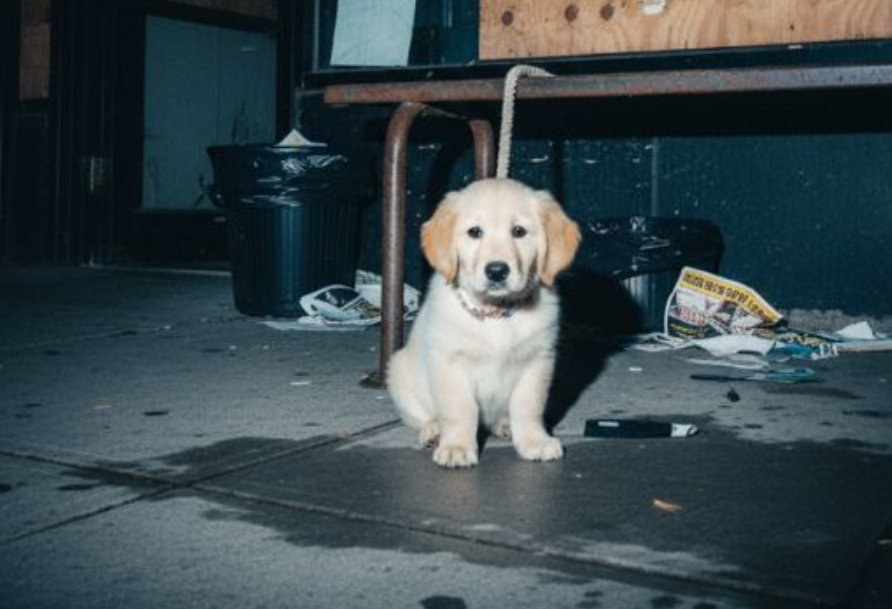
A tiny golden retriever puppy, no larger than a shoebox, tethered to a rusted bench with a worn-out rope. She sat there, calm and unaware of her abandonment, her small tail giving a single hopeful wag when her eyes met mine. No barks, no whimpers—just a quiet, steady gaze that tugged at my heart.
There was no bowl, no food, no sign of care. Only a tight collar with a rhinestone name tag nestled in her fluffy fur. I knelt down, speaking softly, and she let me stroke her cold little paws. She’d been out there too long.
When I flipped the tag over, I expected a name or a phone number. Instead, I found a folded scrap of paper tucked tightly behind it, nearly tearing as I worked it free.
The handwriting was hurried, almost unreadable, but one sentence stood out:
“If you find this, don’t take her to the shelter. They already tried to end her life once.”
That’s when I noticed the faint scar beneath her left ear, a mark that hinted at something far worse than neglect.
I scanned the street, every shadow suddenly sharper, every sound louder. This wasn’t a simple case of abandonment.
I scooped her up, her small body trembling against my chest. She didn’t resist, just nestled closer as I wrapped her in my jacket and hurried home. My apartment, a cramped space above Mr. Lindley’s hardware store, doesn’t allow pets, but I’d deal with that later.
At home, I warmed some chicken from my fridge and set out a towel for her. She devoured the food, licking the dish until it skittered across the tile. Sitting beside her, I watched her alert eyes, too quiet for a puppy. It was as if she’d learned to stay silent.
That note haunted me.
Who wrote it? What did they mean by “tried to end her life”? Was it a panicked owner—or something darker?
The next morning, I called in sick and took the puppy—whom I’d started calling Daisy—to a vet across town, avoiding the local one in case someone was searching for her.
Dr. Haynes, the vet, scanned for a microchip. There was one.
But when she pulled up the information, her expression tightened.
“This dog was marked as deceased,” she said, her voice low. “Three weeks ago. Animal control brought her in after an ‘incident’ at the city shelter, but someone altered her record.”
My throat went dry. “What kind of incident?”
She turned her screen toward me, revealing a blurry report. It detailed a group of puppies slated for euthanasia due to “overcrowding.” One had escaped. Daisy.
Or whatever her name was before someone tried to erase her existence.
Dr. Haynes leaned back. “I probably shouldn’t share this, but something’s off here.”
I nodded. “Can I keep her? Legally?”
She gave a small smile. “No owner is listed now. Whoever changed her record made her invisible to the system. She’s a ghost. Just keep her safe.”
And so I did.
Over the next few weeks, Daisy became my constant companion, trailing me from room to room, curling up against me at night. She flinched at loud knocks, but slowly, she began to play. Her tail wagged more freely, and she even barked when the toaster popped, making me laugh until tears fell.
I thought we were safe.
Then, one night, I came home to find my apartment door slightly ajar.
My heart stopped.
I always locked that door. Always.
I rushed inside, calling Daisy’s name, my voice shaking. No response. Panic clawed at me.
But there she was, trembling under the bathroom sink. And by the door, jammed into the wood with a screwdriver, was another note, written on the same paper as the one in her collar.
“You were warned. Stay out of it.”
I knew then: someone wanted her gone. Not just abandoned. Erased.
Sleep didn’t come that night. I sat with Daisy in my lap, a baseball bat within reach, staring at the door. Calling the police crossed my mind, but what could I say? That someone broke in to steal a dog who, according to records, didn’t exist?
The next day, I went to my friend Milo.
Milo repairs computers and, back in our teenage years, dabbled in some less-than-legal activities. I showed him the notes, the scar, and the vet’s report.
He let out a low whistle. “You think this is tied to some underground dog-fighting ring?”
“Daisy?” I said, incredulous. “She’s barely bigger than a loaf of bread.”
“Exactly,” he replied. “Some groups use small dogs as bait. Puppies, usually. It’s ugly business. Could explain the scar.”
My stomach churned.
He started typing. “Let me dig into this.”
Hours later, he leaned back. “Found something. A private ‘rescue’ group has been pulling dogs from the city shelter, claiming they’re rehoming them. But there are no adoption records. And they’re getting hefty payments from a pharmaceutical testing company. Big money.”
My blood ran cold. “Animal testing?”
He nodded, his face grim. “If Daisy escaped that, she’s a miracle.”
I looked at her, curled at my feet, chewing a stuffed toy. Sweet, trusting Daisy. To someone, she’d been nothing but a test subject.
I couldn’t let them touch her again.
Milo helped me install cameras and new locks at my apartment. He warned me to stay quiet and avoid going public—for now.
We made a plan.
Milo sent a fake adoption inquiry through a shell site linked to the rescue group, posing as someone with “test-ready dogs” looking to partner. Within a day, they responded with a meeting spot.
An old warehouse by the docks. Midnight.
It felt like a scene from a thriller.
We didn’t involve the police. Instead, we contacted someone better.
Milo’s cousin, a local journalist who once exposed a meatpacking plant with a hidden camera, was outraged when we shared our evidence. She agreed to help.
We wired her with a microphone and planned a sting.
That night, she met the contact at the warehouse while Milo and I watched from a van nearby. Daisy stayed with a neighbor. My hands shook so badly I could barely hold the binoculars.
The man who arrived looked ordinary—mid-40s, clean-cut, like someone you’d see at a dentist’s office. He brought a van. And cages.
My heart sank.
He spoke smoothly, offering to take animals by the dozen, asking about their “strength” and specifying a need for “docile ones” for trials. Every word was recorded.
That night, the story aired.
“EXPOSÉ: ILLEGAL DOG TESTING RING LINKED TO CITY SHELTER.”
Five arrests followed. The lab was shut down. Half the shelter’s board was fired.
And Daisy? She became a symbol of hope.
Images of her scar, her soulful brown eyes, and her growing pile of toys spread across the internet. Donations poured in. People protested. Adoptions soared. The shelter got new leadership. Milo’s cousin earned an award.
As for me?
I got to keep my girl. No questions asked.
Sometimes, I think about how easily I could’ve walked past that bench. I was exhausted, broke, and could’ve assumed someone would return for her. But I didn’t.
Daisy saved me, too.
Before her, my days blurred into endless diner shifts and instant noodles. But she gave me something to protect, something to fight for.
She taught me that love doesn’t always arrive at the perfect moment. Sometimes, it’s tied to a bench at 2 a.m., with a cryptic note and a hidden scar.
But it’s always worth it.
Your small actions can make a difference. One step, one choice—they can change everything.
Have you ever rescued someone—or been rescued yourself? Share your story below and like this post if Daisy’s journey warmed your heart.