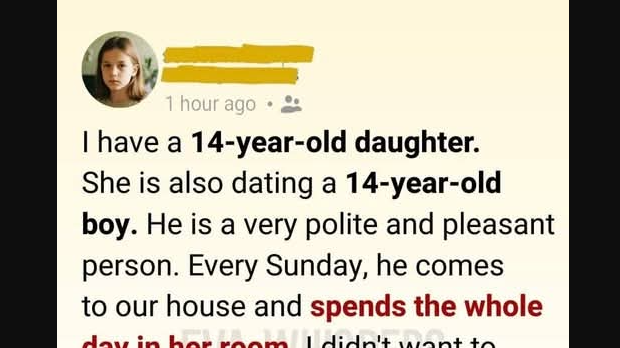
I have a 14-year-old daughter, and she has been seeing a boy her age. He is polite, soft-spoken, and remembers to say “please” and “thank you” every single time he steps into our home. Every Sunday he arrives at our door, takes off his shoes, and heads straight to my daughter’s room, where they spend the entire day together behind a closed door.
In the beginning, I told myself I was being open-minded and trusting. I reminded myself that the world has changed, that teenagers appreciate a sense of independence, and that giving them space can build confidence. Even so, week after week, a small uneasy thought kept tapping on the back of my mind. What if I was overlooking something important? What if giving too much space created blind spots? What if there were things happening that I needed to understand as a parent?
One Sunday afternoon stood out from the rest. The entire house felt unusually quiet. There was no sound of a television playing, no music drifting through the hallway, no familiar chatter. Only stillness. That silence is what finally pushed me out of my comfort zone.
I walked down the hallway slowly, my heartbeat growing louder with each step. I placed my hand on the doorknob, hesitated for only a breath, and opened the door without knocking.
What I saw inside froze me in place.
My daughter was sitting on the floor with her legs crossed, surrounded by notebooks filled with scribbles, colored pens, stacks of worksheets, and open textbooks. The boy sat beside her holding a set of handmade flashcards. On the bed behind them was a poster decorated with bright colors that read, “You’ve Got This!” in large, cheerful letters.
They both looked up at me with startled eyes.
Before I spoke, the boy stood up quickly and said, “I’m sorry, we didn’t hear you come in. We’re studying.”
Studying.
My daughter explained, her voice soft, that she had been struggling with math and science for months. She had been too embarrassed to ask for help and had let the stress build until it became overwhelming. Her confidence had slipped, and some nights she cried herself to sleep out of frustration. Instead of spending their Sundays doing what most teenagers do, he had been giving up his entire day to help her study.
He brought flashcards he made himself. He prepared practice quizzes. He watched tutorial videos at home before coming over. He broke down problems step by step so she could understand them. He never made her feel inadequate. He kept telling her she was capable and bright, and that she deserved to believe that herself.
I looked at him, noticing how young he truly was, and he gave a shy shrug. “I really care about her,” he said quietly. “I want her to feel confident.”
In that moment, the worry that had followed me for weeks transformed into something far different.
Gratitude.
Over the following weeks, I noticed changes in my daughter. She smiled more often. She stopped dreading homework. Teachers emailed to share that her participation had increased and that her test scores were improving. One afternoon she burst through the front door holding a paper marked with a bright red A, her joy filling the room.
That Sunday, instead of pacing around anxiously, I prepared snacks and left them at her door. Sometimes I heard them laughing about wrong answers, celebrating small wins, and motivating each other through difficult chapters.
Months later, during a parent-teacher conference, her math teacher said something that stayed with me: “Whatever support she has outside the classroom is working.”
I didn’t feel the need to explain.
One evening, as the boy was putting on his shoes to leave, he thanked me for allowing him to come over every week. I told him the truth — that there had been a time when I had been uncertain and afraid.
He nodded politely and replied, “I understand. If I were a parent, I’d worry too.”
It struck me then.
Trust does not mean looking away. It means paying attention, stepping in when it matters, and recognizing when your fears are different from reality. The day I opened that door, I expected the worst. Instead, I saw kindness, encouragement, patience, and the purest form of young love — a kind that helps someone become stronger.
Sometimes the moment we fear most becomes the moment that reassures us we are guiding our children well.