A rare stillness settled over Manhattan’s Upper East Side as mourners arrived quietly, one by one, at a church long associated with reflection and family history. There were no flashing cameras or public displays. Instead, the atmosphere was marked by restraint, lowered voices, and a shared understanding that this moment belonged to remembrance rather than attention.
Inside the Church of St. Ignatius of Loyola, the Kennedy family gathered for a private farewell to Tatiana Schlossberg, whose death at 35 followed a prolonged and deeply private struggle with leukemia. The setting itself carried layers of meaning, connecting generations of faith, loss, and continuity, and reinforcing that this farewell was grounded in both personal history and collective memory.
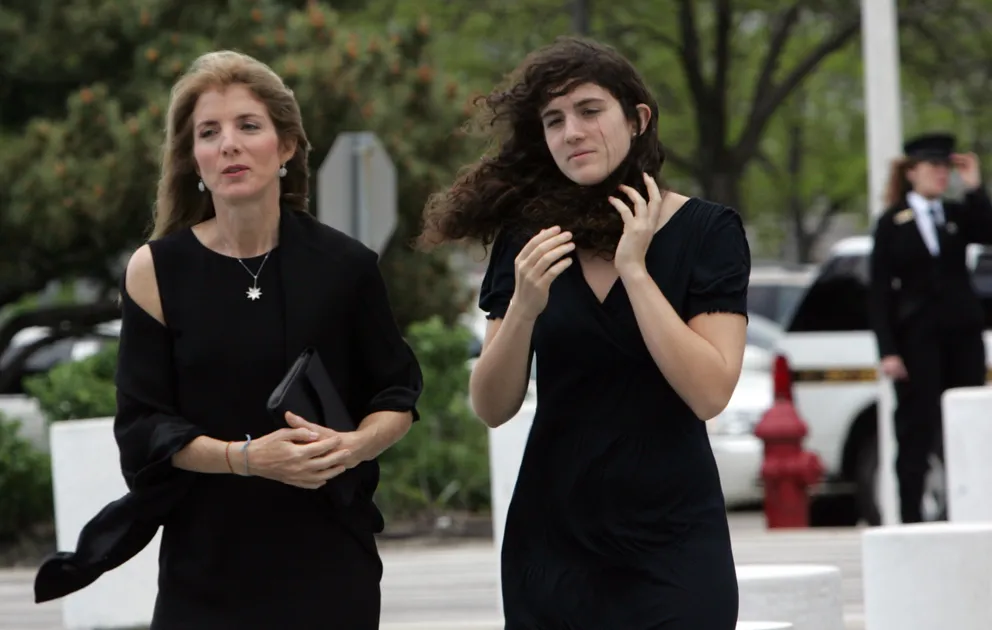
Family members remained close throughout the service, their unity reflecting the depth of the loss they shared. Tatiana’s parents, Caroline Kennedy and Edwin Schlossberg, stood together with her husband, George Moran, and their two young children.
Nearby were her siblings, Jack Schlossberg and Rose Schlossberg, offering steady presence and quiet reassurance. Those in attendance described the gathering as intimate and carefully composed, shaped to honor Tatiana’s character. While her professional life placed her in public view as an environmental journalist and writer, her personal world centered on family, purpose, and thoughtful engagement rather than public attention.
The service focused not on titles or legacy by association, but on Tatiana’s life as she lived it. She was remembered as a devoted wife and mother, deeply invested in raising her children with intention and love. Friends recalled her curiosity, discipline, and the seriousness with which she approached her work.
Her writing explored climate responsibility and environmental stewardship, subjects she believed demanded clarity and honesty. Even in illness, those close to her noted that she remained committed to meaningful conversation and thoughtful presence, choosing depth over spectacle in every aspect of her life.
Though private by design, the service included a small number of respected figures whose attendance reflected genuine connection rather than ceremony. Joe Biden was among those present, joined by longtime family friends and colleagues from journalism and public life. Their presence underscored the breadth of Tatiana’s relationships and the respect she earned through her work and character.
One notable absence was Robert F. Kennedy Jr., who was in Washington attending to official responsibilities. Observers noted that the family has long navigated the balance between public visibility and private grief with care, choosing dignity without allowing moments of loss to become performative.
In the days surrounding the service, many reflected on Tatiana’s own words, which had gained renewed attention following her passing. Shortly before her death, she shared a personal essay describing her leukemia diagnosis shortly after the birth of her second child. In that writing, she spoke candidly about the physical toll of treatment, the emotional weight of uncertainty, and the clarity that emerged when time felt limited. Rather than centering fear, she emphasized presence—being fully engaged with her children, attentive to her work, and honest in her relationships. That perspective resonated deeply with those gathered, echoing through the quiet space of the church.
Those close to Tatiana emphasized that her strength did not present itself loudly. It appeared in consistency, in showing up, and in choosing intention even during profound difficulty. She approached illness with the same discipline she brought to writing and motherhood, focusing on what could still be given rather than what was being lost. Friends described her as reflective, principled, and deeply empathetic, qualities that shaped both her professional contributions and her personal relationships.
As the service concluded, there was no rush to leave. Mourners lingered, exchanging gentle words and shared memories. The absence left behind was unmistakable, yet so was the sense of continuity. Tatiana Schlossberg is remembered not only as part of a historically significant family, but as a woman whose life stood firmly on its own merits. Her legacy rests in her work, her devotion to family, and her unwavering commitment to living with purpose, even during the most challenging chapter of her life.