For three months, no one at the bank knew her name. She didn’t make small talk, didn’t complain, didn’t even ask for help. She was simply there.
A soft figure in a turtleneck sweater and headscarf, slipping silently through the marble halls of the bank, cleaning up the day’s mess without fanfare. She polished the floors until they gleamed, wiped fingerprints off every metal surface, and left behind the faint scent of lemon cleaner and fresh air. The bank sparkled when she was done — not with sterility, but with warmth. It felt like someone truly cared.
Most employees ignored her. Some were casually cruel.
“Hey, mute!” a young loan officer would sneer, pointing out a spotless corner with fake disdain. “Missed a spot.”
She’d respond only with a soft sigh, pick up her cloth, and continue working. No words. No reaction.
Others whispered behind her back. “Creepy how she never talks.” “Perhaps she’s not all there.”
But still, she worked. Quietly. Diligently.
Her name was Aleptina. At least, that’s what it said on the payroll. Few used it. No one asked where she came from or what her story was. And she never volunteered information.
What they didn’t know was that she once had a voice — a beautiful one — and a life filled with promise.
Years ago, she was known as Alia, a bright young teacher with a passion for children and a love for painting. Her life had been modest but full — until one night shattered everything.
It was a June evening, warm and sleepy. Alia had just finished a watercolor of a lilac bush when the smell of smoke invaded her apartment. At first, she thought it was a neighbor cooking. But then came the screams.
Frightened voices echoed in the stairwell, and panic thickened the air as much as the smoke. A fire had broken out in the apartment across the hall — the one where a little boy named Lesha lived with his parents.
Without thinking, Alia grabbed her father’s toolbox and pried the door open. Flames licked the walls, smoke thick and choking. Inside, she found Lesha and his mother unconscious. She carried the boy first, coughing and blinded, toward the window. The fire blocked her path to the hallway.
Down below, firefighters shouted to her, holding out a rescue net.
With shaking hands, she passed Lesha through the window to safety. Then, as the heat overwhelmed her, she collapsed and was pulled out in the nick of time.
Lesha survived. His mother didn’t. The father vanished soon after.
Alia spent months in the hospital. Her back, arms, and shoulders bore the angry marks of fire. The physical pain was unbearable, but it was the silence that followed that hurt the most.
Her mother had died shortly after the fire, her heart giving out from the stress and fear. Alia stopped speaking altogether.
The doctors called it psychological shock.
She resigned from her teaching job. Her world became small — a quiet apartment, a fish tank, and her art. She painted every night. Sometimes watercolors, sometimes oils. Her emotions spilled onto the paper, even if her voice no longer could.
Eventually, her father, worried sick, suggested selling their apartment and moving somewhere cheaper. Alia agreed without a word.
In time, she took up work as a cleaner. Her burns still ached, but she pressed on. In the silence of her days, she found a strange peace. People didn’t expect words from cleaners.
Her first job was at a small office where the manager noticed her careful work and kind demeanor. When that office relocated, the manager referred her to a friend at a local bank.
And so, Aleptina arrived at the bank — a woman with no voice but a heart full of unspoken stories.
Three months passed.
Then one morning, everything changed.
A murmur ran through the bank like a wave. A luxury black car had pulled up. Out stepped a man in a tailored suit and sunglasses. The regional director, Sergei Mikhailovich.
He walked with the confidence of someone used to commanding attention. Employees scrambled to stand straight and fix their hair.
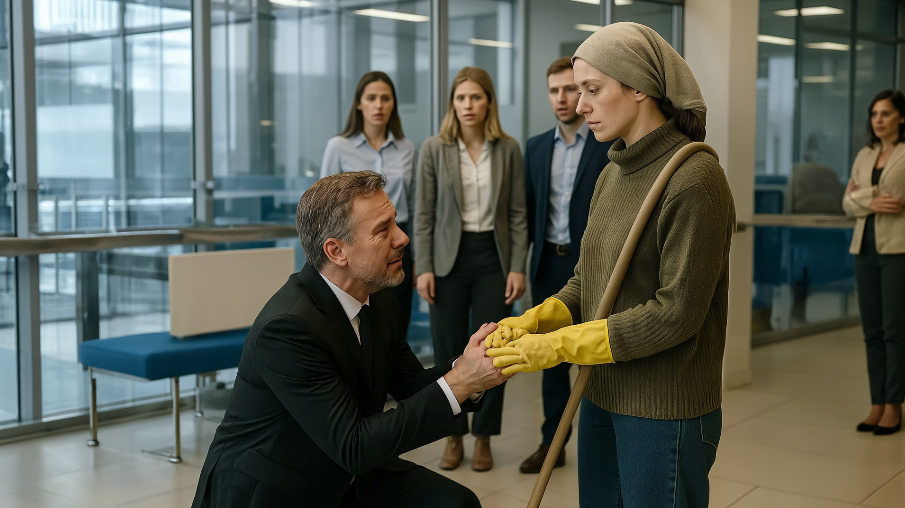
Aleptina didn’t look up. She was polishing the brass handles at the entrance, yellow gloves gleaming under the lights.
But as Sergei stepped through the door, his gaze fell on her — and he stopped. Something in his expression shifted. His steps slowed.
Then, without warning, he walked over, knelt before her, and gently removed her gloves. The room froze.
And then — to everyone’s shock — he kissed her scarred hands.
Tears welled up in his eyes.
“Alia,” he whispered, “I have searched for you for years…”
People stared. The mute cleaner and the director?
But to Sergei, nothing else mattered.
“You saved my son,” he said. “You gave him life. You gave me life.”
The pieces clicked into place.
Lesha.
He had never known the name of the woman who carried his boy out of the fire. After the tragedy, he had fallen apart, spiraled into guilt and grief. He left everything behind, moving away, trying to forget. But Lesha never did. And neither did he.
He had tried to find her, but her name had never made it into the news. Simply a young woman, hospitalized, then gone.
And here she was — silent, scarred, still working through the pain.
“I owe you everything,” he said softly. “Please… come with me.”
Aleptina — Alia — looked at him, stunned. Her mouth trembled.
Then, for the first time in years, she spoke. Just one word.
“Lesha?”
Sergei nodded, tears running down his cheeks. “He’s studying to be a doctor. Precisely as you once dreamed of being. He wants to help people, as you helped him.”
Alia’s lips parted. The silence inside her finally broke.
Over the following weeks, everything changed.
Sergei made arrangements for Alia to receive treatment — both physical and emotional. Top surgeons offered pro bono care. A counselor worked gently with her, helping her rediscover her voice and rebuild her confidence.
News of what she had done — of the quiet cleaner who was once a hero — spread through the bank. The same employees who once mocked her now looked at her with awe.
But Alia didn’t seek praise.
Instead, she asked for one thing: “Let me paint.”
With Sergei’s help, she held her first small art exhibit. Her paintings — soft, flowing watercolors full of light — moved people to tears. Every piece told a story she had never been able to articulate.
She never returned to cleaning floors, not because she felt superior to it, but because she finally had the chance to live her truth.
She kept her headscarf — not to conceal, but to honor who she had been. And she spoke now, not often, but always with purpose.
One day, at a gallery event, a young man stepped forward.
“Hello,” he said shyly. “I am Lesha.”
Alia smiled, tears welling in her eyes again.
She reached out, and for the first time in nearly a decade, held the hand she had once saved from fire.
In a world so quick to judge by appearances, Alia reminded everyone of this truth: Quiet doesn’t mean broken. Scars don’t mean weak. And some heroes don’t need capes or medals — they only need a mop, a brush, and a heart full of love.