I always thought I understood silence. Growing up with Keane, you learn to read things most people miss—a flick of the eyes, a twitch in the jaw, the way he’d line up his pencils by color and size before homework. You learn patience too, or you learn to pretend. Because pretending is what got us through most of childhood.
Keane was diagnosed when he was three. I was six. I don’t remember the moment they told us, but I remember the shift. Our house got quieter. Mom got tired. Dad got angry at weird things, like the sound of crinkling chip bags or cartoons playing too loud. I got good at being invisible.
But Keane? He stayed the same. Gentle. Withdrawn. Smiling sometimes, usually at clouds or ceiling fans.
He didn’t talk. Not then. Not really ever.
Until he did.
It was a Tuesday, which meant diaper laundry and leftover pasta and trying not to scream. My baby, Owen, had just hit six months and was in a phase I could only describe as “tiny demon trapped in a marshmallow.” My husband, Will, had been working longer shifts at the hospital, and I was hanging by a thread made of cold coffee and mental checklists. Keane, as usual, was in the corner of the living room, hunched over his tablet, matching colors and shapes in a never-ending loop of silent order.
We’d taken Keane in six months ago, just before Owen was born. Our parents had passed a few years apart—Dad from a stroke, Mom from cancer—and after a long and painful stint in state housing that left him more withdrawn than ever, I couldn’t leave him there. He said nothing when I offered our home. Just nodded once, his eyes not quite meeting mine.
It worked, mostly. Keane didn’t demand anything. He ate what I made, folded his laundry with crisp military corners, and played his games. He didn’t speak, but he hummed, quietly and constantly. At first, it drove me nuts. Now, I barely noticed it.
Until that Tuesday.
I’d just put Owen down after his third tantrum of the morning. He was teething, gassy, maybe possessed—I didn’t know. I only knew I had a 10-minute window to scrub the week off my skin. I stepped into the shower like it was a hotel spa, and let myself pretend, just for a minute, that I wasn’t a frayed rope of a person.
Then I heard it. The scream. Owen’s “I’m definitely dying” cry.
Panic kicked in before logic. I yanked the shampoo from my hair, skidded across the tile, and flung myself down the hallway.
But there was no chaos.
Instead, I froze.
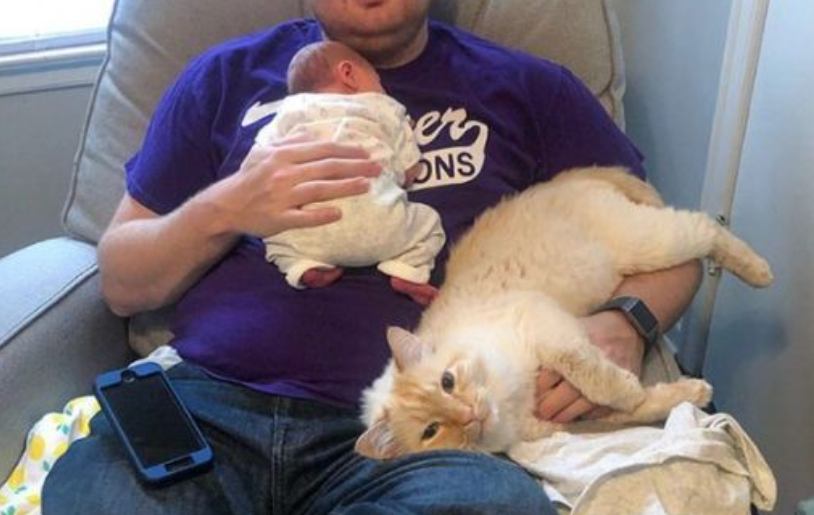
Keane was in my armchair. My armchair. He never sat there. Not once in six months. But now, there he was, legs tucked awkwardly, Owen curled on his chest like he belonged there. One hand gently rubbed Owen’s back in long, steady strokes—exactly how I did it. The other arm cradled him just right, snug but loose. Like instinct.
And Owen? Out cold. A little drool bubble on his lip. Not a tear in sight.
Mango, our cat, was draped across Keane’s knees like she’d signed a lease. She was purring so loudly I could feel it from the doorway.
I just stood there, stunned.
Then Keane looked up. Not quite at me—more like through me—and said, barely above a whisper:
“He likes the humming.”
It hit like a punch. Not just the words. The tone. The confidence. The presence. My brother, who hadn’t strung a sentence together in years, was suddenly… here.
“He likes the humming,” he said again. “It’s the same as the app. The yellow one with the bees.”
I blinked back tears, then stepped closer. “You mean… the lullaby one?”
Keane nodded.
And that’s how everything started to change.
I let him hold Owen longer that day. Watched the two of them breathe in sync. I expected Keane to shrink when I paid attention—like he used to. But he didn’t. He stayed calm. Grounded. Real.
So I asked if he’d feed Owen later. He nodded.
Then again the next day.
A week later, I left them alone for twenty minutes. Then thirty. Then two hours while I went to get coffee with a friend for the first time since giving birth. When I came back, Keane had not only changed Owen’s diaper—he’d organized the changing station by color.
He started talking more too. Small things. Observations. “The red bottle leaks.” “Owen likes pears better than apples.” “Mango hates when the heater clicks.”
I cried more in those first two weeks than I had the entire year before.
Will noticed too. “It’s like having a roommate who just… woke up,” he said one night. “It’s incredible.”
But it wasn’t just incredible.
It was terrifying.
Because the more present Keane became, the more I realized I’d never truly seen him before. I’d accepted the silence as all he could give, never questioning if he wanted to give more. And now that he was giving it—words, affection, structure—I felt guilt claw at me like a second skin.
He’d needed something I’d missed.
And I almost missed it again.
One night, I came home from a late Target run to find Keane pacing. Not rocking, like he used to when anxious—but walking, in tight measured steps. Owen was screaming from the nursery. Mango was scratching at the door.
Keane looked at me, eyes wide.
“I dropped him.”
My heart jumped. “What?”
“In the crib,” he clarified. “I didn’t want to wake him up. I thought… but he hit the side. I’m sorry.”
I ran to Owen. He was fine. Barely even crying now. Just tired. I scooped him up, checked him over. No bumps. No bruises.
Back in the living room, I found Keane sitting with his hands clasped, whispering something over and over.
“I ruined it. I ruined it.”
I sat beside him. “You didn’t ruin anything.”
“But I hurt him.”
“No. You made a mistake. A normal one. A human one.”
He stared at me.
“You’re not broken, Keane. You never were. I just didn’t know how to hear you.”
That’s when he cried.
Full, silent sobs.
I held him, like he held Owen. Like someone who finally understood that love isn’t about fixing people. It’s about seeing them.
Now, six months later, Keane volunteers at a sensory play center two days a week. He’s become Owen’s favorite person—his first word was “Keen.” Not “Mama.” Not “Dada.” Just “Keen.”
I never thought silence could be so loud. Or that a few whispered words could change our whole world.
But they did.
“He likes the humming.”
And I like the way we found each other again. As siblings. As family. As people no longer waiting to be understood.
So, what do you think—can moments like this really change everything?
If this story touched you, share it with someone who might need a little hope today. And don’t forget to like—it helps more people see what love can really sound like.