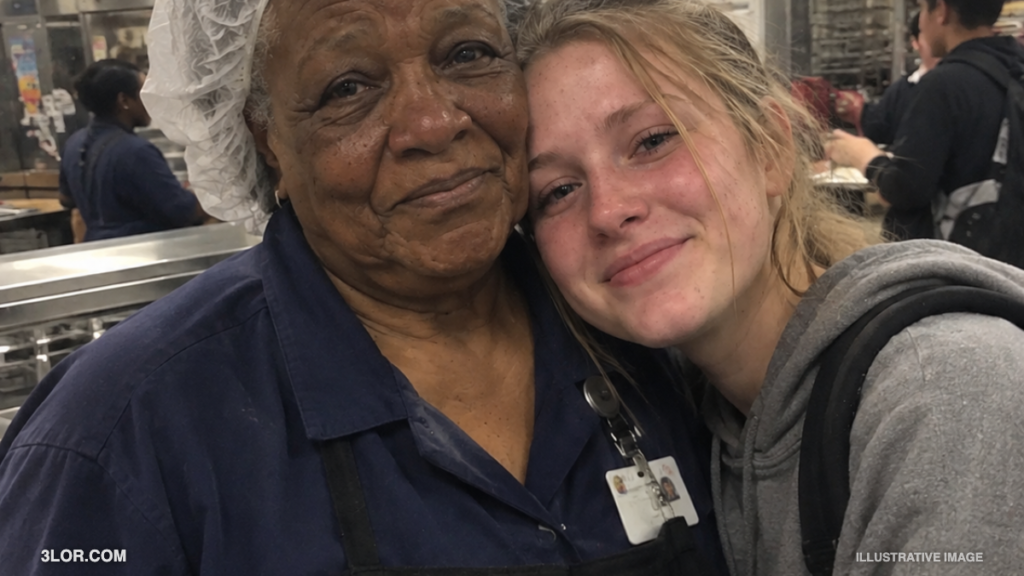
“My grandma served you thousands of lunches,” I said, gripping the sides of the podium, “so tonight, I’m serving you the truth you never wanted to taste.”
The gym went completely still.
I could see my principal sitting behind me.
Teachers lined the first two rows.
Hundreds of parents filled the bleachers.
And directly in front of me were kids who had spent four years laughing at the woman who raised me.
For one second, I wanted to sit down.
Then I remembered the last morning Grandma worked.
She had left the house at 5:17 a.m.
I knew the exact time because I heard her trying to close the front door quietly so she wouldn’t wake me.
She had worked that entire day.
Eight hours on her feet.
Then she’d stopped at the grocery store on the way home because I needed strawberries for a school project.
Six days later, her heart stopped.
So I unfolded the piece of paper I’d brought with me.
“Most of you knew my grandmother as Mrs. Ruth.”
A few people lowered their eyes.
“You knew the hairnet. You knew the apron. You knew the woman who stood behind the counter and asked whether you wanted carrots even though almost everybody said no.”
A few nervous laughs moved through the gym.
I didn’t laugh.
“What you didn’t know was that she woke up at 4:45 every morning because we shared one car and she wanted me to have it for school.”
I looked toward my classmates.
“You didn’t know she raised me after both my parents died.”
Someone in the front row whispered something.
I kept going.
“You didn’t know that when I was nine and couldn’t sleep unless someone sat beside my bed, she worked mornings at the school and cleaned offices at night so she could still be home before I fell asleep.”
My voice started shaking.
I stopped.
Breathed.
Then continued.
“You didn’t know that the woman some of you called ‘stupid’ kept a notebook in our kitchen.”
That got their attention.
I reached beneath the podium and lifted a small blue spiral notebook.
I’d found it the night after Grandma died.
It had been sitting in the drawer beside expired coupons, batteries and takeout menus.
At first, I thought it was a grocery list.
It wasn’t.
Grandma had written students’ names inside.
Dozens of them.
Beside each name was a little note.
Marcus — no cheese. Allergy.
Emily — parents separating. Ask how she’s doing.
Jordan — extra fruit when possible. Says he isn’t hungry but always finishes it.
Kayla — grandmother in hospital.
Page after page.
Year after year.
Some of those names belonged to people sitting in front of me.
I looked up.
“She remembered you.”
Nobody moved.
“Even when you didn’t remember her name.”
I turned another page.
There was one boy Grandma had written about seven different times.
He had been one of the loudest kids in our grade.
I’ll call him Tyler.
He was sitting three rows from the front.
The first note beside his name was from sophomore year.
Tyler — comes through line twice some Fridays. Don’t embarrass him. Give extra if there’s enough.
I looked at him.
His face changed immediately.
I hadn’t planned to read that one.
But standing there, I realized something.
Grandma had protected his dignity even in a notebook nobody was supposed to see.
So I didn’t say his name.
Instead, I closed the notebook.
“There are people in this room who made jokes about my grandma’s job.”
I could hear someone crying in the bleachers.
“She heard some of them.”
That was the part nobody knew.
Neither had I.
Not until I found a folded letter tucked into the back of the notebook.
Grandma had written it to me.
She never gave it to me.
I pulled it from my graduation gown.
“My grandmother knew I was embarrassed.”
My voice cracked on the word.
That hurt more than anything.
Because for years, I’d convinced myself I was protecting her by pretending the jokes didn’t bother me.
But Grandma always knew.
I unfolded her letter.
I didn’t read all of it.
Some words belonged only to me.
But I read this:
“Megan, never be ashamed of honest work. There will always be people who think a title tells them how much respect someone deserves. Feed them anyway. Life has a way of teaching people what hunger feels like.”
The silence changed.
It wasn’t awkward anymore.
It was heavy.
I looked down at the empty chair where Grandma should have been sitting.
“I spent years wishing my grandmother worked somewhere else so people would stop making fun of us.”
That was difficult to admit.
“I wish I could take that back.”
I swallowed.
“Because she wasn’t ‘just the lunch lady.’”
“She was the person who raised me.”
“She was the person who remembered which kids couldn’t eat dairy.”
“She noticed when somebody stopped buying lunch.”
“She slipped extra food onto trays without announcing why.”
“She asked how you were doing and actually waited for the answer.”
“And apparently, she remembered more about some of you than you ever bothered to learn about her.”
Nobody clapped.
Not yet.
And I’m glad they didn’t.
I hadn’t gone up there for applause.
Then I said the sentence I had practiced alone in Grandma’s kitchen the night before.
“If the only thing you ever noticed about my grandmother was the apron she wore, you didn’t embarrass her.”
I looked at the students in front of me.
“You embarrassed yourselves.”
I folded the paper.
That was supposed to be the end.
Then someone stood up.
It wasn’t a teacher.
It was Tyler.
The same boy whose name appeared over and over in Grandma’s notebook.
His face was red.
He didn’t look at me.
He looked toward the empty chair beside my aunt.
“Mrs. Ruth fed me when my mom couldn’t.”
The microphone picked up my breathing.
Tyler rubbed his face with his sleeve.
“My mom lost her job sophomore year.”
Nobody said anything.
“Sometimes there wasn’t food at home. Mrs. Ruth knew.”
He looked at me then.
“She never told anybody.”
I couldn’t speak.
“She’d put an extra sandwich in a paper bag and tell me the kitchen had made too many.”
He gave a tiny laugh.
“I knew that wasn’t true.”
Then a girl on the other side of the gym stood.
“Your grandma did that for me too.”
Another voice came from behind her.
“She remembered my birthday.”
Then another.
“She sat with me when I had a panic attack.”
A teacher stood near the wall.
“Ruth used to pay lunch balances.”
I turned around.
“What?”
The teacher covered her mouth for a moment.
“She didn’t want students to know.”
I stared at her.
Grandma had spent the last month of her life telling me not to waste money on an expensive graduation dress.
I’d bought mine secondhand for $28.
And she had been quietly paying for other children’s lunches.
That was when I started crying.
Not pretty movie tears.
I couldn’t get words out.
My nose was running.
My hands wouldn’t stop shaking.
My principal came over and put his hand on my shoulder.
I thought he was going to lead me away from the microphone.
Instead, he looked at the crowd.
“I think Megan’s grandmother deserves to graduate with this class too.”
Everyone stood.
I wish I could tell you I felt triumphant.
I didn’t.
I wanted Grandma.
I wanted her standing in the back pretending she wasn’t crying.
I wanted to complain about the ridiculous amount of pictures she’d make me take afterward.
I wanted one more ride home with her asking whether graduation felt “different” now.
Instead, hundreds of people were standing for a woman who would never know it happened.
At least that’s what I thought.
After the ceremony, people kept coming up to me.
Some apologized.
Some told me stories about Grandma.
Some couldn’t look me in the eye.
I wasn’t interested in making anybody suffer.
I had already learned how little that fixes.
Then Tyler found me outside.
He waited until everyone else had left.
“Can I ask you something?”
“Okay.”
“Did she really write about me?”
I looked at the notebook in my hand.
“Yes.”
He stared at the ground.
“Can I see?”
I opened to one of the pages.
I covered the notes about other students and handed it to him.
He read Grandma’s words.
Tyler — came back hungry today. Added sandwich. Good kid having a hard year.
His chin started trembling.
“She wrote ‘good kid’?”
“Yes.”
“But I made fun of her.”
“I know.”
“Why would she write that?”
I knew exactly what Grandma would have said.
“Because she probably figured being cruel and being bad weren’t always the same thing.”
He handed the notebook back.
Then he walked away.
Three weeks later, I started getting envelopes in the mail.
The first contained $20.
No return address.
A note inside said:
For Mrs. Ruth’s lunch kids.
Then came $50.
Then $10.
Then a check from a parent.
My principal called me in July.
Students, teachers and families had donated enough money to start a small fund in Grandma’s name.
Nothing enormous.
No giant ceremony.
No television cameras.
The fund simply paid overdue lunch balances and helped students whose families were struggling.
They called it Ruth’s Table.
I almost hated the name because Grandma would have hated having anything named after her.
She would’ve waved her hand and said, “Just feed the child.”
So that’s exactly what we put underneath the name.
RUTH’S TABLE
Just feed the child.
I left for community college that fall.
The blue notebook came with me.
So did Grandma’s apron.
For years, I’d hated seeing that apron at school.
It reminded me that we didn’t have much.
That Grandma worked in a cafeteria.
That other kids could make me feel small with three stupid words:
“Lunch lady’s granddaughter.”
Now it hangs inside my closet.
And whenever I see it, I think about something I didn’t understand at eighteen.
There are jobs people notice because they come with titles, offices and expensive clothes.
And there are people nobody notices until they’re gone.
My grandmother spent years standing behind a cafeteria counter.
She never became wealthy.
She never had an impressive title.
Most people who passed through her line probably forgot her within five minutes.
But she noticed hungry children.
She remembered allergies.
She remembered birthdays.
She remembered sadness.
And when someone tried to hide that they needed help, she was kind enough to help them quietly.
At graduation, I thought I was finally going to teach everyone who laughed at her a lesson.
Years later, I understand that Grandma had already taught it.
I was just the last one to learn it.
There is no shame in serving people.
The shame is in believing the person serving you is beneath you.