The Four Pies at Five AM: How Delivering Thanksgiving Dessert to My Son’s Fourteen-Seat Table Broke Three Years of Lies
My daughter-in-law, Melissa, sat frozen halfway down the banquet table, one manicured hand pressed hard against her mouth.
Her mother stood behind her chair, eyes bouncing between my flour-dusted canvas jacket and her daughter’s ashen face. Then came the words that dropped like lead into the silent dining room:
“Melissa… isn’t that the bakery lady you told us about?”
Nobody answered.
I looked straight down the center runner at my son, David. The color had drained completely from his cheeks, leaving him looking like a man staring at an apparition.
“Mom?” he whispered.
I didn’t yell. I didn’t drop the boxes or make a scene. After three years of being told there was no room for me at Thanksgiving, I had finally learned that you never have to raise your voice to deliver a devastating truth.
“Good morning, David,” I said, stepping across the threshold just far enough to clear the chill of the morning porch. “Four pies from Hartley’s Bakery. One sweet potato, one pecan, one apple, and one pumpkin. Delivery fee included.”
Melissa stood up so fast her chair legs shrieked against the hardwood.
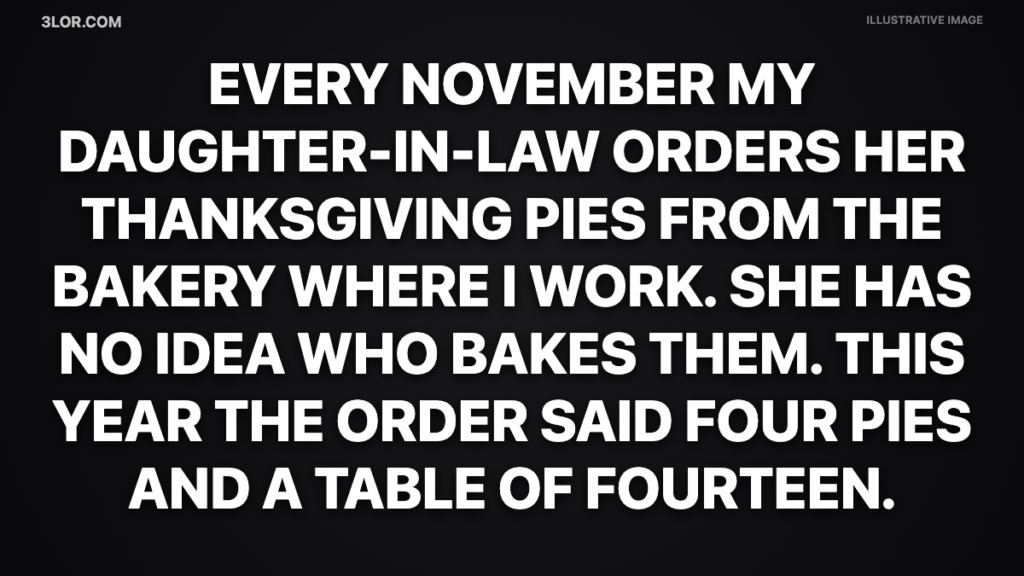
She had seen me dozens of times—at her wedding, at Christmas dinners before my husband passed, in sterile hospital waiting rooms when David had pneumonia, and at our granddaughter’s sixth birthday party. But she had never seen me at dawn in an apron, hair tucked beneath a baker’s net, carrying the exact desserts she bragged to her wealthy friends about sourcing from the finest shop in the county.
“You’re… the baker?” Melissa whispered, her fingers trembling against the table linen.
“I’ve baked every single pie on this table for the past three years, Melissa,” I answered, keeping my voice level.
I reached into my pocket and pulled out three yellowed, carbon-copy order tickets I had saved inside an old tin recipe box. I laid them flat on the sideboard.
The Arithmetic of Exclusion
David walked over slowly, staring down at the tickets.
“What are these, Mom?”
“Evidence that I can count, David,” I replied.
He looked down at the first slip: November 2023 — Hartley’s Bakery — Customer: Melissa Bennett — Order: 4 Large Pies (Serves 14–16).
He looked at the second slip from 2024: 4 Large Pies (Serves 14–16).
Then the slip from this morning.
David slowly lifted his head, his eyes sweeping across the long mahogany table set with crystal stemware, polished silver, and fourteen high-backed chairs.
His parents-in-law. Melissa’s brother and his wife. Wealthy neighbors from the country club. Distant acquaintances. Fourteen people.
“You told me we were keeping Thanksgiving small,” David said, his voice dropping into a register that made Melissa flinch. “Every single year, you looked me in the eye and told me we were doing a quiet dinner just for the three of us.”
Melissa’s eyes brimmed with tears. “David, I never wanted—”
“You told me my mother preferred solitude after Dad died,” David cut in, the betrayal cracking his composure wide open. “You told me she was too frail, that the noise gave her headaches, that she begged us to leave her alone in Dorchester!”
Melissa’s mother sat down heavily in her chair, staring at her daughter with unmasked disgust. “Melissa… what on earth did you do?”
I stepped closer to the table. In the center sat an antique porcelain gravy boat with a faded gold rim—the very piece my late husband had bought for our first anniversary forty years ago.
“Give me that, David,” I said softly, pointing to the heirloom.
He picked it up with shaking hands, holding it like stolen property. “Mom… Melissa said you gave this to her when we bought the house.”
“Your mother never gave that away,” Melissa choked out, collapsing back onto her seat, sobbing into her linen napkin. “I took it from the attic boxes when you were loading the moving truck.”
“Why?” David shouted, slamming both palms onto the table. “Why did you lock my mother out of our lives?”
The Confession
The entire room sat paralyzed as Melissa finally broke.
“Because I was terrified of her!” she wept. “When we bought this house, my parents put down the deposit, but your mother kept offering her savings. She knew every childhood habit you had. She knew how your father laughed, she knew your favorite meals, she knew your soul. Every time she walked into a room, I felt like a fraud who would never measure up. I thought if people saw her here, they would compare me to her.”
“So you erased her?” David asked, looking at his wife like she was a complete stranger.
“I thought it would just be one year,” Melissa sobbed. “Just one dinner until I felt secure. But then one year became two, and two became three. I told everyone she was difficult and reclusive so nobody would ask why her seat was empty.”
David turned toward me, tears cutting down his face. “Mom… why didn’t you call me? Why didn’t you knock on my door?”
“I did call you, David,” I answered, holding the porcelain gravy boat against my chest. “I sat at my kitchen table by the phone every fourth Thursday in November, telling myself you were just busy, that the roads were bad, that you’d call after dessert. You only called the following Monday to ask if I had survived the weekend. A son shouldn’t need a formal invitation to check if his mother is eating alone.”
The dining room remained dead quiet. Fourteen guests stared into their laps.
Melissa’s father, a retired civil judge who had remained silent at the head of the table, cleared his throat and stood up.
“Mrs. Bennett,” the older man said, his voice deep and solemn. “There is an empty chair at this table. Will you do us the honor of taking it?”
I looked at the fourteen plates. I looked at the pies I had rolled and baked before the city woke up. I looked at my son, whose shoulders were shaking with the grief of three stolen years.
I could have taken my gravy boat, walked out into the cold, and let them choke on their guilt. But my mother had taught me decades ago: A grievance never tastes sweet, no matter how much sugar you put on it.
“Set a place,” I said quietly. “The sweet potato pie is best served warm.”
My seven-year-old granddaughter scrambled out of her chair and threw her arms around my waist, burying her face into my baker’s apron.
“Grandma! You’re the pie lady? I missed you so much!”
I knelt down, wrapped my arms around her small shoulders, and kissed her forehead. “I’m not going anywhere, sweetheart.”
Rebuilding from the Ashes
Healing a fractured family does not happen between the turkey and dessert.
The months that followed were uncomfortable, quiet, and necessary. David began showing up at my small house every Sunday at seven in the morning. At first, he pretended he wanted to learn the secret to my gravy and crusts. But we both knew the truth: he was trying to claw back three years of deliberate blindness.
By spring, Melissa began coming with him.
She didn’t offer cheap excuses. She sat at my Formica kitchen counter, scrubbed potatoes, and endured the quiet shame of an apology that words alone could never settle. Forgiveness is not pretending a betrayal never happened; it is choosing to let the scar close rather than keeping it open with spite.
In early November, Melissa knocked on my back door alone, holding a battered shoe box.
Inside was a framed photograph taken thirty years ago: my late husband standing by our old oven, a crooked tie over his shoulder, gravy splashed across his sleeve, grinning ear-to-ear beside a teenage David.
“I found it in the bottom of a cedar chest,” Melissa whispered, her eyes red. “I thought you should have it back. And… I wanted to ask you something about Thanksgiving.”
“Go ahead, Melissa.”
“I don’t want a fourteen-seat table anymore,” she said, her voice cracking. “I realized that a table full of acquaintances is just a wall people build when their house is empty. We want to come to you this year.”
The Crowded Kitchen
On Thanksgiving morning, I rose at four.
I pulled on the soft navy sweater my husband had given me for our thirty-fifth anniversary. Outside, the November frost coated the garden gate, but my kitchen was alive with the roar of the oven and the scent of cinnamon, roasted turkey, and nutmeg.
By seven, David backed his pickup truck into my narrow driveway, carrying three folding tables and a stack of mismatched wooden chairs.
By eight, Melissa and her parents arrived with bags of groceries. By nine, neighbors from down the block, two widows from my church choir, and the young counter clerks from Hartley’s Bakery who had nowhere else to spend the holiday walked through my unlocked back door.
My small house was chaotic, loud, and bursting at the seams.
There weren’t fourteen seats. There were twenty-two.
We ran out of dining chairs, so David hauled up an old wooden armchair from the basement—the chair his father used to sit in when he read the morning paper. My granddaughter climbed up onto the cracked leather cushion, her legs swinging, smiling proudly as she helped pass the bowls.
At noon, when the platters covered every inch of wood, David stood up and tapped his water glass with a butter knife.
“Three years ago, I thought peace meant avoiding hard questions,” David said, his voice shaking as he looked around the crowded room. “I let silence take the place of my mother. I will never make that mistake again. To the woman who taught me how to stand, and who had the grace to teach us how to make room.”
Twenty-two glasses rose into the air.
In the center of the table, gleaming under the chandelier, sat the porcelain gravy boat with the gold rim. It was filled to the brim, passed from hand to hand, warm and belonging to everyone.
Later that evening, after the last car pulled out of the driveway, I stood in my quiet kitchen.
The sink was overflowing with dishes. The counters were dusted with flour and breadcrumbs. On the refrigerator hung a brand-new order slip written in my son’s handwriting:
Thanksgiving — Customer: Family — Order: 22 Seats — Never Empty Again.
I took down my apron, turned off the kitchen light, and smiled into the dark.
A family isn’t defined by who gets invited to a grand table. It’s defined by the people who notice when your seat is missing, and who refuse to sit down until they’ve brought you home.
Note: This narrative is an original work of dramatic fiction produced for storytelling and editorial purposes. Names, characters, businesses, and incidents are entirely products of the author’s imagination.