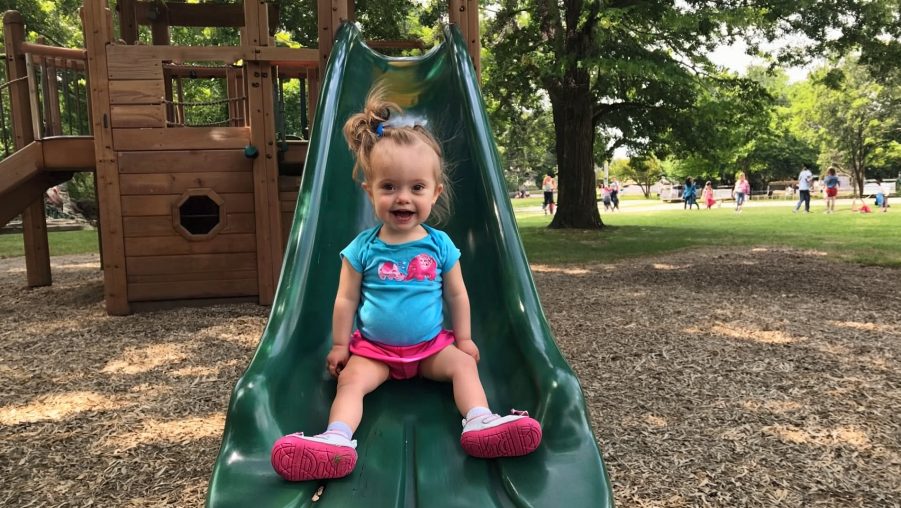
This photo? It looks ordinary.
A kid on a slide. Ponytail lopsided. Shirt riding up. Pink shoes full of bark chips. You’d scroll past it in a heartbeat if she weren’t mine.
But that day, I remember exactly what I was thinking as I took it: Please let her feel normal for five minutes.
Because most days, I can’t go five minutes without worrying.
She has a rare chromosome duplication. Not fatal, not exactly. But enough to make milestones feel like mountain peaks. Walking took three years. Speech is still a patchwork of signs and syllables only we fully understand.
So when she climbed that slide ladder by herself—slow and wobbly but determined—I nearly cried.
And then I saw her.
A mom across the playground. Watching. Not in a cruel way, but with that tight smile I’ve come to recognize—pity wrapped in politeness.
She didn’t look away when I caught her. Gave me a nod. The kind that says: You’re brave. You’re doing your best.
But I didn’t feel brave. I felt like I wanted to yank my daughter off that slide and take her home where the stares stop.
And suddenly—I was spiraling. Thinking about all the birthday parties she never gets invited to. Thinking about how some of the kids pretend not to hear her when she tries to say hello.
Thinking about how even her cousins sometimes avoid playing with her because they don’t understand her speech and think she’s “weird.”
I looked back at her on the slide. She was giggling. Actually giggling.
She had bark chips in her mouth, her pants were twisted sideways, but her face was lit up like the sun. And like that, I snapped the photo.
Because she didn’t need to feel normal. She was already feeling happy. It was me who needed the reminder.
Still, that nod from the mom across the playground stayed with me.
We left the park not long after. She got tired, as she often does, and I carried her back to the car while she hummed something I think was “Twinkle Twinkle.” Her fingers tapped a beat on my shoulder the whole way.
At home, I posted the photo to my private Facebook. Family and a few close friends. Captioned it: “She did the slide all by herself today. Big moment.”
Reactions trickled in—heart emojis, encouraging comments, my sister posting crying emojis like she always does when she’s proud.
But later that night, I got a message I wasn’t expecting. From a mom named Jenna.
We weren’t close. Our kids went to the same preschool for a while before I pulled my daughter out for therapy appointments. Jenna had a son named Eli. He was a little whirlwind of energy and always had mud on his knees.
She wrote: “Hey. I saw your post. I was at the park today too. I was the one watching. I hope I didn’t make you feel weird. I wanted to say something, but didn’t know how. Your daughter was amazing.”
I stared at the message.
That was her? I had only seen her from a distance. I assumed the nod meant pity. But perhaps I got it wrong.
I replied: “Thank you. Honestly, I thought you were judging me. So, thank you for saying something.”
She messaged back almost instantly: “Not judging. Remembering. My younger brother had the same chromosome duplication. He passed away when I was 19. He was the sweetest soul I’ve ever known. I guess seeing your daughter reminded me of him.”
My throat tightened.
I didn’t know what to say at first. Then I typed: “I’m so sorry. And thank you for telling me. That means a lot.”
We messaged a bit more that night. Nothing heavy. She told me how her brother used to love trucks and hated peas. I told her about my daughter’s obsession with sea turtles and how she signs “more” every time I play her favorite song.
Over the next few weeks, we talked more.
And something funny started to happen—I began looking forward to her messages. Someone who understood the odd mix of joy and ache I lived with.
Then one morning, she invited us to a small playgroup she hosted in her backyard.
“It’s nothing fancy,” she said. “A few moms and kids. Safe space. No expectations.”
I hesitated. A hundred worries ran through me. Would the other moms be polite but distant? Would my daughter get overwhelmed? Would she cry?
But we went.
And it was… peaceful.
There was a bubble machine. A blanket on the grass. Goldfish crackers and juice boxes. Nothing complicated.
My daughter sat near the edge at first, scooping gravel into a cup like it was treasure. The other kids were rowdy, chasing each other around, but no one pushed her out. They gave her space.
One little girl with curly red hair came over and offered her a yellow plastic dinosaur.
My daughter stared at it for a long moment, then smiled. “Rawr,” she whispered.
And they both giggled.
I don’t know why that tiny sound broke something open in me—but I cried. Sat there, sunglasses on, pretending I had allergies.
Jenna sat beside me quietly. “He never had many friends either,” she said, without needing to explain who ‘he’ was.
“Neither does she,” I whispered back.
She nodded. “It only takes one.”
After that, the playdates became a routine. Once a week. Then twice. My daughter started recognizing the house and would kick her feet in excitement when we pulled into the driveway.
She was changing. Slowly. Her speech grew a little clearer. She started reaching for the other kids instead of hiding behind me.
And something inside me was changing too.
One afternoon, after the kids had worn themselves out and were munching on apple slices, Jenna asked if I’d thought about re-enrolling my daughter in preschool. I froze.
“I don’t think she’s ready,” I said. “I mean… what if she can’t keep up? What if the teachers don’t have the patience?”
Jenna didn’t push. Said, “What if one of the kids there needs to learn how to be patient? And she’s the one who teaches them?”
That sat with me.
Later that week, I visited the same preschool we left months ago. The director still remembered us. She greeted my daughter warmly and said they’d love to have her back.
I wanted to run out of the room, but my daughter clung to my leg, then let go, stepping forward to touch a picture of a rainbow on the wall. She smiled.
So we said yes.
The first few days were hard. She cried when I left. I cried in the parking lot. But the teachers kept sending updates—photos of her stacking blocks, painting suns, sitting quietly while another child read a book beside her.
Then, a twist I never expected.
Two weeks after she started school, I got a call from Jenna.
Her voice was shaky.
“They think Eli might be on the spectrum,” she said. “He’s not speaking in full sentences. His motor skills are off. They’re recommending evaluations.”
My heart clenched. She had been so strong for me—now it was her turn to be scared.
I didn’t say any of the usual things. Told her I was here. That we’d figure it out. That she wasn’t alone.
And over the next few months, the roles flipped.
I held her hand in waiting rooms. Talked her through IEP paperwork. Sent her videos of my daughter using sign language so she could teach Eli.
She cried on my couch one night while the kids played in the next room.
“I used to think I understood what it was like,” she said, tears streaking her face. “But I didn’t. Not really.”
I squeezed her hand. “Now you do.”
And we both laughed through our tears. Because somehow, we were okay.
One year later, my daughter and Eli stood on the playground together—hand in hand.
She still struggled with words. He still struggled with coordination. But they played.
She led him to the slide, like she had learned to do on her own all those months ago. He followed, climbing one step at a time, wobbling but determined.
And then—he slid down.
He landed in a giggling heap at the bottom, and my daughter clapped and shouted, “You did it, Eli!”
I looked up and saw Jenna across the playground, crying and smiling.
This time, I was the one who gave her the nod.
The kind that says: You’re brave. You’re doing your best.
And this time, I meant it. For her. For me. For both of us.
Because perhaps the real milestones weren’t walking or talking or sliding down a playground. Perhaps the real ones were trust, friendship, the quiet moments that build bridges between two tired hearts.
Perhaps the twist was never in the diagnosis, or the therapy sessions, or the evaluations.
Perhaps the twist was that the girl I once worried wouldn’t belong ended up showing someone else the way.
And I think that’s the most beautiful part of all.
So here’s the lesson: Sometimes, we think we’re the ones carrying all the weight. That we have to be strong and brave and perfect. But the truth is, we’re all sliding down life’s messy, crooked slides—trying to feel a little bit normal, a little bit seen.
And when someone reaches out, even with a nod, don’t underestimate the power of that moment. It might be the start of something bigger than either of you imagined.
If this story touched your heart, share it. Like it. Tell someone they’re doing great. Because chances are—they really need to hear it.