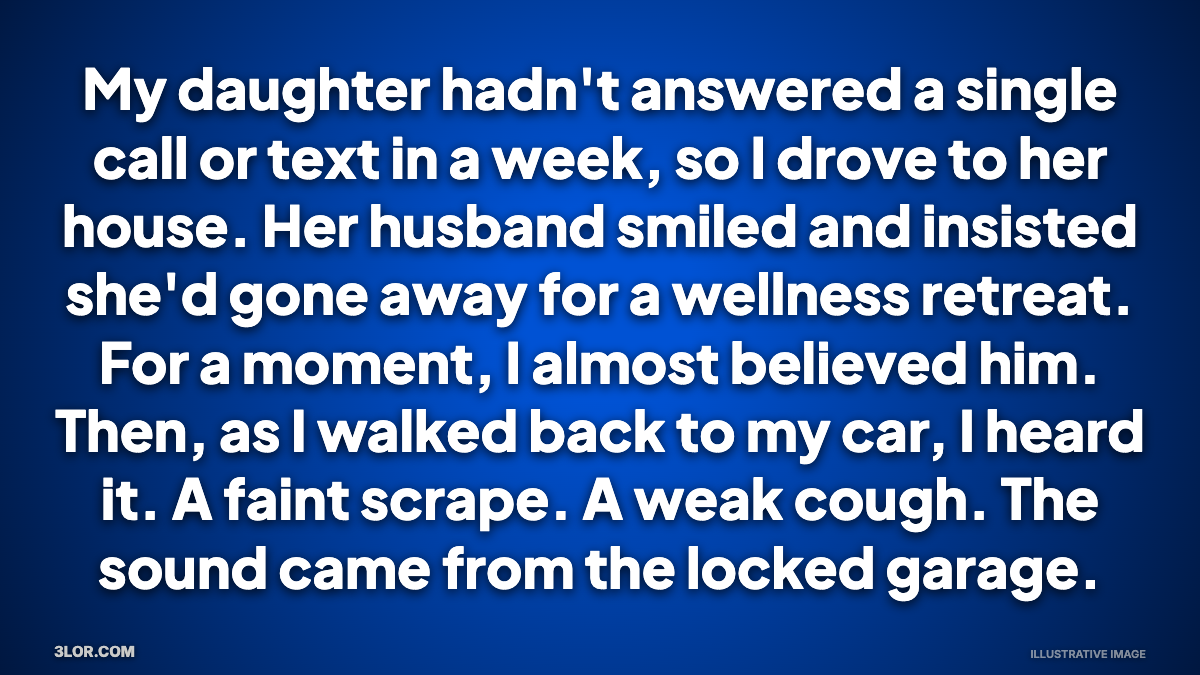
Three scrapes. A pause. Three more.
Not an animal. Not a building settling. A rhythm. A person who had heard my voice and was spending the last of her strength answering it in the only language she had left.
Every instinct I owned screamed at me to throw myself at that door. Thirty-four years of courtrooms screamed back: a locked garage, a smooth husband, and a hysterical mother-in-law is not probable cause — it’s a family dispute, and family disputes get women like Rachel killed by men like Nolan while everyone is still deciding.
So I did the hardest thing I have ever done. I stepped back into the rain, and I dialed 911 with a prosecutor’s voice.
“I’m a retired district prosecutor. I’m reporting a possible unlawful imprisonment. I can hear a person inside a locked residential garage, responding to my voice with deliberate sounds. I need units now, and I need them quiet.”
Four minutes. It remains the longest four minutes of my life. I stood in that alley with my palm still remembering the cold of the door, and I talked to my daughter through six inches of wood in a voice I made stay calm.
“Baby, it’s Mom. Don’t spend it all. Just — when the cars come, you scrape. Save it for the cars.”
The first officer was young enough to be my grandson. Nolan met him on the porch with the smile already installed, a glass of wine in his hand like a prop.
“Officer, I’m so sorry. My wife is at a wellness retreat in— my mother-in-law is having an episode. She’s been calling everyone. Rachel’s fine.”
“Then you won’t mind opening the garage, sir.”
“It’s just tools. Lawn equipment.”
“The lock is brand new,” I said quietly. “And his wife has not been seen or heard from in seven days. And her sister-in-law is inside right now wearing Rachel’s favorite cardigan — the one Rachel never lends, because her mother embroidered it.”
Nolan’s smile did the thing it had done in the hallway. It stopped reaching his eyes.
The young officer looked at the garage. Looked at me. And I asked for the only thing I needed.
“One minute,” I said. “Everyone. Just be quiet for one minute.”
Rain on the roof. Rain on the gutters. A dog, streets away.
Then — faint, deliberate, unmistakable —
Scrape. Scrape. Scrape.
The officer’s hand went to his radio before the third one finished.
They cut the padlock with bolt cutters from the cruiser.
I will not describe everything in that garage, because some of it belongs to my daughter and not to the internet. I will say: a mattress on the concrete. A case of water bottles, most of them empty. A bucket. And my Rachel — seven days thinner, wrists rubbed raw, voice gone almost to nothing from the first two days of screaming into a fan vent that wasn’t running — lifting her head off that mattress like it weighed a hundred pounds.
“Mom,” she tried to say.
Nothing came out. She mouthed it.
It was enough. It was the most enough thing in the world.
Later — days later, in a hospital room with flowers she’d actually get to smell — she told it in pieces.
She’d found the second set of books. Nolan’s “consulting income.” The accounts in her name she knew nothing about. She’d told him she was done — done with the marriage, done being the confused, emotional wife in his story — and that she was calling a lawyer in the morning.
He’d smiled. The same smile.
He’d told her she was overwrought and needed to lie down in the guest room, and somewhere between the hallway and that smile she’d understood the glass of wine at dinner had tasted wrong. She woke up in the garage.
Seven days of him visiting at night with water and that soft, reasonable voice. Sign the papers, Rachel. Admit you made the transfers. We say you had a breakdown, you get help, nobody goes to prison. Or stay here until you see it clearly.
And Tessa — Tessa, who brought the bottles twice, crying through the door. Tessa, who’d worn Rachel’s cardigan because Nolan told her to be seen in it around the neighborhood, “so people think she’s been around.” Tessa, who was twenty-six and terrified of her brother the way Rachel had learned to be. She is cooperating with the prosecution now. I have opinions about Tessa that I keep to myself, because my daughter has asked me to, and my daughter has earned the right to decide a great many things from now on.
Nolan is in county jail awaiting trial. His lawyer says the word “misunderstanding” a lot. I spent thirty-four years listening to men like him explain women like us, in rooms built for exactly that purpose.
This time, he explains it to a jury. I find I can be patient about that. I have become, in my retirement, a very patient woman.
Rachel came home to my house first. Then, one grey Tuesday, to her own — with new locks, a new phone, and a dog she’s still deciding about.
Last night, at 11:47, my phone lit up on the nightstand.
Love you, Mom.
I read it eleven times before I answered.
The sound wasn’t a scream. It was worse — it was almost nothing at all. A scrape in the dark, under the rain, that the whole world would have walked past.
A mother wouldn’t.
I almost did. I will hear it in time, every time, for the rest of my life.
This story is fiction, written with AI assistance. Any resemblance to real persons or events is purely coincidental.