“You’re lying.”
The silence on his end lasted three full seconds. I counted them the way I used to count pauses in witness testimony — the small gaps where the truth tries to get out.
“Elaine,” he said at last, his voice lower now, the charm switched off like a lamp. “Go home.”
“Open this garage, Nolan.”
“I don’t know what you think you heard, but—”
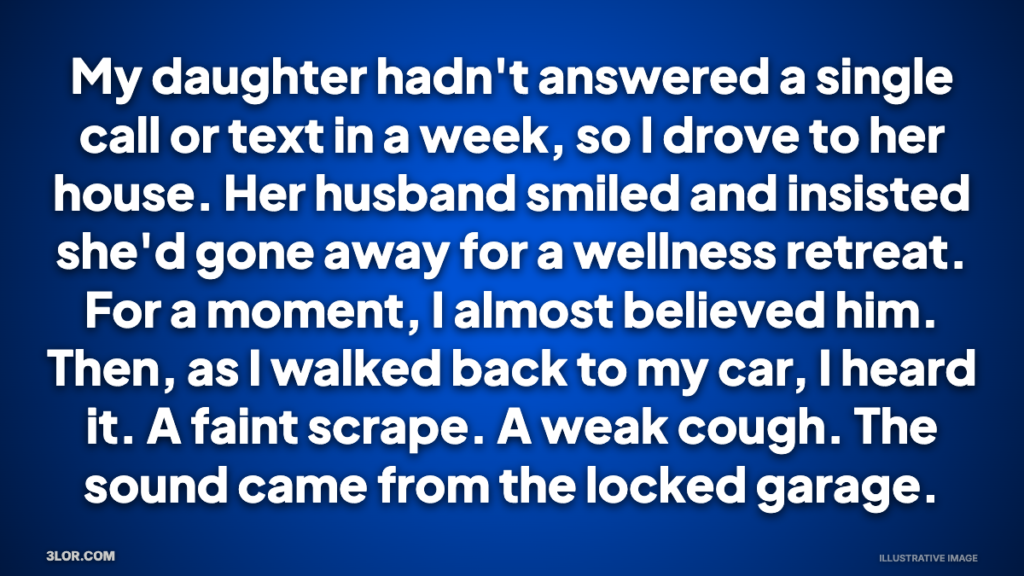
“I heard my daughter.”
I ended the call before he could answer. My hands were shaking — not from fear, from fury — and it took me two tries to dial 911. Thirty-four years in a courtroom teaches you how to sound calm when you are anything but.
“My daughter is locked inside a garage,” I told the dispatcher, giving the address. “She’s been missing for seven days. I can hear her inside.”
Two officers arrived in eleven minutes. I have never been so grateful for rain — it kept the street empty, and it kept Nolan from seeing the cruiser until the headlights were already in his driveway.
I met them at the curb and told them everything in ninety seconds, the way I’d want a witness to tell it to me: the missing week, the deleted message, the new padlock, the sounds. One of them, a young woman with her hair pulled back tight, pressed her ear to the garage side door. Ten seconds passed.
Then she heard the cough too.
They knocked on the front door of the house. Nolan answered in a robe, barefoot, performing confusion so hard it was almost insulting. And behind him stood Tessa — no longer wearing Rachel’s cardigan. She’d changed clothes in the eleven minutes since I’d called. Consciousness of guilt has a wardrobe.
“Sir, we need you to open the garage,” the officer said.
“I lost the key,” Nolan said smoothly.
“Then we’ll open it without one.”
“You can’t do that without a—”
“We heard a person in distress inside,” the young officer cut in. “That’s exigent circumstances. Step back, please.”
Nolan’s face did something then that I’ll remember for the rest of my life. The charm didn’t fade. It collapsed — like a tent with the poles kicked out. Underneath it there was nothing but a cornered animal doing math.
The fire crew arrived with bolt cutters six minutes later. The padlock — thick, new, completely unnecessary for garden tools — gave way with a sound like a bone snapping. The officer rolled the door up.
The smell hit first. Damp concrete and urine and stale air. A thin mattress lay on the floor. Three empty plastic water bottles were scattered near it, and one was still rocking slightly, as if something had nudged it moments before.
Rachel was curled on her side on the mattress, knees drawn up. Her hair was matted. Her lips were cracked white. Around both wrists were angry red lines where something — zip ties, the paramedic said later — had bound them until she’d worked them loose or they’d been cut.
She turned her head toward the light.
“Mom?”
I don’t remember crossing the garage. I remember her weight against me, too light, and her whispering, “You came,” like she hadn’t been sure anyone would.
At the hospital, once the IV was in and some color had come back to her face, Rachel told the detective everything. The Tuesday before, she’d found bank statements Nolan had hidden — their joint savings, drained to almost nothing over two years. When she confronted him and said she was leaving, that she’d already spoken to a divorce lawyer, he didn’t yell. He never yelled. He just took her phone, walked her out to the garage “to talk,” and locked the door behind him.
He called her office from her phone and requested personal leave. He deleted the message she’d managed to send me before he took it. He told everyone who asked that she was at a wellness retreat, and he almost made it sound boring enough to be true.
Tessa broke in the hallway while the paramedics worked. She’d known for three days. Nolan had told her Rachel was “having a breakdown” and needed to be “kept somewhere quiet until she calmed down.” Tessa was the one who slid the water bottles under the door at night — which is why Rachel was alive at all. She wore the cardigan, she sobbed to the detective, because she’d grabbed it from Rachel’s closet telling herself her sister-in-law didn’t need it right now. There are some sentences a person says out loud and then has to live inside forever.
The ventilation fan? Nolan had disconnected it the same day he bought the padlock — cut the power so no airflow would carry sound out through the vent. Premeditation, the detective wrote in his notebook, underlining it twice.
Nolan Pierce was arrested that night. Tessa was charged as an accomplice; her lawyer is already talking cooperation.
Rachel is still in the hospital as I write this. She’s weak, she’s angry, she’s alive. Yesterday afternoon, a nurse brought her a replacement phone, and the first thing she did — the very first thing — was text me.
Love you, Mom.
Thirty-four years I spent as a prosecutor, learning to read people the way other people read books. I never imagined I’d need every bit of it for my own daughter. And I keep thinking about that moment by my car, in the rain, when I almost dismissed the scrape as an old building settling.
A mother wouldn’t.
This is a fictional story. The characters and events are imaginary. The text was written with the assistance of artificial intelligence.