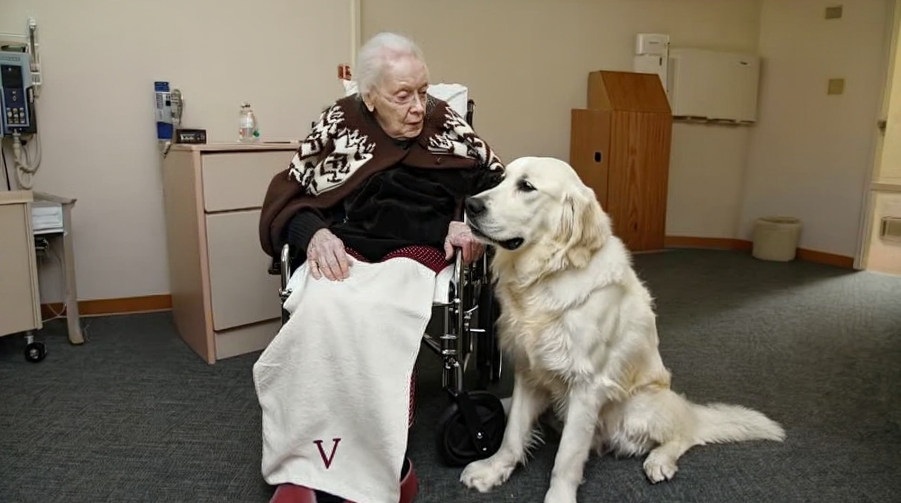
She’s 97. Sharp as ever, stuck in that wheelchair after the fall. We visit once a week, perhaps twice. But lately, it’s not us she’s been waiting for—it’s the dog.
He’s not part of the facility’s therapy program. No vest, no handler. He appears at 3:40 p.m. precisely, sits by her door like he owns the place, and lets her rest her hand on his head as if it’s the most natural thing in the world.
The staff say they’ve never seen him enter. He doesn’t eat, doesn’t bark, merely waits.
The most peculiar aspect is what she says to him.
Last Tuesday, I caught her whispering, “Colonel, you’re late. The envelope went to the wrong sister.”
I laughed, thinking it was a memory slip—she only had one sister.
But then she looked straight at me and said, “I meant the sisterhood. The other V.”
She tugged the corner of her lap blanket. Embroidered on it, by her knee, was a single letter: V.
I thought it was her monogram.
But today, when the dog left, I followed him. Down the hallway, past the nurses’ lounge, to a stairwell no one uses.
He scratched at a loose panel in the wall. I pulled it open.
Inside was a narrow, dusty compartment. Old wiring. A rusted switchboard. And… a box. Wooden, with a symbol on it. The same V. Burned into the top like a brand.
The dog—Colonel—sat beside me, simply staring. No growling, no anxiety. As if he was waiting for me to act.
I lifted the box out carefully. It wasn’t locked, simply heavy with time. Inside were old letters, a faded photograph of five women in military-style coats, and a badge—brass, round, with the same V in the middle and the words “Veritas Unit” around it.
I stared, heart pounding.
Veritas.
Truth.
My great-aunt never discussed her youth. She claimed it was uneventful. But now, in my hands, was the beginning of something entirely different.
I brought the box back to her room. Colonel followed, quiet as a shadow.
She saw it in my arms and smiled as if I’d brought her a long-lost friend.
“I thought it was gone,” she whispered. “I thought it died with Vivian.”
I sat down, placed the box in her lap. “Aunt Mae… what is this?”
She ran a finger along the edges of the photo. “It was never only me and one sister, dear. ‘Sister’ held a different meaning.”
She looked at me, eyes clear.
“We were the Veritas Unit. Five women, one goal. Expose lies. Not with guns, but with proof.”
It sounded wild. Unreal. But the box was real, and so was the weight in her voice.
“We were never official,” she said. “Never in the books. But during the war, things couldn’t go through channels. Truths needed leaking. Secrets that saved lives.”
I blinked. “You were spies?”
She chuckled. “Not spies. Historians who acted like spies.”
She lifted the badge. “We were stationed across Europe, but our work was mostly quiet. Letters. Evidence. Sometimes the truth was more dangerous than any bomb.”
She reached into the box, pulled out a folded envelope.
“This one never reached the right hands. Vivian—she was the last one who could’ve delivered it. But she died in Prague.”
I watched her eyes glaze over, memories returning.
“She was brave. All of them were. But after the war… well, secrets got buried.”
I opened the envelope carefully. Inside, a single page with coded text. On the back, a list of names. All crossed out, except one: Eliza Vaughn.
I didn’t recognize the name. But Aunt Mae did.
“She was the journalist. The one we trusted.”
I frowned. “And this letter?”
“Proof of a betrayal,” she said simply. “A cover-up that cost hundreds of lives.”
I asked if it still mattered now, nearly 80 years later.
She looked out the window, at the fading sun. “The truth always matters.”
That night, I went home with the box. Couldn’t sleep.
I started researching Eliza Vaughn. It turned out, she had disappeared in 1951. Official records stated “accidental drowning,” but the body was never found.
I followed the names on the list. Most were long dead. But one caught my eye—Senator Bernard Kellin. Still alive. Ninety-two. Living in Vermont.
The name resonated. He was praised for his “wartime service,” but something in Aunt Mae’s letter painted him differently.
I wasn’t sure what to do. Contact a journalist? The police?
Instead, I took the box to an old friend—Nadia. Investigative reporter. Smart, skeptical, and sharp.
She didn’t laugh. Didn’t roll her eyes. She read through everything quietly.
When she looked up, her face was pale. “This… if this is real, it rewrites history.”
We spent the next few weeks digging. The documents were old, but authentic. The badge traced back to a black ops group rumored in obscure military logs. And the code in the letter? Cracked by a World War II hobbyist in Germany we found through Reddit. It referred to a series of falsified troop movements that led to the bombing of a refugee site—blamed on the Axis at the time.
But it wasn’t.
The documents showed someone on the Allied side had made a strategic decision. An ugly one. Sacrifice the camp to make it look like enemy cruelty. Stir up international support. Classic manipulation.
Nadia wrote the piece. Carefully. Fact-checked it three times. Didn’t use my name or Aunt Mae’s. Only the initials—V Unit.
When it published, it shook the internet. Not viral in a pop-culture sense. Viral in a “holy hell” kind of way. Historians started talking. Then a university reached out. Then NPR. Then the BBC.
Three days later, I got a call from Senator Kellin’s office.
He wanted to meet.
I hesitated. But Aunt Mae said, “Let him face what he ran from.”
So I flew to Vermont.
He was frail, thin as twigs, sitting in a leather chair by a fireplace that looked barely used.
He didn’t deny it.
Didn’t even flinch.
“Your great-aunt,” he said softly, “was one of the only ones who refused the hush money.”
I asked why he did it.
He shrugged. “We thought we were saving the world. But the truth? We were afraid of appearing weak.”
He looked at the flames.
“There’s no fixing it now.”
I left without shaking his hand.
Back home, the article had taken on a life of its own. Schools started including the Veritas Unit in war history lessons. A documentary was announced. And Aunt Mae?
They gave her a medal. Posthumous, they said.
But she was still alive.
We accepted it.
Colonel still visited. Every day, same time.
One day, I asked Aunt Mae where he came from.
She smiled. “He found me after Vivian died. Walked right up to me as if he knew.”
I laughed. “You think he’s a ghost?”
“No,” she said. “I think he’s a promise.”
A week later, Aunt Mae passed away. Peaceful. Colonel was there, curled at her feet.
After the funeral, he vanished. No one saw him again.
I sometimes wonder if he was real. But then I look at the photo, the badge, the box on my shelf.
He was real enough.
Months later, I got a letter in the mail. No return address. Inside was a key, and a note: “Truth has roots. The other V still watches.”
The key fit a safety deposit box in Vienna.
Inside, a journal. Vivian’s.
It held more than memories. Names. Codes. Another list.
And a message.
“If someone’s reading this, it means truth survived. Use it. Kindly.”
I donated the contents to the museum handling the Veritas exhibit. Except one item.
The photo of the five women.
I keep it on my desk.
They look happy. Brave. Alive.
And in the corner, barely noticeable… a dog. Sitting beside Vivian.
Same face. Same eyes.
Colonel.
Some stories don’t require explanation.
They need telling.
Aunt Mae lived a quiet life to the world. But inside her, a storm of courage.
She didn’t fight with bullets. She fought with truth.
And when the world forgot, a dog reminded her.
Here’s what I learned: Truth always finds a way back. Even if it takes a dog, a dusty box, and a few brave women to bring it home.
So tell your stories. Ask questions. Follow the dogs.
And never assume someone’s best years are behind them.
Sometimes, they’re finally being heard.