I didn’t file for divorce that afternoon.
I made an appointment with an attorney.
There is a difference.
I brought the deed, our tax records, screenshots from the bank, and nine years of paperwork I’d kept because Travis hated throwing anything away but hated filing it even more.
The attorney looked at the deed first.
“This came from your father’s estate?”
“Yes.”
“And Travis was never added?”
“No.”
She nodded.
“Then don’t sign anything concerning this property without legal advice. And don’t assume the house and the marital finances are the same issue. They aren’t.”
That was the first useful thing anyone had said to me all day.
We spent the next week figuring out what had actually happened.
Travis hadn’t made us broke.
He had made me think we were broke.
There were accounts I hadn’t known about. Regular transfers. Bonuses he’d described as “not much this year.” Credit-card statements going to an email address I couldn’t access.
Some of the money was ordinary spending.
Some wasn’t.
A storage unit held a boat he’d bought with a friend eight months earlier.
The boat explained quite a few conversations about why we couldn’t afford a new washing machine.
I didn’t call him.
I opened an account in my own name, redirected the income that was mine, changed passwords on everything I legally controlled, photographed the property and its contents, and followed my attorney’s instructions.
Then I waited for Travis’s hitch to end.
Seventeen days after that phone call, his truck came up the gravel drive.
I was on the porch.
He got out carrying his offshore bag.
“Why doesn’t my key work?”
“I changed the locks.”
He stared at me.
“You changed the locks on my house?”
“My house is an interesting choice of words.”
That wiped the smile off his face.
I handed him an envelope.
He opened it.
He read the first page, then looked at me.
“You filed?”
“Yes.”
“Over a bank account?”
“No.”
He laughed, but there wasn’t much humor left in it.
“June, come on. You’re really doing this?”
I had imagined that moment several times.
In some versions, I gave him a speech.
I didn’t.
I asked one question.
“How much did the boat cost?”
His face answered before he did.
“Who told you?”
“Nobody had to.”
He dropped his bag onto the porch.
For the next ten minutes, Travis explained our marriage to me.
The boat was an investment.
The separate accounts were for tax planning.
He had removed me because I worried too much.
He controlled the money because somebody had to be responsible.
Finally I asked:
“If I was the irresponsible one, why did you need to hide it?”
He stopped talking.
Then he pointed toward the house.
“So what, I’m supposed to leave?”
I told him what my attorney had told me to say and nothing more.
The rest would be handled properly.
That frustrated him more than yelling would have.
For years, every disagreement had ended when Travis became certain enough for both of us.
Now there was nothing to argue into submission.
The divorce wasn’t quick.
And the fact that the deed carried only my name did not magically mean Travis walked away with nothing. Marriage, property and money are more complicated than that.
That’s why I had gone to an attorney instead of taking legal advice from my own anger.
But the house my father left me remained mine.
So did the eleven acres.
Months later, I finally replaced the washing machine.
Nothing fancy.
The delivery men hauled the old one away, and I stood in the laundry room listening to the new machine run without grinding.
It cost less than one of Travis’s watches.
That bothered me more than I expected.
Not because of the money.
Because I finally understood how many times I’d gone without something reasonable while a man earning six figures convinced me that asking for it made me irresponsible.
The following summer, I hired someone to repair the upstairs air conditioner.
I stopped mowing all eleven acres myself too.
Turns out I never enjoyed that.
I had simply become proud of needing very little because needing very little kept the peace.
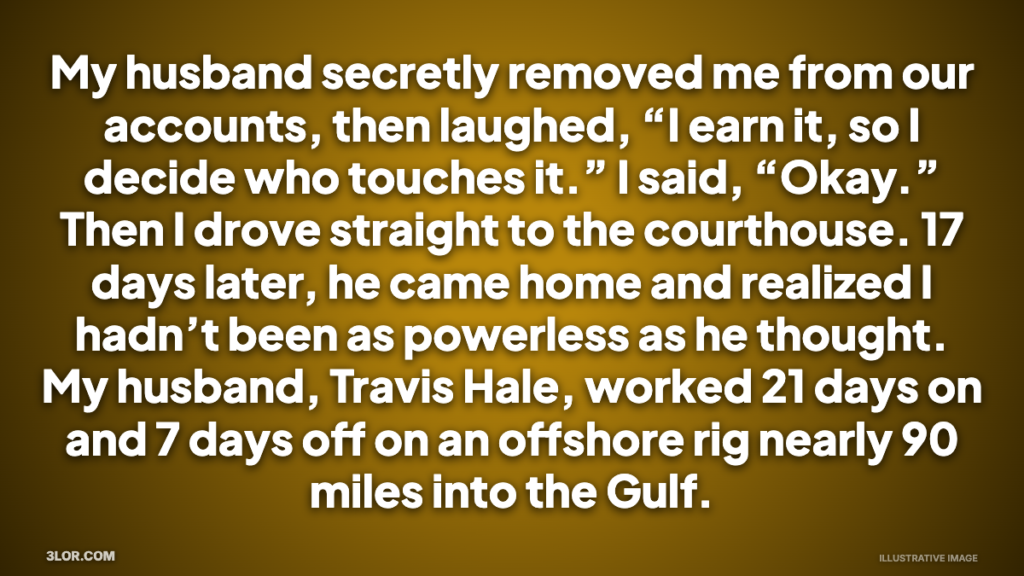
Travis once told me, “I earn it, so I decide who touches it.”
He was right about one thing.
Money does give people choices.
He just hadn’t noticed I still had some of my own.
This is a fictional story. The characters and events are imaginary. The text was written with the assistance of artificial intelligence.