When my husband told me he wanted a divorce, he did it without meeting my eyes.
It was a quiet evening in early October.
The soup on the stove was still simmering, filling the kitchen with the familiar scent of onions and rosemary.
Upstairs, our daughter Emma was finishing a school project, surrounded by paper, glue, and far too much glitter.
Everything felt ordinary.
The kind of ordinary that makes you believe your life is steady.
Even when something beneath the surface has already started to shift.
“Nora,” he said from the doorway, his phone still in his hand, his tie loosened though still in place.
“This isn’t working anymore.”
I turned toward him slowly.
“What isn’t?”
“Our marriage.”
The words landed with a weight I was not ready to carry.
Twelve years reduced to a single sentence.
At first, I thought it was stress.
Work had been demanding.
He had been distant for months.
Long hours at the office, short answers at home, a growing silence between us.
I told myself that relationships go through difficult periods.
That distance could pass.
I trusted time more than I trusted the uneasy feeling building inside me.
“I think we should separate,” he continued.
“I’ve already spoken to a lawyer.”
That word stayed with me.
Already.
It meant decisions had been made without me.
Before I could respond, Emma appeared at the kitchen entrance.
She held her notebook close, her expression careful and observant.
“What’s going on?” she asked.
Neither of us answered quickly enough.
Children understand more than we expect.
The months that followed felt distant and controlled.
Daniel moved out gradually, first into another room, then into another place.
Legal documents replaced conversations.
Our life became numbers, schedules, and terms written on paper.
Words like fairness and respect were used often.
They felt hollow.
Emma changed in quieter ways.
She spoke less, observed more.
She carried her thoughts without sharing them.
One evening, I sat beside her and tried to open a conversation.
She answered carefully.
When I asked if she was upset, she said she was.
When I asked if it was about her father, she said it was about both of us.
She told me I kept saying everything might be for the best.
She said it was not.
Then she went back to her book.
The court date arrived weeks later.
That morning, Emma insisted on coming with me.
I hesitated, though something in her voice made it difficult to refuse.
She was calm, certain, and unusually steady.
In the end, I allowed it.
The courtroom felt colder than expected.
Daniel was already there, composed and prepared.
He glanced at Emma and said she should not be present.
I told him she had insisted.
He seemed irritated, though controlled.
The hearing began.
The judge reviewed documents, agreements, and proposed arrangements.
Everything was structured and formal.
Emma sat quietly behind me, hands resting on her backpack.
I answered questions as they came.
So did Daniel.
It felt like speaking from a distance.
Then something shifted.
I heard a chair move.
Emma stood up.
At first, I thought she needed a moment away.
Instead, she walked forward.
“Emma,” I said quietly, trying to stop her.
She continued.
She stood facing the judge, small in the large room, though steady.
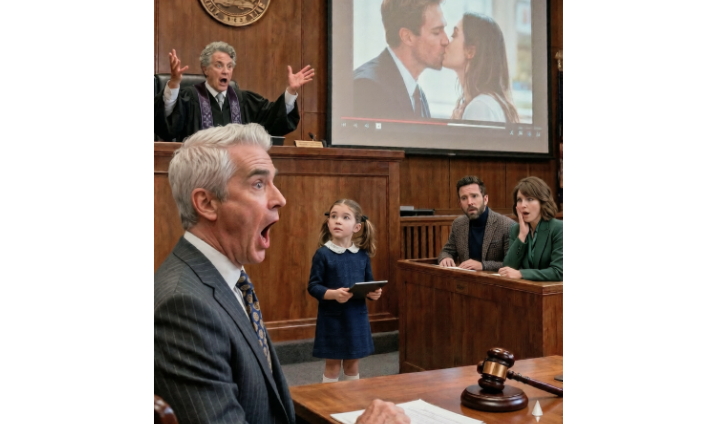
“Your Honor,” she said clearly, “may I show you something?”
The room grew still.
The judge paused, then agreed.
Emma reached into her bag and took out a tablet.
She glanced at me briefly.
“I’m sorry,” she said softly. “You needed to know.”
Then she pressed play.
At first, there was only sound.
Voices. Laughter. Movement.
Then the image became clear.
Daniel was sitting in our living room.
Not alone.
With another woman.
In our home.
The moment felt unreal.
Everything else faded.
The room, the people, the sound of voices.
All of it disappeared behind what I was seeing.
Emma explained quietly when she found the recording.
She had seen it weeks earlier.
She had kept it, waiting for the right moment.
She had carried that knowledge alone.
The judge’s tone changed.
The atmosphere in the room shifted completely.
Daniel tried to respond, though his words carried no weight.
The truth had already been shown.
What followed was not dramatic.
It was quiet, though final in its own way.
The hearing changed direction.
The assumptions that had shaped the case no longer held.
Outside the courtroom, I sat down, trying to steady myself.
Emma reached for my hand.
I pulled her close, holding her tightly.
She apologized in a small voice.
I told her she had nothing to apologize for.
She had done something difficult.
She had chosen honesty when silence might have been easier.
She had stepped forward when others had stepped back.
In the months that followed, the legal process reached its conclusion.
The outcome reflected what had been revealed.
Though what stayed with me was not the paperwork.
It was that moment.
The moment my daughter stood in a room full of adults and chose to speak the truth.
I had believed I was protecting her.
In the end, she protected me as well.