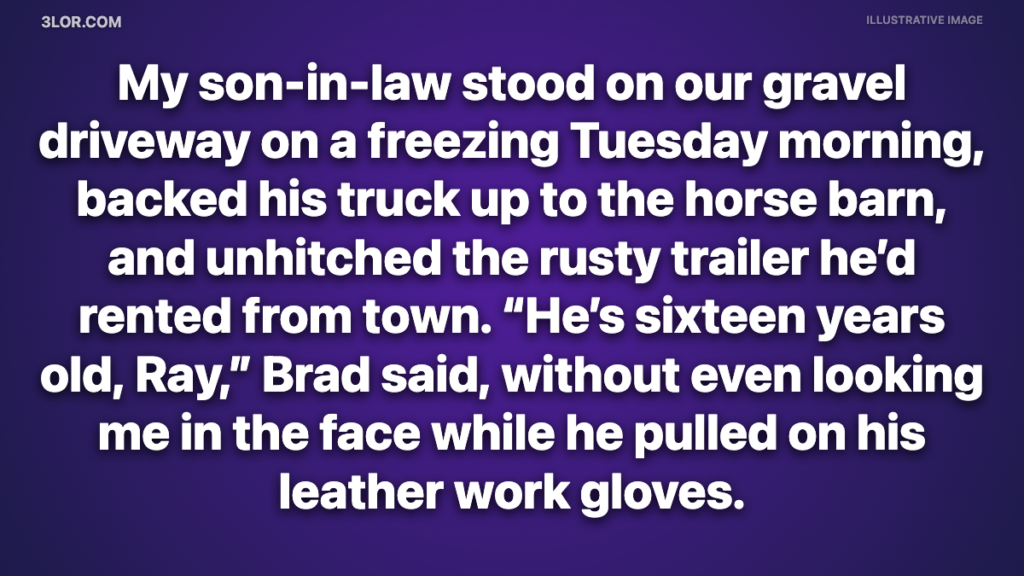
The engine of the rented flatbed cut off forty yards deep into the pine break, but the cooling metal of the manifold kept clicking against the frost.
Brad didn’t look back at the gravel where the yellow trust registration was still pinned under his leather work glove. He looked at the treeline. The man who stepped out from the driver’s side of the unmarked flatbed wasn’t dressed for chores. He wore a navy quilted vest, steel-toe utility boots without a speck of dry manure on the treads, and he carried a clipboard wrapped in clear plastic to keep the freezing drizzle off the carbon slips.
“Ray,” Brad whispered, his voice dropping an octave, losing that flat suburban arrogance he’d brought through my front gate. “Don’t make an issue out of this in front of the contractor.”
“Contractor for what?” I asked.
“He’s from the regional bio-salvage unit out of Fort Collins,” Brad said, the words slipping out too fast, like grease through hot fingers. “They pay forty cents on the pound for draft cross carcasses. If we load him alive, we don’t pay the hauling fee. It was Sarah’s idea. She said she couldn’t stand watching him drag his hocks through the pasture another winter.”
Behind the wire, Buster shifted. The old gelding didn’t look at Brad. He pressed his scarred shoulder hard against the cedar post, his nostrils flaring wide, pulling the smell of diesel and rendering tallow that always clings to those salvage trucks. Animals know what iron smells like when it’s been washed with lye.
The driver walked up the path, his boots crunching on the frozen ruts. He didn’t say good morning. He looked at Brad, then at the barn.
“Is the animal down or standing?” the man asked.
“Standing,” Brad said quickly. “Gate’s unchained. Let’s just hook the lead and get the ramp down.”
“Nobody touches that latch,” I said.
The driver stopped three feet short of the split-rail. He wasn’t a family man looking for an argument; he was an hourly employee working under a state livestock transport manifest. He looked down at the paper pinned under Brad’s thumb on the truck hood.
“You got the brand inspection slip?” the driver asked Brad.
“I have the power of attorney,” Brad said, pulling a folded legal packet from his back pocket. “Registered with the county probate clerk last Tuesday. Land, improvements, and all agricultural assets.”
“Let me see that carbon,” I told the driver.
I didn’t wait for Brad to hand it over. I picked up the yellow slip he’d tried to cover. It wasn’t just a bill of sale. It was an irrevocable deed of transfer recorded in Garfield County in the spring of 2012, forty-eight hours after the flash flood that took my wife, Martha, downstream past the county culvert.
Martha hadn’t died in that water. She lived five more weeks in the regional burn unit with septic pneumonia, her lungs full of river silt. And during those five weeks, while her daughter Sarah was busy dividing up the cedar furniture and picking out paint swatches for the master bedroom, Martha had the hospital notary come up to the third floor twice.
The driver took the yellow sheet. He pulled a small penlight from his vest pocket, clicked it on, and held the beam steady against the bottom third of the page where the county seal was embossed into the dry paper.
“This ain’t an ag asset,” the driver muttered, his tone shifting entirely.
Brad stepped in close, trying to crowd the man’s shoulder. “He’s livestock on private acreage. Look at the tax code on the county parcel.”
“Read clause four, son,” I said.
The driver traced his thumbnail along the red ink at the bottom margin.
“Livestock identified as ‘Buster,’ unregistered cross gelding, brand left hip lazy-S, is hereby designated a permanent dependent of the Martha Vance Memorial Care Trust. In the event of an attempted transfer, destruction, or sale for commercial rendering, title to Garfield County Parcel 402—comprising four hundred and eighty acres of deeded grazing and mineral rights—shall instantly terminate and revert to the Colorado Land Conservation Board as an unencumbered public wilderness preserve.”
The driver looked up from the plastic clipboard. He didn’t look at me. He looked straight at Brad, his mouth setting into a hard, thin line.
“You didn’t run a title search on the easement, did you?” the driver asked.
Brad’s face had lost every trace of color. The cold wind was whipping his thin cotton work shirt against his ribs, but he wasn’t shivering from the weather. “The lawyer said… the lawyer said the land was held in fee simple once Sarah turned thirty.”
“Your lawyer checked the county assessor’s index,” I told him, stepping past him toward the barn gate. “He didn’t check the grantor-grantee deed rolls because he assumed an old mechanic from the limestone quarry didn’t know how to file a reversionary clause. Sarah’s mother knew exactly who her daughter was going to marry. She knew it the day you showed up at the funeral in a rented Cadillac with a lease application in your glovebox.”
The front screen door of the house banged open against the siding.
Sarah stood at the top of the porch steps, wrapping a wool cardigan around her shoulders, her slippers soaking up the slush on the top riser.
“Brad!” she shouted across the yard. “What is taking so long? The appraiser from Denver is going to be here at eleven to measure the pasture lines!”
Brad didn’t answer her. He looked at the truck, then at the driver, who was already stepping backward down the gravel toward his flatbed.
“Hey,” Brad called out, his voice cracking on the cold air. “Where are you going? We signed the intake order.”
The driver climbed into the cab and reached for his radio mic without even pulling his door all the way shut.
“Intake order’s void on a cloud title,” the driver said through the open window. “And mister, if I were you, I’d get off this gravel before the conservation officer down at the district office sees this dispatch. They don’t give thirty-day cure notices when you try to liquidate trust property. They just padlock the main gate.”
The diesel engine rumbled back to life, tires spitting frozen pea gravel as the heavy truck backed out toward the two-lane highway.
I unhitched the leather halter hanging from the cedar gatepost, walked into the mud of the paddock, and snapped the brass lead onto Buster’s ring. The old horse dropped his head against my chest, his rough winter coat smelling of cedar sawdust and sweet molasses feed.
Sarah came down the porch steps, her thin shoes sinking into the frozen slush, her eyes wide as she saw the empty driveway.
“Where did the trailer go?” she demanded, looking at Brad. “Did you get the bill of sale signed?”
Brad didn’t speak. He just handed her the yellow slip.
She looked down at her mother’s handwriting—the jagged, shaky script from that third-floor hospital room fourteen years ago.
“What did you do, Dad?” she whispered, her voice trembling with that same childish rage she used whenever she didn’t get the keys to the station wagon. “You gave our land to the state?”
“I didn’t give away a single acre, Sarah,” I said, leading Buster toward the warm aisle of the barn where the alfalfa bales were stacked dry to the rafters. “Your mother gave you forty-eight hours to pack your clothes and your husband’s tools before the state troopers come down that dirt road to post the public easement signs. You wanted the house remodeled. Now you can go remodel an apartment in town.”
I pulled the heavy sliding barn door shut, dropped the two-by-four timber into the iron brackets, and left the two of them standing in the gravel while the wind began to howl through the empty pine break.
This narrative is an original dramatization written for entertainment purposes. Names, characters, businesses, legal instruments, and specific incidents have been fictionalized or adapted for dramatic effect. Any resemblance to actual persons, living or deceased, or actual events is purely coincidental. All rights reserved.