THE DAY EVERYTHING CHANGED
The life I thought I understood came apart in the quiet corridor of a hospital.
Moments earlier, I had been pacing back and forth between bright white walls, listening to the steady rhythm of machines and distant footsteps. Every sound felt magnified. Every second stretched longer than the one before it. I remember looking at the clock again and again, convinced that time had slowed down.
Then the doctor walked toward me.
Before he even spoke, something in his expression told me that the future I had imagined would not exist anymore.
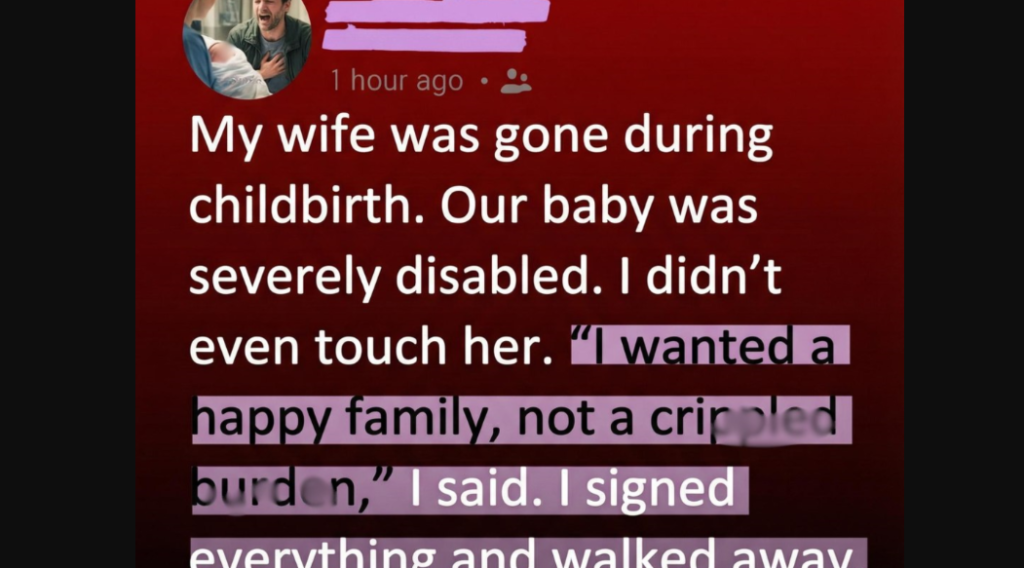
My wife had passed away.
The words echoed through the hallway in a way that felt unreal, as though they belonged to someone else’s story. I struggled to understand them, to fit them into the life we had been building together.
Then the doctor continued.
Our daughter had survived.
But the delivery had been complicated, and she would face significant medical challenges as she grew up.
Within a single afternoon, everything changed.
The woman I loved was gone. The child we had waited for had arrived into a world already filled with uncertainty.
Instead of stepping forward into that moment, fear took control.
Instead of reaching out to hold my daughter, I hesitated.
That hesitation became a decision that shaped the next seventeen years of my life.
A DECISION I CALLED PROTECTION
At the time, I convinced myself that I was not strong enough to face what lay ahead.
Grief clouded every thought. I struggled to imagine raising a child alone while learning how to navigate a future filled with medical appointments, therapies, and responsibilities I felt unprepared to manage.
I told myself that stepping away might protect her from the chaos inside me.
Documents were placed in front of me during those days. Forms and agreements that seemed impossible to focus on while grief filled every corner of my mind.
I signed them without fully understanding the long-term consequences.
Friends tried to reach out. Family members attempted to guide me through those difficult weeks.
Their voices sounded distant.
Instead of facing the pain, I created distance.
Work became my refuge. Long hours filled my schedule. Noise and distraction replaced quiet reflection.
Whenever memories of the hospital returned, I buried them beneath routine.
Birthdays came and went.
Anniversaries passed quietly.
Each year that followed placed more distance between me and the child I had never truly met.
I told myself that others would give her stability that I could not provide at the time.
Yet silence does not erase responsibility.
It slowly magnifies it.
SEVENTEEN YEARS LATER
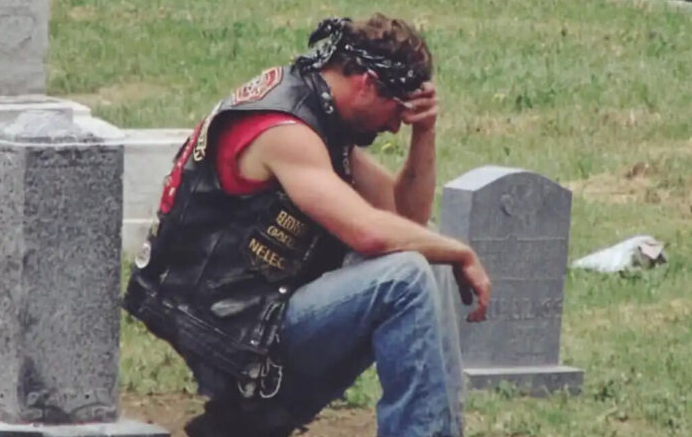
Nearly two decades later, I found myself standing outside the same cemetery where my wife had been laid to rest.
The visit had been delayed for years.
I carried a small bouquet of flowers that felt insignificant compared with the weight of memory I brought with me.
Her name was carved into stone, unchanged by time.
As I traced the letters with my fingers, emotions that had been hidden for years surfaced all at once.
Love had once filled our home with plans and laughter.
Fear had pushed me away from the life we had started.
“I’m sorry,” I said quietly.
The apology carried many meanings.
For the absence.
For the silence.
For the choices that created distance instead of courage.
For the first time since that hospital day, I allowed myself to grieve completely.
Not only for my wife, but for the father I had not become.
LOOKING AT MYSELF HONESTLY
Standing there, I understood something difficult.
Time cannot be reversed.
Seventeen years cannot be reclaimed.
Yet the future still offers choices.
Redemption rarely begins with dramatic actions. It begins with honesty.
It begins with acknowledging what has been avoided.
That realization led me to ask a question I had avoided for nearly two decades.
Who had my daughter become?
LEARNING ABOUT HER LIFE
When I began asking about her, the answers surprised me.
She had grown into a determined young woman.
Challenges had shaped her strength. Medical obstacles had not defined her abilities.
Teachers described her curiosity and persistence. Friends admired her optimism and courage.
The path she traveled had been demanding.
Support from others had helped her navigate that journey.
Hearing these stories filled me with both pride and regret.
Pride for the person she had become.
Regret for the role I had not played during those years.
Still, a new emotion began to appear alongside the regret.
Hope.
TAKING THE FIRST STEP BACK
Reconnecting after so much time requires patience.
It begins with small steps rather than expectations.
I understood that trust cannot be rebuilt instantly. Years of distance require time to understand and process.
What mattered most was honesty.
I no longer hid from the past.
Instead, I accepted responsibility for the choices that created distance.
The journey forward remained uncertain, yet one truth became clear.
Running away had never truly solved anything.
Facing life again brought a sense of peace that had been missing for years.
WHAT SECOND CHANCES REALLY MEAN
The most important lesson I learned did not come from the hospital or the cemetery.
It came from reflection.
Loss changes people in unexpected ways. Fear can guide decisions when courage feels impossible to find.
Growth begins when someone chooses to confront those fears honestly.
I cannot change the years that passed.
Yet I can choose what happens from this moment forward.
Redemption does not demand perfection.
It asks for sincerity.
Whether forgiveness will come remains unknown.
What I know today is simple.
The moment I stopped running from my past, I found the courage to move toward the future again.
And sometimes, that single step becomes the beginning of every second chance.