I was twelve years old when our mother passed away. At that age, life feels steady and dependable, shaped by routines you believe will last forever. That belief dissolved in a hospital hallway filled with harsh light and the sharp scent of antiseptic. Machines hummed softly. Adults spoke in lowered voices, as if volume alone could deepen sorrow.
Among all those memories, one image stands above the rest.
My sister.
She stood beside me at the funeral with her back straight and her shoulders set. Her eyes held no tears. She was nineteen, still growing into adulthood, yet something fundamental shifted inside her that day. As grief rippled through everyone around us, she became calm and immovable.
In a single moment, she stepped into roles she never asked for. She became my guardian, my constant presence, and my sense of safety.
There was no announcement.
No promise spoken aloud.
She moved forward and did what the moment required, quietly and without ceremony.
She left college without telling anyone. She found two jobs. She learned how to stretch groceries far past what logic allowed. She mastered the art of turning exhaustion into a reassuring smile, one convincing enough that I believed her every time she said, “We’re going to be okay.”
And life continued.
That was the story I carried with me.
As the years passed, I focused on school. My sister focused on keeping everything standing. Days filled with textbooks and exams shaped my world. Her days filled with rent, bills, and responsibilities shaped hers. Rest rarely entered her schedule. When it did, she brushed it aside as ordinary tiredness.
I accepted her words without question.
Time moved quickly. I succeeded academically. Teachers noticed. Counselors encouraged me. Letters arrived, one after another. College. Medical school. Residency. Each milestone felt like evidence that everything she had done was leading somewhere meaningful.
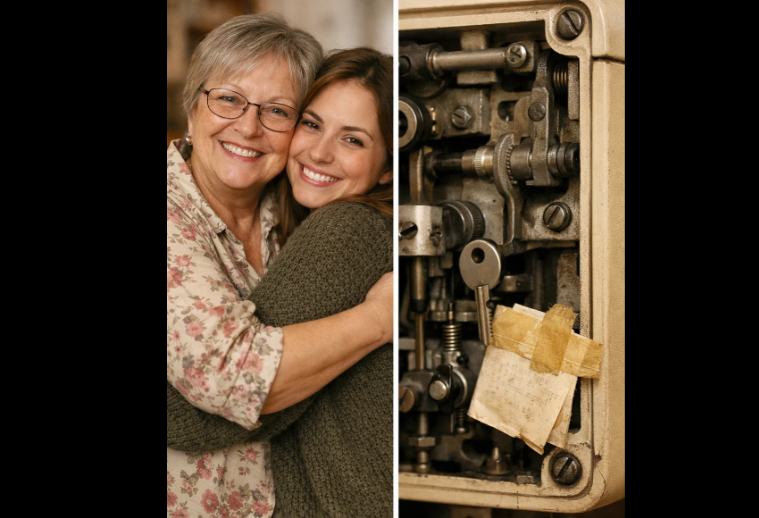
At graduation, dressed in a stiff gown as applause filled the room, I searched until I found her. She sat near the back, clapping gently, pride visible in her expression.
When she hugged me afterward, something surfaced inside me that I did not recognize in the moment.
Fueled by achievement, I spoke carelessly.
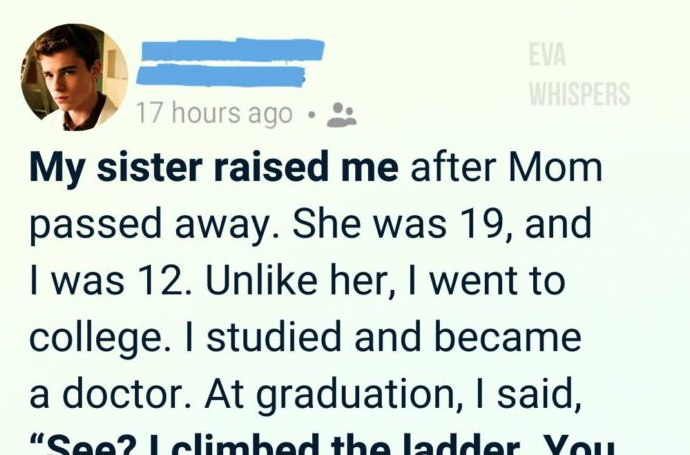
“See? I climbed the ladder. You took the easy road and became a nobody.”
The words fell heavily between us.
For an instant, I expected her to react. She did not. She smiled, small and worn, and said, “I’m proud of you.”
Then she turned and walked away.
Three months passed without conversation.
I told myself she needed time. I assumed distance would resolve everything. My life moved forward with a new job, a new city, and new routines. Guilt appeared occasionally. I pushed it aside. Strength had always defined her. I believed it always would.
Work eventually brought me back to town for a conference. I decided to visit her without notice. I pictured a tense conversation, perhaps forgiveness, perhaps silence.
What I found reshaped me.
The front door stood unlocked. Inside, the house felt wrong immediately. Silence filled every corner. Furniture was gone. Bare walls marked the absence of photographs that once told our story.
A faint sound drew me toward the living room.
She lay on the floor.
Her skin looked pale. Her body trembled. Breathing came shallow and uneven. Pain traced her face in ways I had never seen. She looked small, fragile, as though years of strength had been slowly drained away.
I dropped to my knees and called her name, my hands unsteady as I tried to help her sit up.
She smiled.
“I didn’t want to worry you,” she whispered.
At the hospital, the truth emerged piece by piece. A chronic illness she ignored. Symptoms dismissed. Medications purchased inconsistently. Doctor visits postponed because other needs came first.
Then came the words that altered everything.
“There was never any inheritance,” she said softly. “Mom didn’t leave us anything.”
Confusion filled me.
“The money you thought came from savings,” she continued, “came from me. I wanted you to study freely.”
The missing furniture. The jewelry. Our mother’s belongings. Sold over time, one by one.
Her life had grown smaller so mine could grow.
Every memory shifted. The extra shifts. The exhaustion. The repeated assurances that everything was fine. The smiles I accepted without question.
She had carried pain quietly as I built a future on her sacrifice.
That night, after she stabilized, I stayed beside her bed. When sleep finally reached her, I cried without restraint. The kind of grief that empties you and leaves nothing untouched.
I understood how wrong my measurements had been.
I had defined success through titles and applause. She had lived it through care, responsibility, and endurance.
I had carried pride. She had carried two lives.
When she woke the next morning, I spoke the words that had waited too long. That she was never a nobody. That my path existed because of her. That regret filled me more deeply than language allowed.
“I’m here now,” I told her. “You’re not alone. I take care of you.”
She squeezed my hand. Tears traced her face as she smiled the same familiar, tired smile.
In that moment, I learned what no classroom ever taught me.
True greatness does not seek recognition.
It shows up early.
It stays when others leave.
It holds everything together quietly.
Her love shaped my future.
It also taught me what real success looks like, and restored my faith in the power of kindness.