I was finishing my shift report, half-zoned out, coffee gone cold, when I heard the door buzz open. A little pair of shiny shoes padded across the floor, followed by a soft, determined voice.
“I need to talk to Officer Delgado. He’s my dad.”
We all looked up.
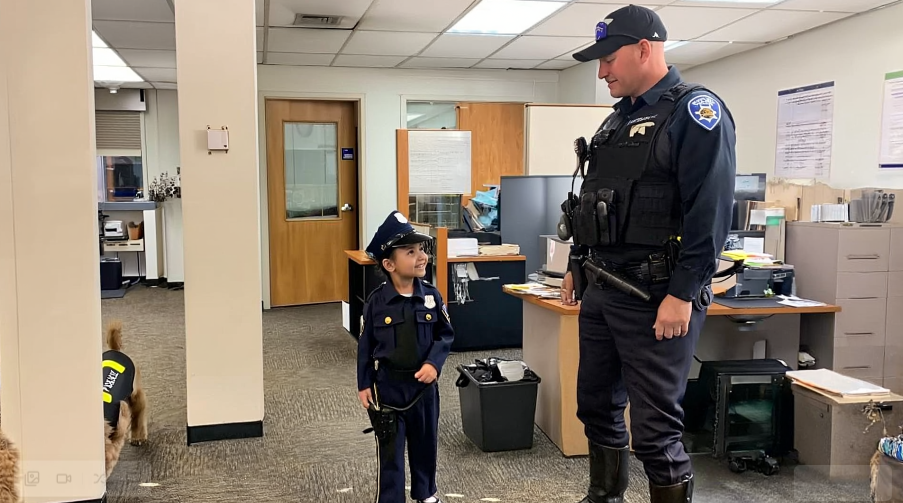
There she was—perhaps five years old, in a perfectly pressed kid-sized police uniform, badge and all. Holding a teddy bear in one hand and a serious expression on her face. Officer Delgado nearly dropped his coffee when he saw her.
“Amara?” he blinked.
She nodded. “Mom said to bring you this bear because you forgot it. Also, we need to talk.”
We all laughed at first—she looked so official, it was hard not to. But Delgado’s smile faltered when he crouched down and whispered something to her. She whispered something back. I couldn’t hear what they said, but I saw his whole face change.
He stood up very fast after that. Eyes on the clock. He tossed his coffee, grabbed his coat—and didn’t say a word to any of us.
Then I saw Amara glance at his phone on the desk. The screen lit up with a message that made my stomach twist.
And it wasn’t from her mom.
The message simply read: “She knows. Call me. Now.”
It came from a number saved under an initial—“L.”
I wasn’t sure what bothered me more: the cryptic tone or the fact that Amara had come alone, dressed like that, with eyes that looked too grown-up for her age.
As soon as Delgado left with Amara, the room buzzed with questions. But no one dared ask them out loud. We respected Delgado. Quiet, hardworking. Never brought his personal life into the station.
But something about today felt different. And it didn’t sit right with me.
I waited until my shift ended, then checked the entry logs. Amara had come in from the east gate—closest to the city bus line. No adult with her.
She’d come alone.
That wasn’t only strange. That was dangerous.
Curiosity gnawed at me, so I did what I probably shouldn’t have. I checked the number that sent the message. Turns out “L” was registered to a Leila Rivera. No address listed in the system, but a quick cross-check with dispatch notes from last year turned something up—a domestic disturbance report.
Filed by Delgado himself.
That’s when things really stopped making sense.
Delgado had always said Amara’s mom—Sandra—was a schoolteacher. That they split up when Amara was a baby, but kept things amicable. He never mentioned a Leila. Never even hinted at any trouble.
But if this Leila was someone from a domestic case, and she knew Delgado well enough to send a text like that… then why did Amara say her mom told her to come?
I couldn’t let it go.
The next day, Delgado didn’t show up for work. He called out, which he never did. Said he had “family stuff” and would be back on Monday.
But Monday came and went.
By Wednesday, his voicemail was full. And the precinct started getting calls—from concerned neighbors.
No one had seen him or Amara since Friday afternoon.
It was Thursday morning when I made a decision. Not official, not authorized. Only… human.
I drove out to Delgado’s house.
The front lawn looked untouched. Mail piling up in the box. Lights off. I knocked. Waited. Nothing.
I was about to leave when I heard something—a faint tap from inside.
I pressed my ear to the door. Silence.
Then again: tap… tap… tap.
I called it in. Didn’t break the door down—protocol, you know—but I waited for backup. When we finally got inside, the house was cold. Too cold for July. Windows shut tight. Curtains drawn.
The place looked… abandoned. But not ransacked. More like someone had left in a rush.
In the living room, we found the teddy bear. Lying face-down next to Delgado’s badge.
Upstairs, Amara’s room was empty. Neat. Too neat.
But in the master bedroom, we found a note. One line, written in neat handwriting on the back of a torn envelope:
“You’ll never take her from me again.”
It was signed, “L.”
I froze.
It wasn’t a family issue. It wasn’t Delgado taking time off.
Something was very, very wrong.
The official search began that night.
Amber Alert went out for Amara. Delgado was flagged but not yet listed as a suspect. Only “missing with child.”
Still, whispers spread.
People wondered if he’d snapped. If he’d taken her and run.
But I didn’t believe that.
Not for a second.
Delgado had been quiet, yes. But never unstable. And the way Amara looked at him that day—trusting, calm—it didn’t match the story people were telling.
I kept thinking about the uniform. Why had she worn it?
And the bear. Why bring it?
Unless it wasn’t hers.
Unless it was a message.
Two days later, we got a call from a woman in a small mountain town about three hours north. Said she ran a roadside motel. Thought she recognized a guy and his daughter from the news.
By the time we got there, the room was empty.
But the clerk handed me a sketch Amara had left behind. A crayon drawing of two people—her and her dad—standing near a tree with a swing. In the corner, a little figure in a black dress with big red lips and no eyes.
It sent a chill down my spine.
But the drawing gave us something: the tree. The swing.
The motel was close to a campground Delgado used to talk about. He once said it was “his spot” when life got too loud. Said Amara learned to fish there.
We took a chance.
When we found them, they were camped deep in the woods. Delgado had built a small shelter, was cooking over a fire when we arrived. Amara was sitting beside him, holding the bear, humming softly.
He didn’t run. Didn’t fight. Looked at us and said, “Please—let me explain.”
And we did.
We sat by that fire for almost two hours while he told us everything.
Leila Rivera wasn’t his ex. She was his former foster sister.
They grew up together in a rough group home. She was older, tough, and for a while, she protected him.
But as they got older, Leila changed.
Controlling. Possessive.
He left the home at eighteen. Joined the force. Cut all ties.
Years later, she showed up again—this time claiming she was Amara’s mother.
Only, she wasn’t.
Delgado had full custody because Sandra, Amara’s actual mom, had passed when Amara was a baby.
But Leila started showing up at the school. At the playground. Talking to Amara. Telling her strange things.
Delgado filed a restraining order. It worked for a while.
Until it didn’t.
Two weeks ago, he started getting messages. From fake numbers. Threats. Then one night, he came home and found Amara’s bedroom window open—and her teddy bear gone.
He knew it was Leila.
She was testing the waters. Seeing how far she could go.
When Amara showed up at the station in uniform, she wasn’t acting cute.
She was trying to warn him.
Leila had found them again. Had come to the house. Told Amara not to tell anyone or “something bad” would happen.
But Amara was smart. She dressed in the little uniform he’d bought her for playtime, walked herself to the station—and gave him the only clue she could: the bear.
That’s why he left in such a hurry.
Not to run from the law—but to protect his daughter.
The department didn’t know what to do at first. Technically, he’d taken a child across county lines without permission. But considering the restraining order, the threats, the past reports…
And the fact that two days later, Leila was arrested for trying to break into a school in another district—carrying a knife and a notebook full of scribbled drawings of Amara…
Let’s say the situation became very clear.
Charges against Delgado were dropped.
He got a formal reprimand for not informing us sooner—but also a commendation for protecting his daughter with everything he had.
Amara started seeing a therapist. Slowly, she began drawing trees again. And swings. With her dad beside her.
No more red-lipped figures.
Sometimes people ask why I tell this story.
I guess it’s because we all saw a little girl in a funny costume that day and thought it was a joke.
But it wasn’t.
It was a cry for help dressed up in courage.
And it worked.
Amara’s bravery—and Delgado’s love—kept something awful from happening.
So now, when I see a kid trying to say something, I listen.
Not with my ears.
With everything I’ve got.
Because sometimes the quietest voices carry the biggest truths.
If this story moved you, please like and share. You never know who might need the reminder that even small voices deserve to be heard.