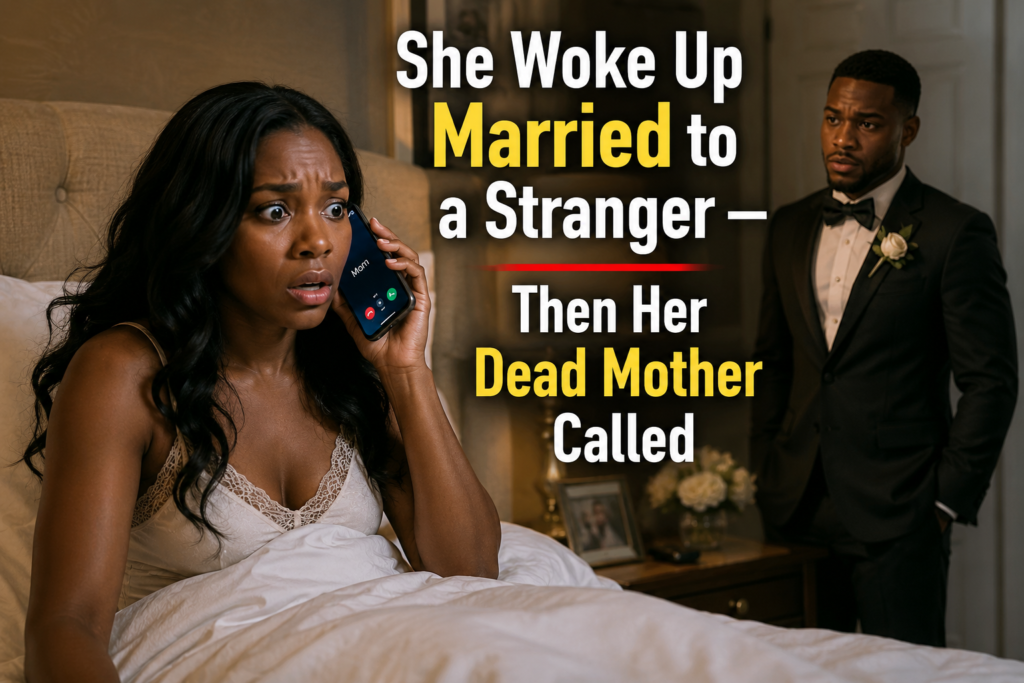
The woman on the screen was sobbing before she even got the words out. “Lucy… don’t sign a thing. That man isn’t your husband. He’s the son of the doctor who made you vanish.”
Matthew froze like he’d watched a corpse sit up and speak. Eleanor stumbled back a step. I was still flat on the gurney, pen pinched between my fingers, throat clamped shut, my insides trembling even though my body wouldn’t move.
The woman kept going. “Lucy, listen closely. Your real name is Lucy Armstrong Davis. You were born April 18, 1997. There’s a scar behind your left knee — you fell off a red bike in Brooklyn. Your father was Julian. I’m your mother.”
Matthew snapped. He grabbed the monitor’s remote and smashed it into the wall. The picture died, but the sound kept leaking through in broken pieces. “Don’t… sign… no—”
He turned on me, and the polished doctor’s mask was gone. What stood there now was just a man caught. “How did you pull this off?”
I said nothing. Not courage — fear. If I opened my mouth I’d start screaming, and if I screamed, he’d have the needle in me before I could move an inch.
Eleanor was already at the safe. “Matthew. End this. Now. Give her the dose.” He yanked a syringe from a steel drawer. The liquid inside had no color at all, which somehow made it worse than poison. Looking at that needle, something clicked into place: this room had been my tomb for two years, and every single morning I’d woken up inside it without any memory of the night before.
He bent toward my arm. “I told you, Valerie. When a mind fights back, you go deeper.”
That’s when my phone rang. Not the one on the nightstand — Matthew checked that one nightly. The other one. The one I’d buried inside a bag of rice in the kitchen after I found the camera hidden in the smoke detector.
Matthew’s head snapped up. “What is that?”
It rang three more times, then a recording kicked in — Anna’s voice, my friend from grad school. “Val, I can hear everything. Police are outside. Stay on the line.”
Eleanor went white. Matthew bolted for the hidden door.
I stopped playing along. I kicked out and sent the tray with the syringe clattering to the floor, the needle skittering somewhere under the gurney.
Matthew rounded on me and closed his hand around my throat. “You bitch.” The pressure built, black spots crowding my vision, light fracturing at the edges.
And then — a yellow kitchen. A woman humming while she sliced papaya. A man crouched over a red bicycle in a yard crowded with plant pots. Me, small, laughing.
Lucy. The name didn’t come as a word. It came like a door kicked off its hinges.
I drove the pen into the back of his hand. He howled and let go. I dropped off the gurney in a heap, legs betraying me, years of sedation making my body a stranger’s. I dragged myself toward the table and snatched the red folder.
Eleanor tried to wrestle it away. “That isn’t yours.” I met her eyes. “Yes. It is.” The voice that came out wasn’t mine — or rather, it was the voice of someone who’d just climbed back up from somewhere very deep and very dark.
She slapped me hard enough to ring my ears. I didn’t let go of the folder.
Then fists on the front door, and a voice cutting through everything. “NYPD! Open up!”
Matthew swore, tore off his lab coat, and cracked open a hidden panel beside the medical fridge. Of course there was an escape route. Men like him always build the exit before they build the grave.
“Mom — go.” Eleanor grabbed a bag stuffed with documents but paused just long enough to lean into my ear. “Your mother should’ve stayed dead.”
I bit her. No thought behind it, just every ounce of rage I didn’t know I still had. She screamed. Matthew hauled her through the passage and the panel sealed shut behind them.
I was alone in the white room, barefoot, face burning, throat bruised purple, the red folder hugged to my chest like it was the last solid thing in the world.
The pounding came again, louder. “Valerie Reed! Lucy Armstrong! Are you in there?”
Hearing both names in the same breath is what finally broke me open. “Here!” I screamed. “I’m here!”
Minutes later the closet door caved in. Two officers rushed the room, a woman in a detective’s vest right behind them, and Anna at her heels, crying, clutching my hidden phone. She threw her arms around me so hard it hurt. “I never trusted that son of a bitch.” I laughed — an ugly, broken sound tangled up with sobs. But it was mine.
The detective crouched to my eye level. “Captain April Montes. We need to get you out and clear the house. Can you stand?”
“Don’t let them get away,” I said. “There’s a tunnel.”
She didn’t hesitate — sent two officers straight into the panel while others tore through cabinets Matthew had always kept locked. Vials with the labels scraped off. USB drives. Folders. Video files sorted by date. My entire stolen life, catalogued like a lab experiment.
On a shelf sat a wooden box: rings, IDs, student cards, a library card with a photo of me as a teenager. Lucy Armstrong. Brooklyn Tech High School.
Seeing that card, I folded in half. It wasn’t just a name on plastic. It was a whole life that had been sitting in a box, waiting.
They walked me to the living room while forensics moved through the house. Under the main lights it looked different — the perfect dining set, the neurology textbooks lined up with obsessive precision, wedding photos where I was smiling with empty eyes. All of it staged. A house built purely to convince the world I was fine.
Anna wrapped a blanket around my shoulders on the couch. “I knew something was off,” she said. “Every time we talked about your thesis you’d forget things you’d written yourself. Once you told me, ‘If I’m not me tomorrow, look for me in the smoke.’ I thought it was just a figure of speech.”
Smoke. The word split something open in me. Fire. Sirens. Shattering glass. My mother screaming at me to run. A man in a lab coat clamping a hand over my mouth. Me in the back of a van, watching a clinic burn through the rear window.
“The clinic,” I whispered. Montes leaned in. “Which clinic?” “I don’t know its name. Green tile. It smelled like rain and rubbing alcohol. My mother was there.”
Anna held my hand tighter. “The woman on the call said her name’s Ines Davis. She’s in a safe house — she reached out to us three days ago.” I stared at her. “Three days?” Anna’s throat worked. “She emailed me. Photos of you as a little girl. I thought it was some scam. Then she asked me to bring up the red bike. When I did, you started crying and had no idea why. That’s when I knew something was really wrong.”
I had no memory of that conversation at all. Matthew had erased even my own attempts to save myself. But he couldn’t erase Anna. He couldn’t erase my mother’s terror. He couldn’t erase every copy of the truth.
An officer stepped out of the tunnel. “Captain, it comes up in the parking garage behind this building. Blood at the exit — not fresh enough to be theirs entirely.” Montes’ jaw tightened. “Seal every exit. Pull traffic cameras.”
She asked if I recognized any other names in the files. I opened the red folder with shaking hands. My real birth certificate. Photos of my father. Newspaper clippings about a missing minor from 2014. And a note in Matthew’s handwriting.
“Lucy displays fragmented episodic memory. The Valerie identity is sustained through pharmacological and narrative reinforcement. High risk if she hears the maternal voice.”
Narrative reinforcement. That’s the clinical term he used for his lies. That my mother died of cancer. That I had no family left. That we met after an accident, that he’d nursed me back to health, that I married him out of gratitude. That my anxiety was just ingratitude. That my doubts were a symptom.
Further in — a list of properties. A house in Brooklyn. Land upstate. Accounts. Stock. An inheritance still pending. My inheritance, the one they were counting on stealing once I hit a certain legal threshold.
His father’s name came up again and again. Dr. Arthur Carter. Neuropsychiatrist. Died 2015. Owner of a clinic that, according to the file, specialized in “patients with no family network.”
Nausea hit me all at once. “Matthew’s father is the one who took me.” Montes nodded grimly. “And Matthew picked up where his father left off after he died. We need your statement — but the hospital comes first.” “No.” Every head turned. “First I want to see her.”
Anna understood before anyone else did. “Your mom.”
There was no getting me out that night. They took me to the ER under police escort — bloodwork, blood pressure, the bruising on my neck cataloged in careful clinical language. A young doctor examined me like my body was a room after a house fire. “You’ve got a buildup of sedatives in your system, repeated injection sites, significant weight loss. But you’re conscious. That’s what counts right now.”
What counted to me was on a phone screen.
At six a.m. Captain Montes came in with a tablet. The scarred woman appeared again. Not old — aged, but by suffering, not years. Marks ran along her neck, one eyelid sagged slightly. But when she smiled, something in me recognized her before my memory caught up.
“Lucy.” I covered my mouth with both hands. “Mom.”
She cried without a sound. So did I. For a while neither of us said anything, because no words are big enough to bridge twelve missing years.
“I thought you were dead,” I said. “They needed you to believe that.” “Matthew told me you died when I was five.” My mother’s eyes shut. “He stole even your grief from you.”
She gave me only fragments — my body couldn’t hold more than that. My father had found irregularities at Dr. Carter’s clinic. Patients being used in memory experiments — vulnerable people, women with no family, young patients with falsified paperwork. My father built a case. Before he could hand it over, he died in a car crash nobody ever properly investigated.
My mother picked up where he left off. That’s why the clinic called her in that day. That’s why she brought me along. That’s why the records burned.
She survived the fire but spent months in a hospital under a false name, cut off from everyone, hidden by a nurse who later vanished too. “By the time I could search for you,” she said, “you were someone else already. Valerie Reed. Wife of Dr. Matthew Carter. I couldn’t get near you without risking them hiding you all over again.” “Why now, then?” She lifted a folder. “Because I finally found the notary who forged the original power of attorney. And because I found out tomorrow was the day they meant to make you sign away everything for good.”
Tomorrow. One more day and I’d have disappeared legally — not in a van this time, not in some clinic, but in a chair, with a pen, under a name they’d invented for me.
They found Matthew’s SUV at noon, dumped near the FDR. Clothes, a suitcase, bloodstains — not his. Eleanor’s. My bite mark had left its evidence.
That afternoon police raided Matthew’s office in a Manhattan medical tower. More files. Women who’d never been reported missing because, on paper, they were simply married, institutionalized, or “in treatment.” That’s the part that turned my stomach worst of all — sometimes they don’t erase you with violence. Sometimes they erase you with paperwork.
Three days later, Eleanor was caught in New Jersey trying to buy forged documents with cash. Matthew wasn’t with her.
When Montes brought me the news I was sitting beside my mother in her hospital room, holding her hand for the first time. Her skin felt rough. Real. “Where is he?” Montes set down a photo — a man in a baseball cap moving through Penn Station. “We think he’s trying to leave the country.” My mother went rigid. “He doesn’t run without finishing something first.” I already knew that too. Matthew hadn’t lost control. He’d simply postponed it.
That night, while the house slept, I found a note folded inside my thesis binder. It hadn’t been there before. Matthew’s handwriting. “You can take your name back, Lucy. But I still have your memories.” Below it, an address. Brooklyn. My childhood home.
I called Montes. Not out of bravery — because I finally understood that handling this alone was exactly the trap Matthew wanted me to walk into.
We went at first light. The street smelled like fresh bread and wet asphalt. The house sat boarded up, bougainvillea choking the gate, paint peeling in long strips. My mother stayed in the SUV, agents around her, hands pressed to her chest.
I went in wearing a vest, which felt absurd. Part of me still felt like a student, a wife, a confused woman. Another part walked like Lucy — the girl who’d survived without ever knowing it.
Inside, furniture sat draped in white sheets, dust turning in the morning light. In the living room: an old television, a table, and a rusted red bicycle. I saw it and folded to the floor. My father’s laugh. His grease-stained hands. Him calling me “Firefly” because I used to tear around the yard at dusk.
Then — slow clapping. Matthew stepped out of the hallway, hair a mess, shirt stained, one hand bandaged. No gun. A voice recorder. “Welcome home.”
Agents leveled their weapons. “On the ground — now!” Matthew smiled anyway. “Shoot me, and she never finds the last copy.”
Montes stepped forward. “What copy?” His eyes stayed on me. “Your memories, Lucy. The sessions. What your father uncovered. What your mother screamed while the building burned. It’s all right here.” He raised the recorder.
I stepped toward him. “That isn’t my memory.” His blink was almost confused. “Of course it is. You are what you remember.” I shook my head. “No. I’m also what was done to me — and what I chose to do after.”
The smile cracked, just slightly. “Without me, you wouldn’t exist.” “Without you, I’d have actually lived.”
His grip on the recorder tightened, and for the first time I saw real fear in his face. Not fear of prison — fear of becoming nothing. Fear that his experiment had learned to stand on its own and stopped asking his permission to breathe.
He lunged for the window. An agent tackled him mid-stride. The recorder hit the floor and popped open — no tape inside. Just a tiny memory card.
Montes lifted it with gloved fingers. Matthew screamed my fake name. “Valerie!” I didn’t turn. He screamed the other one. “Lucy!” I didn’t turn for that one either. I no longer needed either name’s permission to know exactly who I was.
The trial dragged on for months. I testified three times. My mother testified twice. Anna handed over emails, recordings, the live broadcast from that night. The notary talked to shave time off her sentence. Eleanor tried blaming her son, then her dead husband, then me — claimed I was unstable.
The judge called for order the day I laughed out loud in the middle of it. It wasn’t a happy laugh. It was the laugh of a woman who got called crazy right as she finally started seeing the bars of her own cage.
Matthew never once lowered his eyes. Even cuffed, he kept correcting the expert witnesses, burying his horror under clinical vocabulary, dressing it up as science. But when they played the audio from the white room, his voice came out small. “I’ve spent two years killing Valerie every single night.” That was the end of the doctor. Only the criminal was left sitting there.
Getting my life back wasn’t a movie moment. I didn’t just open my eyes and remember everything at once. Some mornings I woke up unsure what year it was. Some days I missed Matthew and then threw up from the guilt of missing him, until my therapist explained that the body gets addicted to its cage too.
Months later I went back to Columbia, walking across campus with my mother on one arm and Anna on the other. In front of the Low Library I looked up at those stone columns like someone had glued a shattered clock face onto an enormous wall. That was me too. Pieces. Still holding together.
A year after that I defended my thesis. Not about memory, the way Matthew would’ve wanted. About identity — psychological control, and the mechanics by which a victim is taught to distrust herself.
My mother sat in the front row. Anna was already crying before I said a word.
When I finished, a professor asked what name I wanted printed on the degree. I stared at the form. Valerie Reed was a lie — but she was also the woman who pretended to swallow a pill she’d hidden, who buried a phone in a bag of rice, who opened her eyes on that gurney and fought anyway.
Lucy Armstrong was where I started. The girl with the red bike. The daughter who made it back.
I picked up the pen and wrote: Lucy Valerie Armstrong Davis.
Afterward we drove to the Brooklyn house. My mother started opening it up slowly — not to move back in right away, just to stop it being a museum of grief. We planted new bougainvillea in the yard. Painted the kitchen yellow. Hung the red bicycle on the wall, not as something sad, but as proof.
One afternoon I found a photo of myself at fifteen, in the same school uniform I’d seen in Eleanor’s stolen documents. On the back, in my father’s handwriting: “For whenever you doubt yourself — you were always a light.”
I sat on the floor and cried until my mother found me. She didn’t say it’s over. Because it wasn’t, not completely. She just held me and said, “You’re here.” And that much was true.
For two years Matthew told me to trust him. Now I trust different things. My own breathing when something feels wrong. Friends who check in anyway. Mothers who survive fires. The notes you leave yourself for the day you finally have the strength to run.
Some nights I still wake up at 2:47 a.m., eyes on the door, half-expecting gloves, a camera, a black notebook. But there’s only my room, my books, a glass of water I poured for no one but myself.
So I turn on the light. I pick up a pen. I write my full name, once.
Lucy Valerie Armstrong Davis.
Then I go back to sleep — not because someone drugged me, but because, at last, my memory belongs to no one else.
Disclaimer: This story is a work of fiction. Any resemblance to real persons, living or dead, or actual events is purely coincidental.