It was visiting day at the base — families and civilians came in to see their loved ones, tour the grounds, and attend the awards ceremony scheduled for noon.
He arrived just after 11:30. Thin, hunched, dressed in a faded jacket and a pair of scuffed boots that looked older than the cadets themselves. He walked with a cane and carried a small, folded American flag under his arm.
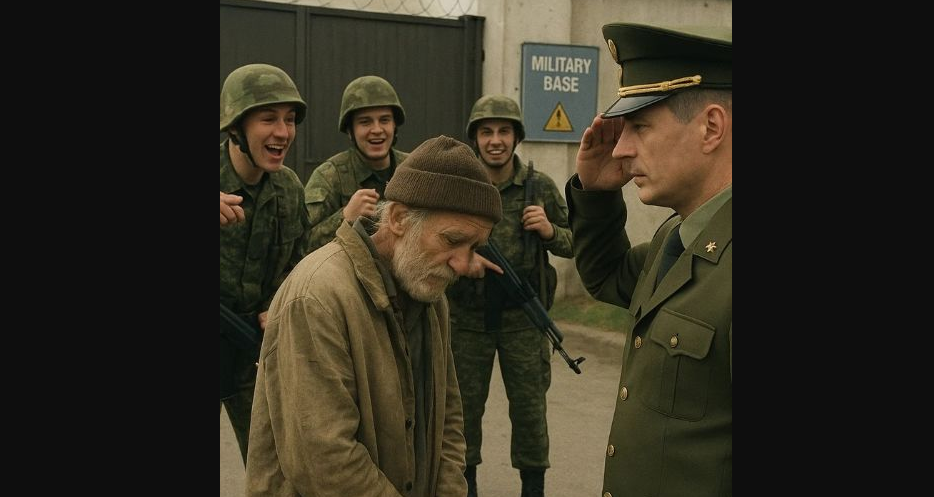
The guards at the checkpoint exchanged glances. “You sure you’re not lost, sir?” one asked. “No,” the old man replied calmly. “I’m here for the ceremony.”
A young soldier behind them snorted. “Bet he just wants a free lunch.” Nearby recruits chuckled. “He probably thinks this is a museum tour.”
The man said nothing. He waited patiently, eyes steady on the field.
One of the officers called over a superior. “There’s a civilian here saying he’s attending the ceremony. But he doesn’t have clearance. And no family with him.” “Should we escort him off base?” another whispered.
Before anyone could decide, the door to the command building opened. A high-ranking general stepped out in full dress uniform, flanked by aides.
He took one look at the old man… and immediately stood at attention. Then he marched straight over and saluted. Everyone around froze.
The general lowered his hand and said, loud enough for the entire base to hear: “Permission to speak freely, Master Sergeant?”
The old man straightened as much as his back allowed. “Permission granted, General.”
Mouths dropped open. Recruits who had been chuckling now stood awkwardly, not sure if they should salute too. The guards at the gate suddenly looked like they wanted to disappear into the pavement.
“I thought you were overseas, sir,” the general continued.
“I came back a few months ago. Quietly. Didn’t want to make a fuss,” the old man replied, glancing toward the open parade grounds. “But I heard today was special.”
“It is,” said the general. “But your presence makes it even more so.”
He turned to the nearest lieutenant. “Get him a seat. Front row. And someone find a bottle of water — cold.”
The young officer, red-faced and stammering, nodded and darted off.
The recruits who had mocked the man moments earlier now avoided eye contact, some sneaking away, others stiffly offering awkward salutes. But the old man didn’t seem angry. He didn’t even look at them. He just followed the general to the field, the flag still tucked under his arm.
An older woman sitting near the front whispered to her husband, “Who is he?” Her husband shrugged. “No idea. But that general just called him ‘Master Sergeant’ like he was his superior.”
And that’s when the whispers began. One by one, attendees began asking around. People took out phones, searching for clues. But the old man didn’t carry a phone. No social media. No flashy pins or medals. Just a folded flag and a quiet dignity.
The ceremony began, and the old man sat silently, watching as young soldiers received medals, promotions, and recognition. When the national anthem played, he stood — slowly, painfully — but he stood, holding the flag tightly against his chest.
After the applause died down, the general returned to the podium.
“I’d like to make an unscheduled acknowledgment,” he said. “Someone very dear to this base has joined us today. A man who served this country with more courage and humility than I can put into words.”
He paused.
“Master Sergeant Raymond Elkins.”
A few older officers gasped. One actually stood up.
The general continued, “For those unfamiliar with the name — and shame on us for that — Sergeant Elkins served through three wars. Korea. Vietnam. And early deployments in the Gulf. He was known for volunteering for the worst assignments, not because he had to, but because he wouldn’t ask his men to do something he wasn’t willing to do himself.”
He looked at Elkins with open admiration. “He saved lives. Trained leaders. And built the backbone of what this base is today.”
The crowd, previously murmuring, now burst into applause. Some people stood. Others wiped their eyes.
Elkins didn’t react. He just nodded slowly, as if he hadn’t come for this part at all.
The general raised a hand, silencing the crowd. “And there’s one more thing. I didn’t know this until this morning — but the flag he’s carrying… that belonged to Corporal Jared Monroe.”
A wave of emotion swept over the audience. Jared Monroe was a name most people on the base knew. He was a soldier who’d died on a mission in Afghanistan, saving three others by drawing enemy fire away from an ambush. He was posthumously awarded the Silver Star.
The general continued, “Corporal Monroe served under Sergeant Elkins. More than that, he lived with him. Raised by him. You see… Jared was his grandson.”
Gasps again.
“After Jared’s death, Master Sergeant Elkins requested to return to training duty. Not to grieve. Not to rest. But to make sure every recruit under his watch would come home safe. He’s been quietly mentoring recruits at smaller facilities across the country, never asking for attention, never asking for thanks.”
Elkins stood slowly. Still silent. Still holding the flag.
“Today, we honor him not with medals or speeches,” said the general. “But with the one thing he’s always deserved — our respect.”
The entire crowd stood. Applause thundered across the field. Some soldiers snapped to attention and saluted, others simply clapped until their hands were sore.
Elkins nodded, then slowly lowered himself back into his seat.
After the ceremony, the general approached him again. “I owe you an apology,” he said quietly. “They should’ve known who you were.”
The old man chuckled. “They’re young. They’ll learn.”
“You sure you don’t want to say a few words?”
Elkins looked around at the crowd still lingering, faces filled with curiosity and admiration.
Then he stood, walking with his cane to the front of the stage. The general stepped back, letting him take the mic.
“I’m not much for speeches,” Elkins began, his voice steady but rough with age. “But I’ll say this.”
He glanced at the folded flag in his hand.
“This flag doesn’t represent politics. Or pride. Or even power. It represents people. Real people. Young people. Good people.”
He paused.
“I’ve seen men fall in the mud so others could rise. I’ve watched boys turn into warriors and come home as ghosts. The uniform we wear — it doesn’t make us better than anyone else. But it does remind us that we serve something bigger than ourselves.”
He looked out over the rows of recruits, many of whom now listened with rapt attention.
“And one day, maybe, if you’re lucky, you’ll grow old. And maybe the world will forget your name. But if you’ve lived right… if you’ve loved your country and your fellow man… someone will remember the way you stood when it counted.”
Silence.
Then someone clapped. And another. And soon, the entire field erupted again.
Later that afternoon, as families packed up and visitors left, the old man sat alone on a bench near the edge of the field. His flag rested on his lap. He didn’t seem sad, just thoughtful.
The same young recruit who had joked earlier about the museum tour approached sheepishly.
“Sir?”
Elkins looked up.
“I just wanted to say I’m sorry,” the recruit said. “I didn’t know.”
“You didn’t need to,” Elkins replied. “You just needed to listen.”
The recruit hesitated, then sat beside him.
“Can I ask… why you came today? Just for your grandson?”
Elkins shook his head. “Not just for him. For all of them. For every boy who thought they weren’t strong enough. Every girl who thought she didn’t belong. Every soldier who doubted themselves. They need to know someone sees them.”
The recruit nodded slowly. “I’ll remember that.”
Elkins smiled. “Good. Then maybe I’ve done my job.”
As the sun dipped lower and the base began to quiet, the general returned one last time. He handed Elkins a small envelope.
“What’s this?” Elkins asked.
“An official invitation. We’re naming the new training facility after you.”
Elkins blinked, visibly moved.
“You don’t have to do that.”
“We do,” the general said. “We absolutely do.”
A week later, a plaque was installed at the new training center. It read: The Raymond Elkins Training Facility In honor of the quiet strength behind every brave soldier.
From that day forward, no recruit passed through the gates without learning his story.
And the young recruit who once mocked him? He became one of the highest-performing members of his unit — and later, a training officer himself.
He kept a photo of Elkins on his desk, right next to a folded American flag.
Because sometimes, the ones who say the least… teach the most.