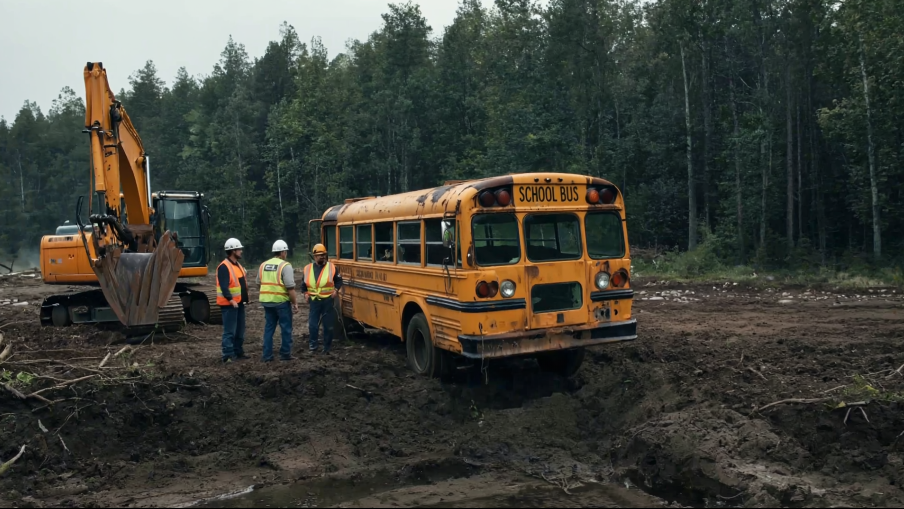
The call came in just after 7 a.m. Deputy Sheriff Lana Whitaker was sipping her first coffee of the day when the dispatcher’s voice crackled: “Possible find near Morning Lake Pines. Crew digging for a septic tank hit what appears to be a school bus. License plates align with a cold case.”
Lana froze mid-sip, the mug warm against her hand.
She didn’t need to write it down—she knew the case by heart. That year, she’d been a sick kid at home with chickenpox, watching from her window as classmates boarded the bus for their final field trip before summer. That memory—and the guilt—had followed her ever since.
The drive to Morning Lake felt endless, fog blurring the road and time alike. Pine trees flanked the path like solemn guardians. She passed a shuttered ranger station, turning down an old road once leading to the lakeside camp. Lana recalled the buzz of excitement: cabins, a lake, bonfires, a brand-new summer escape. She remembered the yearbook photo—kids waving from the windows, cartoon backpacks, Walkmans, disposable cameras.
When she arrived, the construction crew had already marked a perimeter. Faded yellow metal peeked through the dirt—half-buried, half-crushed by decades of weight. “We stopped digging as soon as we saw it was a bus,” said the foreman. “There’s something inside you need to see.”
The emergency exit had been pried open.
A musty, acidic scent filled the air. Inside: rot, dust, and stillness. Some seatbelts were still buckled. A pink lunchbox was wedged under a bench. On the last step, a lone child’s shoe, green with moss. But there were no remains. No bones. The bus was empty—a sunken riddle in the soil.
At the front, taped to the dash, was a class list in familiar loops: Miss Delaney’s handwriting. Fifteen names, ages nine through eleven. At the bottom, in red ink: We never made it to Morning Lake.
Lana stepped out, hands trembling, breath misting in the cold air. Someone had been here, recently enough to leave a message. She ordered the site sealed and called the state investigators. Then she drove straight to the county records office.
The old Hallstead County Records building smelled of mildew and citrus. Lana waited as the clerk rolled out a dusty file box. “Field Trip 6B, Holstead Ridge Elementary, May 19, 1986. Closed five years after. No leads.”
Inside: children’s photos, class lists, personal items. At the bottom, a final report stamped in red: MISSING—PRESUMED LOST. NO SIGNS OF FOUL PLAY.
That stamp had haunted Hallstead for decades. No answers. No justice. Only questions remained.
Theories abounded. The bus driver, Carl Davis, had been new, barely checked. He vanished with the bus. The substitute teacher, Ms. Atwell, had no verifiable past. Her address was now an empty lot. Some said it was a cult. Others, a crash into the lake. But no proof. No trace.
Then came the call from the hospital. A woman had been found by a fishing couple, a mere half-mile from the excavation site. She was barefoot, dehydrated, her clothes torn and weathered—barely conscious, yet alive.
“She keeps insisting she’s twelve,” the nurse told Lana. “We thought it was shock. Until she said her name.” She handed over a clipboard: Nora Kelly, one of the long-lost children.
When Lana stepped into the hospital room, the woman sat up slowly. Her hair was matted, skin pale, but her bright green eyes were familiar. “You got old,” Nora whispered, tears brimming.
“You remember me?” Lana asked, her voice unsteady.
Nora nodded. “You had chickenpox. You were supposed to come too.”
Lana sat beside her, overwhelmed. “They said no one would remember,” Nora whispered. “That no one would come for us.”
“Who told you that?” Lana asked.
Nora glanced at the window. “We never made it to Morning Lake.”
The following days blurred into interviews and discoveries. Forensics confirmed no bodies in the bus, but they did find a photograph tucked inside a side panel—children standing in front of a shuttered building, eyes blank. In the shadows, a tall bearded man appeared.
Nora, weak but lucid, began recalling fragments. Their bus driver was unfamiliar. A man met them at a fork in the road. “He said the lake wasn’t ready for us. That we had to wait.” She remembered a barn with boarded windows, clocks frozen on Tuesdays, and fabricated names. “Some forgot their homes,” she said. “I did not.”
Following her memories, Lana found an old barn on County Line Road, once owned by a man named Avery. In the weeds: a child’s bracelet—Kimmy Leong’s. Inside, names were etched into walls—some carved deeply, others faintly. In a locked box: Polaroids, candid shots of children eating, sleeping, crying. Each marked with a new name: Dove. Silence. Glory.
That night, Lana sat with Nora, showing her the bus photo. “This was after our first winter,” Nora said. “They made us pose each season. That building—it’s where we stayed longest.”
Records led Lana to Riverview Camp, purchased in 1984 by a private foundation. There, she found the same building. Outside: small, recent footprints. Inside: a pale boy, no older than ten. “I’m Jonah,” he said. He did not recall another name. “They took it away. Are you here to retrieve me?”
Jonah was brought to the station. He recognized faces in the yearbook—Marcy, Sam, even Lana. “You were going to come. You were fortunate.”
Forensics found another photo in the bus: four kids at a fire, one with dark skin and cropped hair. A note read: He chose to stay. That boy was Aaron Develin, now living in town under his real name. When questioned, Aaron admitted: “I remained when the others fled. I believed in it. For an extended period.”
He led Lana to the ruins of the first camp. There, buried beneath collapsed timbers, she found a cassette recorder, a bracelet, and a child’s drawing—We are still here.
Aaron pointed to a second trail. “That’s where they kept the little ones. After the fire, they called it Haven.”
Lana followed the trail to a cedar tree, its roots split by lightning. Beneath it, a hidden hatch led to underground rooms—makeshift classrooms, murals, bunk beds, desks. At the center: a locked case labeled Obedience is safety. Memory is danger.
In one sealed chamber, Lana discovered a collage of notes, photos, and a painted mural of a girl running through woods. The name Cassia appeared repeatedly. Cassia, she learned, was Maya Ellison—the quiet woman who owned the town’s bookstore.
When shown the mural, Maya wept. “I always thought she was imaginary. I did not believe she was me.”
Nora, Kimmy, and Maya were reunited. They spoke of their lost years, their erased names. Some of the children had died. Some had fled. Others, perhaps, were still present—waiting.
Now, at Morning Lake, a sign stands: In memory of the missing. To those who waited in silence—your names are remembered. And in that stillness, Hallstead County finally breathes again, knowing that no secret can remain buried forever.