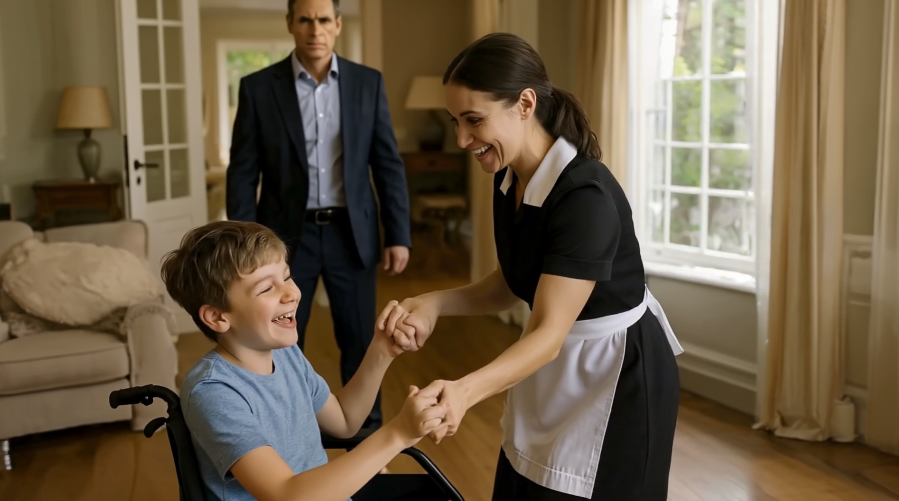
Most days, Edward Grant’s penthouse felt more like a museum than a home: pristine, cold, lifeless. His nine-year-old son, Noah, had not moved or spoken in years. The doctors had given up. Hope had faded. But everything changed one quiet morning when Edward returned home early and saw something impossible: his cleaner, Rosa, dancing with Noah.
And for the first time, his son watched.
What began as a simple gesture became the spark that unraveled years of silence, pain, and hidden truths. This is a story of quiet miracles, profound loss, and the power of human connection. Sometimes, healing is not achieved with medicine. It’s achieved with movement.
That morning had unfolded like every other: mechanical, silent, predictable. Edward left for a board meeting just after 7 a.m., pausing to glance at the untouched breakfast tray outside Noah’s room. The boy hadn’t eaten. He never did.
Noah hadn’t spoken in nearly three years. A spinal cord injury from the accident that killed his mother left him paralyzed from the waist down. What frightened Edward more than the stillness was the absence in his son’s eyes—no pain, no anger. Just a void.
Edward had poured millions into therapy, experimental treatments, simulations. Nothing reached Noah. The boy sat daily in the same chair by the same window, under the same light. The therapist said he was isolated. Edward believed he was locked in a room no one could enter—not even with love.
That morning, Edward’s meeting was canceled. With two unexpected hours, he returned home—not from longing, but from habit.
As the elevator doors opened, Edward stepped out, distracted by mental checklists. Then he heard it. Music. Faint, real, imperfect—alive.
He moved down the hallway. The music clarified into a waltz. Then came something impossible: the sound of movement. Not machinery or cleaning tools. A dance.
He turned a corner and froze.
Rosa.
She twirled barefoot on the marble floor. Sunlight spilled through open blinds. In her right hand—Noah’s. His fingers gently encircled hers as she moved, guiding his arm in a simple arc.
Noah was watching her. Head slightly tilted, blue eyes focused. He had not made eye contact in over a year.
Edward’s breath caught. He stood there, stunned, as Rosa guided Noah through the gentlest of movements. When the music faded, Rosa looked at Edward. She was not startled. She seemed to have expected him.
She didn’t drop Noah’s hand. She gently stepped back, allowing Noah’s arm to lower. Noah’s gaze drifted downward—not blankly, but like a child who had simply grown tired.
Edward wanted to speak, but could not. Rosa nodded at him, then turned away, humming softly as she cleaned. Edward lingered, overwhelmed.
Later, he called Rosa into his office. He didn’t yell. He simply asked, “Explain to me what you were doing.”
Rosa stood calmly. “I was dancing,” she said.
“With my son?”
“Yes.”
“Why?”
“I saw something in him. A flicker. I followed it.”
“You’re not a therapist.”
“No. But no one else touches him—not with joy. I didn’t force anything. I followed.”
Edward paced. “You could’ve undone everything.”
“Nothing has worked for years,” she said gently. “Today, he chose to respond. Not because he was told to—but because he wanted to.”
Edward’s defenses began to crumble.
“He needs you to feel,” Rosa added. “Not fix. Feel.”
Edward dismissed her silently, but the words stayed.
That night, he poured himself a drink but didn’t touch it. Instead, he opened an old photo of Lillian, his wife. They were dancing in it, barefoot in the living room, holding a giggling baby Noah. On the back, her handwriting: Teach him to dance—even if I’m gone.
He cried for the first time in years.
The next morning, he watched Rosa clean from the hallway. She didn’t speak to Noah. She simply hummed. Noah watched.
Over days, his small reactions returned—eye movements, slight twitches, tentative smiles. Then one day, Edward heard it: a hum, off-key but real, coming from Noah.
When Rosa danced, Noah followed with his eyes. Then, his arms. Eventually, his body.
Edward never interrupted. He watched. And one day, he stepped in.
She handed him one end of a yellow ribbon. He took it. Together, with Noah between them, they moved.
No longer therapy. It was something else: family.
Weeks later, Rosa found a letter in a forgotten drawer. Addressed to “my other daughter.” Her hands trembled. It was signed: Harold James Grant.
Edward’s father.
When she told Edward, neither spoke for a long time. Then he whispered, “You’re my sister.”
Rosa nodded. “Half. But yes.”
Noah regressed when she left, overwhelmed. But she returned. And when she did, she placed one hand on Edward’s and the other on Noah’s.
“Let’s start from here,” she said.
They danced again.
Months later, they opened the Stillness Center—for children like Noah. On opening day, Noah walked three steps and bowed. Then he picked up the yellow ribbon and twirled, slowly, fully.
Applause roared. Edward wept. Rosa stood beside him, trembling.
“He is her son too,” he whispered.
Rosa smiled through her tears. “I think she always knew.”
And together, they moved—not as healer and patient, not as billionaire and maid, not even as brother and sister—but as something else entirely: Family.