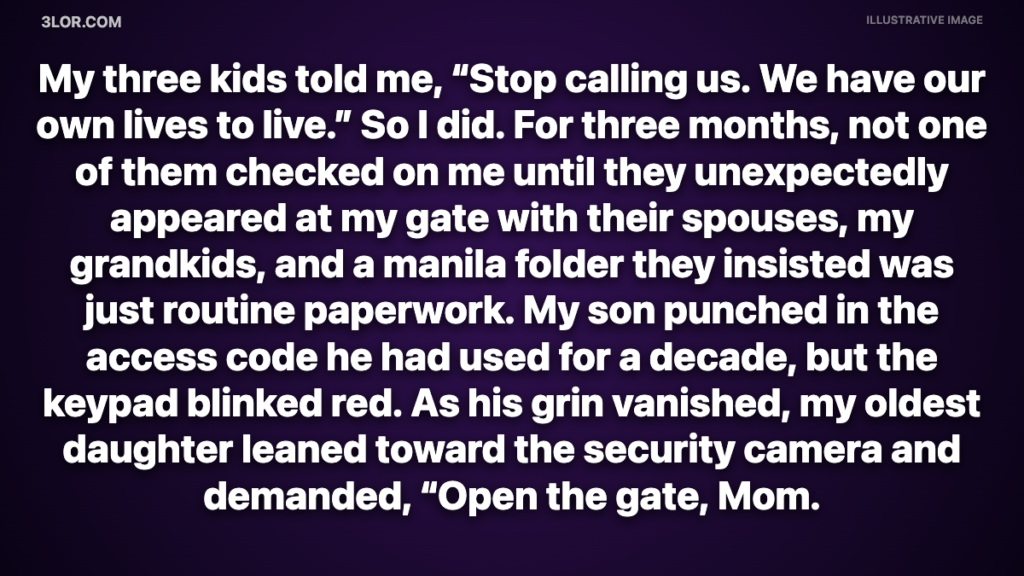
“Mom, open the gate.”
“I specifically told you not to come here.”
“It’s the holidays.”
“I am aware.”
“The grandkids are so excited to see you.”
Dangling the grandchildren was the one manipulative tactic my adult children thought was foolproof.
“I adore my grandchildren,” I replied through the intercom speaker. “But that doesn’t grant you a free pass to disregard my boundaries.”
Lucas suddenly grabbed the wrought-iron bars and attempted to hoist himself over. The private security guard I had hired stepped out from the shadows of the driveway immediately.
“Sir, step down off the gate.”
Lucas dropped back to the pavement, his face flushed with rage. Victoria glared directly into the camera lens mounted to the brick pillar.
“You hired a literal bouncer to keep your own kids out?”
“I hired security to safeguard my property. You three are the ones attempting to trespass.”
“This is the house I grew up in!” Lucas yelled.
“It was the house you grew up in. Today, it is my house.”
Samantha shifted closer to the callbox, her voice wavering. “What is it you actually want from us, Mom?”
“I wanted just one of my children to sit next to my hospital bed when I had pneumonia. I wanted you to come over because you missed your mother, not because you were eager to liquidate my real estate.”
“We are just trying to help you,” Victoria argued.
“No. You’re trying to control me.”
Lucas shook his head in disgust. “Fine. We are sorry. Does that make you happy?”
“That is not a real apology.”
“Then what do you want?”
“I want you to realize that I am not a burden to be managed—and I am not a walking inheritance check waiting to be cashed.”
The three of them fell dead silent.
Victoria broke the pause, crossing her arms. “So this is just about money to you?”
“You iced me out for three full months, showed up unannounced, and literally tried to scale my fence because I refused to talk about selling my home. And yet, you’re accusing me of making this about money.”
“You are going to regret cutting off your own flesh and blood,” Lucas warned darkly.
He didn’t say he cared about me. He didn’t say he loved me. He just threatened me with future isolation.
I instructed the guard to escort them off the premises, stepped back into my foyer, and cut the intercom feed.
The Letter in the Archive
The very next morning, David, my forensic estate attorney, came over for a sit-down we had booked weeks prior. His three-month audit of my former wealth manager Richard’s records was finally complete.
David set a scuffed leather portfolio onto my kitchen table.
“When my legal notice hit Richard’s compliance department, they dug this out of a private archive he maintained,” David explained. “Thomas left explicit instructions that this was to be handed to me if he passed away before our scheduled review.”
My late husband Thomas’s familiar handwriting was scrawled across the manila envelope:
For Margaret—when the time is right.
Inside was a letter dated just one week prior to his sudden fatal heart attack:
My dearest Margaret,
I pray I am just being paranoid. But our children have been making disturbing inquiries regarding your capacity to handle the estate and trust accounts should I pass before you.
I spent my life working so you would never have to rely on anyone who treats you with disrespect. If our kids truly care for you, shower them with love. But if they are only measuring your value by their expected inheritance, do not leave them a single dime they could use to gain leverage over you.
Paperclipped to the letter were Richard’s internal meeting notes from six months prior to Thomas’s death:
Victoria had explicitly asked when Margaret could be pressured to sell the primary residence.
Lucas had aggressively demanded that he be appointed to manage the family’s investment portfolios.
Samantha admitted she had been quietly copying our private household financial records for her siblings.
Thomas’s final sentence made my hands shake:
If the three of them ever show up together pushing you about the house, know that it is a coordinated effort.
“Why didn’t Richard turn this over after Thomas died?” I asked, stunned.
“Your children made a backdoor deal promising to keep the entire multimillion-dollar family portfolio under his firm’s management once Lucas took over,” David said. “Richard quietly mislabeled the file as a ‘family dispute’ and buried it.”
David slid a second document across the table: a limited power of authorization ostensibly granting Lucas the right to pull data regarding my trust accounts. The signature at the bottom was a clumsy forgery of my own name. Lucas had filed it ten days earlier, but my newly appointed corporate trustee flagged it for review.
The Leaked Emails
Several hours later, Richard’s former paralegal, Melissa Reed, reached out to David. Spooked by the corporate compliance probe, she blew the whistle and turned over internal email chains between Richard and my three children.
Their “surprise holiday visit” had been meticulously mapped out for six weeks:
The Care Facility: Victoria had already toured a local nursing facility, selected a private room, and retained a luxury real estate broker to list my home immediately upon my relocation.
The Medical Records: Samantha had compiled my daily prescription lists and medical history to manufacture an appearance of frailty.
The Paperwork Ambush: Lucas had drafted a sweeping financial power of attorney, medical proxy forms, and a binding lease agreement for the care facility.
Their exact scheme was to slip the legal forms into a stack of routine medical updates and pressure me to sign while the grandchildren ran through the house creating a distraction.
One email from Lucas laid it out in cold print:
She’s not going to read the fine print if the kids are running around the living room.
The endgame was simple: get me into assisted living, use the power of attorney to liquidate my Seattle property, and route the sale proceeds into a corporate account controlled solely by Lucas.
When Samantha had briefly pushed back, typing: This really feels wrong, guys, Lucas fired back instantly: Then don’t expect a third of the payout.
Samantha had gotten in the car anyway.
The Courtroom Reckoning
David reported the forged signature to law enforcement and retained Katherine Brooks, an aggressive litigator specializing in elder fraud and contested conservatorships.
True to their contingency plan, my children struck back within three weeks. They filed an emergency petition in family court demanding that Lucas be appointed my legal conservator, arguing that my new security gate, my refusal to open the door on Christmas Eve, and my revised will were symptoms of paranoia and cognitive decline.
The legal battle dragged on for four grueling months.
I underwent a comprehensive psychiatric evaluation and passed without a single deficiency, confirming complete cognitive independence.
During the final evidentiary hearing, Katherine laid out the complete paper trail: Thomas’s warning letter, the forged signature filings, the forensic audit logs, the leaked email transcripts, and high-definition security camera footage of Lucas violently trying to climb over my front gate.
Faced with felony perjury charges, Samantha broke down on the witness stand. Sobbing, she confessed that Victoria and Lucas had orchestrated the entire plan to strip me of the property, admitting she only complied because she was terrified of being disinherited.
The judge dismissed the petition with prejudice, ruled the filing a malicious action in bad faith, and ordered my three children to reimburse every dollar of my legal fees. The forged authorizations were formally referred to the district attorney for criminal investigation.
On the courthouse steps afterward, Victoria tried to intercept me. “Mom, we were just terrified you were going to leave the family estate to strangers.”
“You were so obsessively terrified of what you might lose when I died,” I replied evenly, “that you destroyed everything you had while I was still breathing.”
Lucas stepped forward, raising his voice: “Dad built that estate for this family’s legacy!”
“I am the family he built it to protect.”
Samantha stood a few yards away, crying quietly. “I am so sorry, Mom.”
“You knew what they were doing, Samantha. And you showed up at my gate anyway.”
I turned my back on all three of them and walked down the courthouse steps.
A Quiet Table
Richard Vance was terminated from his firm and sanctioned by the state bar for fiduciary misconduct. To avoid criminal prosecution, Lucas entered a diversion agreement that required full restitution. Victoria was forced out of her real estate brokerage partnership, and Samantha went into intensive therapy to unravel years of family manipulation.
I restructured my estate plan with finality:
My grandchildren’s college education trusts were fully funded and placed under independent institutional management until they turn twenty-five.
The remainder of my estate was bequeathed to legal foundations that defend elderly citizens against familial financial abuse.
Lucas, Victoria, and Samantha were completely disinherited.
An inheritance is a voluntary gift born of affection, not an entitlement owed to predators.
A year later, I listed the family estate and sold it on my own terms. I moved into a sunlit single-story home near a regional botanical garden—a peaceful space free of locked gates and painful echoes.
Victoria mailed long, formal apologies that I left unanswered. Lucas communicated only through his attorneys. Samantha, however, slowly stopped asking for money or immediate forgiveness and simply checked in to ask how my garden was doing.
Eventually, I allowed Samantha to call me once a month. I made no promises about wills or money. If any semblance of a relationship was to survive, it had to exist entirely outside the shadow of an inheritance.
The following Christmas, Samantha asked if she could bring the grandchildren over for lunch. She arrived precisely on time, rang the doorbell politely, and waited on the porch.
She walked inside, hung up her coat, and quietly helped me set the porcelain plates. Not a single word was spoken about trusts, lawyers, or the house we had left behind.
As the sound of the children laughing echoed through the kitchen, I thought back to that cold holiday morning a year earlier—the three idling cars, the raised voices, and Lucas rattling the iron gate.
My children assumed I had merely hired guards and changed the locks. In reality, I had reclaimed my life.
Thomas hadn’t just left me an estate. He had given me permission to stand my ground. And for the first time in years, I stopped mourning the family I wished I had, and embraced the absolute peace I had fought to secure.
Note: This narrative is an original work of fiction created for storytelling purposes. Names, characters, businesses, and incidents are products of the author’s imagination.