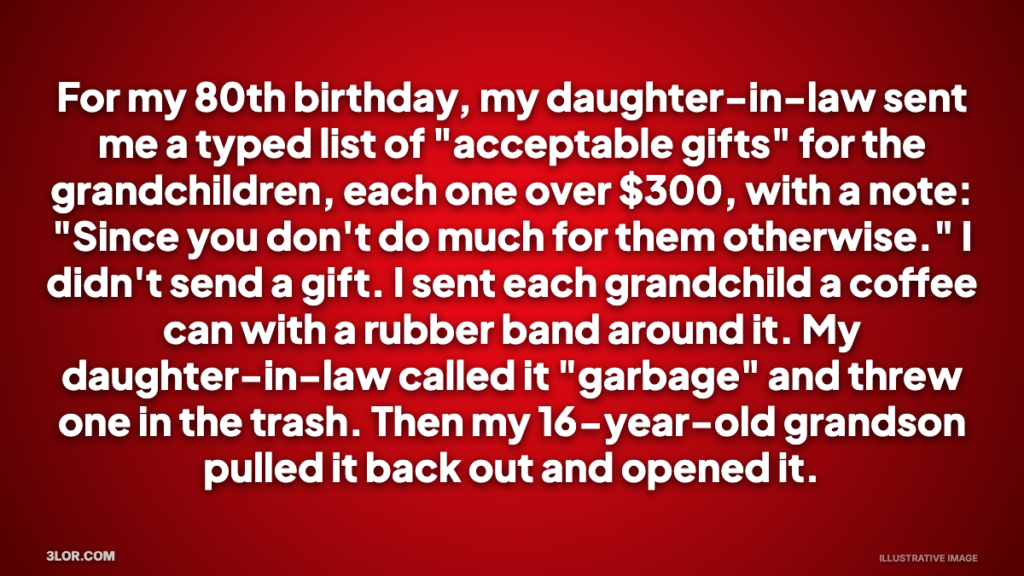
The sharp metallic clank of the tin can hitting the bottom of the stainless-steel trash can echoed across the Italian marble floors.
Vanessa stood by the island, smoothing the belt of her silk morning robe, her lip curled in that practiced, dismissive smirk I had endured for nearly two decades. Rob stood three paces behind her, hands deep in the pockets of his designer sweatpants, his eyes fixed firmly on the floorboards to avoid meeting mine.
Then Tyler reached into the trash bin.
He pulled the discarded tin out from under a crumpled paper towel and a handful of coffee grounds. He didn’t care about the grime. His fingers worked the thick, yellowed rubber band off the rim, snapped off the brittle plastic lid, and peered inside.
The silence that followed was heavy and absolute.
“Mom,” Tyler said, his voice dropping an octave, completely stripped of teenage sarcasm. “You need to come look at this.”
Vanessa sighed with exaggerated exhaustion, tossing her manicured hands in the air. “Tyler, throw that filthy thing away. If your grandmother wants to give you trinkets from a yard sale, she can do it outside.”
“Mom,” Tyler repeated, not blinking. “Look.”
Vanessa marched over to the island, snatched the can from Tyler’s hands to dump it back into the disposal, and froze.
Her jaw went slack. The flush left her cheeks so fast it looked as if she had taken a physical blow to the stomach. A sharp, strangled gasp tore out of her throat—a raw, unpolished sound of pure shock.
Inside that old, scratched metal can, packed tightly in layers of acid-free wax paper, were stacks of American Gold Eagle bullion coins, nestled over neat, rubber-banded rolls of century-old silver Morgan dollars, and a thick, blue velvet pouch containing certified certificates of deposit.
Rob stepped closer, frowning. “What is it, Van?”
He looked down into the can. His breath hitched.
“Mom…” Rob stammered, his neck turning a mottled red as he looked up at me. “What… what is this?”
I didn’t step forward. I kept the other three coffee cans held securely against my chest, right where my late husband Walter’s work jacket used to rub against my collarbone.
“Your father worked forty-two years on the assembly line and thirty years running the backhaul routes,” I said, my voice steady, cutting through the silence of their two-million-dollar kitchen. “When Walter retired, he took a fraction of his pension payout every single quarter and converted it into bullion. Not paper assets. Not stocks you could blow through on leased sports cars or European vacations. Hard, tangible metal.”
Tyler looked at the coin on top—a one-ounce gold piece struck in the year of his birth, gleaming under the bright recessed LED spotlights.
“Every time one of my grandchildren took their first breath,” I continued, looking directly at Rob, “their grandfather and I went to the bank vault in Lansing. We put the first ten ounces away. And every birthday, every Christmas, every single holiday where your wife sent me an email explaining that my presence wasn’t required because the family was ‘traveling’ or ‘too booked,’ I drove to the coin dealer and added five more.”
Tyler turned the can upside down over the marble island.
The gold spilled across the polished stone with a heavy, ringing chime that made Vanessa flinch. Thirty-two one-ounce gold coins rolled across the counter, accompanied by five sealed certificates of deposit from the state credit union, each compound-matured over sixteen straight years.
Tyler ran his hand over the gold, his chest heaving. “Grandma… this is… this is a college tuition.”
“It’s eighty-two thousand dollars in gold alone, Tyler,” I answered quietly. “And another thirty-five thousand in accrued principal on that paper. That’s your can. The one your mother just threw into the garbage disposal.”
Vanessa’s hands were shaking violently. She reached out toward the pile on the counter, her manicured fingers trembling with an instinct that disgusted me.
“Marion…” she whispered, her voice cracking, trying desperately to force a warm, affectionate smile onto a face that hadn’t shown me an ounce of warmth since Walter was buried. “Marion, you… you never said. You told us you were scraping by on his base survivor benefit.”
“Because Walter told me to,” I replied. “The month before the cancer took him, Walter sat at the formica table in our little kitchen. He watched you and Rob lease that country club membership while your mortgage was three months behind. He told me: ‘Dolores, if they know there’s gold in the ground, they will dig it up and sell the shovel. Let them think you have nothing. If they love you when your pockets are empty, give the kids the earth. If they treat you like an unpaid bill, let them choke on their own lists.'”
I pulled the folded paper from my cardigan pocket—the crisp, typed letter Vanessa had mailed me three weeks ago.
I smoothed it flat against the edge of the island, right next to the pile of gleaming metal.
“‘Since you absolutely don’t do much for them otherwise, this would be a nice way to show up for once. V.'” I read aloud.
Rob closed his eyes. He leaned his forehead against his hand, the humiliation washing over him like cold water.
“Mom, please,” Rob pleaded, his voice breaking. “We were stressed. We had business loans coming due. Vanessa was under pressure—”
“You let your wife treat your mother like a stray dog looking for table scraps,” I said, not raising my voice, but letting every word drop with the weight of twelve lonely years. “You laughed when she told your country club friends that you ‘married down.’ You stood by that front door two minutes ago and watched her throw your own children’s future into a plastic garbage sack without uttering a single word of protest.”
I turned to Tyler. The boy had tears pooling in his eyes, but he wasn’t looking at the money anymore. He was looking at his mother with an expression that will never leave her household: complete, unadulterated loss of respect.
“Tyler,” I said softly.
“Yes, Grandma?”
“Put the coins back in your can.”
He hesitated, then carefully, reverently gathered every single piece of gold and placed it back into the scuffed metal tin. He slid the plastic lid on and pulled the rubber band over it.
“That can is yours,” I told him. “It stays with you. Not in your parents’ joint account. Not toward your mother’s seasonal lease. You turn eighteen in fourteen months. The custody of that deposit is assigned directly to your name at the Michigan State Trust Company under an irrevocable third-party deed. You will use it for your engineering degree, just like you told me you dreamed of when you called me from the school library last fall.”
Tyler pulled the can tight against his chest, stepped away from the kitchen island, and walked over to stand right beside me.
Vanessa lunged forward, her voice rising into a sharp, shrill screech. “Wait! What about the other three? You have Madison’s! You have the twins’! Rob, say something! That’s our children’s money!”
I stepped back toward the foyer, the other three heavy cans held firmly in my arms.
“No, Vanessa,” I said, locking eyes with her. “It isn’t your children’s money. It was Walter’s sweat, and it was my sacrifice. I had every intention of placing all four on this counter today. I had every intention of sitting at your table for my eightieth birthday, forgiving the past twelve years, and watching my grandchildren understand that their grandparents never forgot them for a single day.”
I adjusted my grip on the three remaining tins.
“The twins are nine. Madison is fourteen. They have years ahead of them to learn whether they want to follow their mother’s ledger or their grandfather’s bloodline. Their cans will sit in my safety deposit box until the day they turn eighteen. If they reach out to their grandmother because they love her, they will receive every ounce. If they only know how to send typed invoices for five-hundred-dollar gadgets, it will go directly to the Shriners Children’s Hospital in Walter’s name.”
“You can’t do this, Marion!” Vanessa screamed, her face flushed crimson, tears of pure rage spilling over her eyeliner. “Rob, don’t let her leave with that!”
Rob didn’t move. He stood frozen, staring at his son, who was looking back at him with absolute contempt.
“Happy 80th birthday to me, Rob,” I said quietly.
I turned toward the front door. Tyler reached around me, opened the heavy oak door, and stepped out onto the porch with me, carrying his can in his arms.
“I’ll walk you to your car, Grandma,” he said, leaving the door wide open behind us as his mother’s furious shouting echoed down the empty hallway.
He opened the passenger side of my ten-year-old sedan, gently placed the three coffee cans on the floorboard, and helped me into the driver’s seat. Before I turned the key in the ignition, Tyler leaned through the window, kissed my cheek, and whispered:
“Thank you, Grandma. Not for the gold. For showing me who Dad used to be before he forgot.”
I pulled out of their driveway into the cool morning sun, the weight lifted from my shoulders for the first time in twelve years, leaving the noise, the greed, and the empty ledger behind me where it belonged.
Editorial Note: This narrative explores the raw reality of elder marginalization within affluent families, highlighting how quiet dignity and patience outlast material arrogance when generational loyalty is put to the test.