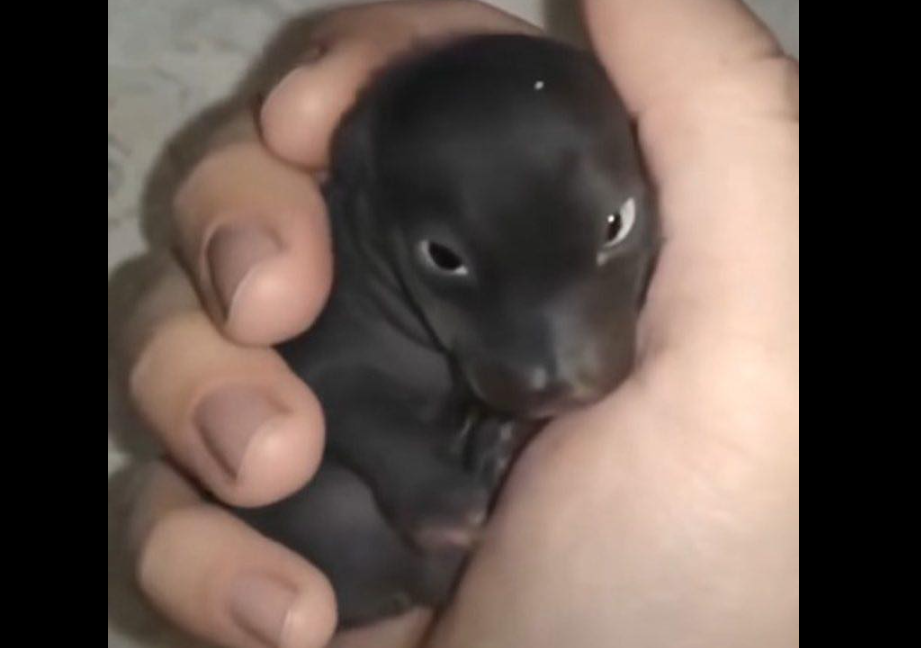
I first encountered her during a cold early morning walk along a quiet trail. The air was crisp, and the ground was covered in a thin layer of frost. When I looked down, I saw her curled tightly in the frozen grass, so small and fragile that she reminded me of a newborn puppy—pink, hairless, and barely able to move.
Her tiny body appeared so weak that for a moment I could not even tell if she was breathing. Guided by instinct, I lifted her carefully, wrapped her in my scarf to give her some warmth, and hurried home. I placed her in a shoebox under a warm lamp and prepared to take her to the closest wildlife rescue center, where she could receive proper care.
When I arrived, the staff gathered with curiosity, studying the tiny creature and trying to identify her species. After speaking with specialists and examining her features more closely, they revealed something no one expected. She was not a puppy at all. She was a newborn domestic rabbit, only a few days old, far too young to survive without her mother.
Since there were no rabbit nests in the area and no reports of missing pets or breeders nearby, everyone wondered how such a fragile infant had ended up alone in the open. The answer became even more puzzling when a couple contacted the center. They explained that their golden retriever had come across something very small earlier that morning and carried it toward them in its mouth.
They believed he had brought them an old toy and had not realized that he had discovered the same tiny creature I later found on the trail.
In a sense, two separate moments of care—one from a devoted dog and another from a passerby—gave this vulnerable baby rabbit an unexpected chance at survival.
The staff at the center named her Willow. From the moment she arrived, she required continuous and intensive attention. She was fed a special formula designed for orphaned rabbits, her temperature was monitored throughout the day, and she was kept safely inside an incubator that provided the warmth her mother would have given her.
Day by day, Willow began to gain strength.
Over the following weeks, her transformation was remarkable. Her skin gradually thickened, a soft layer of fur began to grow, and soon her eyes opened, revealing beautiful blue-grey eyes full of curiosity and life. As the rescue center shared her progress online, people from the local community and even from far away began following her journey, celebrating every milestone she reached. Willow became a symbol of hope, showing how even the tiniest lives can thrive when supported with patience and care.
One year after the morning I discovered her, the center invited me to visit. I expected to meet a gentle, petite rabbit. Instead, I was greeted by a surprisingly large Flemish Giant mix, one of the biggest rabbit breeds in the world. Willow hopped confidently toward me and nudged my hand, as if she remembered the warmth of the scarf that had protected her during her first hours of life.
As I left the center that day, I reflected on how a simple decision to stop on a trail had created a chain of compassion. Willow’s survival was the result of many hearts working together—a dog guided by instinct, a passerby willing to help, and a dedicated team determined to give her every opportunity to grow.
Today, Willow enjoys a peaceful and comfortable life. She often appears in the center’s photos, resting in baskets, nibbling fresh vegetables, or exploring her enclosure with graceful energy.
Her journey serves as a meaningful reminder that extraordinary things can begin quietly, sparked by small acts of kindness on an ordinary morning.