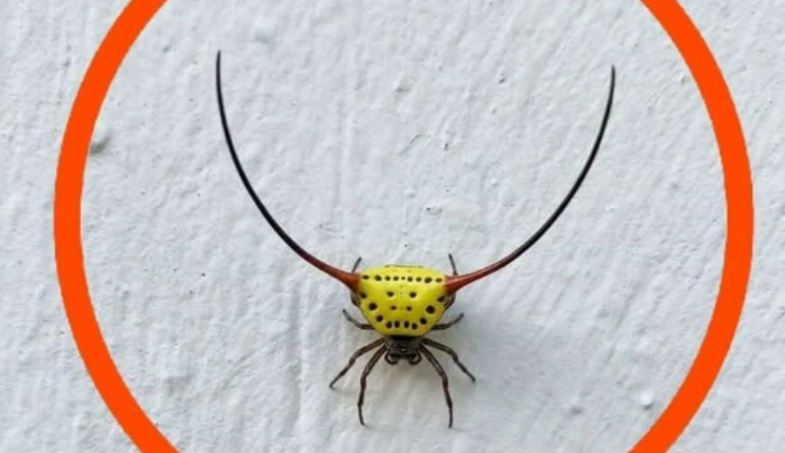
Last night I stopped in the doorway of my own garage.
At first the shape on the wall appeared to be something placed there as a joke.
Then movement or the lack of it revealed that the shape was alive.
There it rested—bright yellow, marked with small black dots, and bearing long dark spines that extended from its body.
The creature remained motionless.
It showed no attempt to flee.
It stayed attached to the surface as though it had been positioned there for observation.
My initial response involved no scientific consideration.
Concern rose quickly.
Thoughts turned toward possible explanations that involved danger or unfamiliar origins.
Ideas included a spider of unusual type, an insect from another region, or a creature with potential to cause harm.
I stepped back while keeping visual contact.
Continued observation made the form appear increasingly unfamiliar.
The central body presented a compact shape with striking coloration.
Long curved spines extended outward from the sides.
These features created an impression of greater threat than the actual behavior suggested.
The design appeared to emphasize visual impact.
After some time passed, interest in identification grew stronger than the initial concern.
I approached with care.
The creature showed no reaction to the movement.
A photograph was taken and shared with contacts for input.
Responses arrived with speed.
Suggestions included avoiding contact.
One response proposed extreme measures regarding the structure.
Another indicated possible toxicity.
Questions arose about whether the creature belonged to the local environment.
For a period the received information influenced the interpretation.
Further examination through available resources led to a clearer identification.
The creature matched descriptions of a spiny orb-weaver spider.
The scientific designation for this type is Gasteracantha.
The appearance functions as protection.
Aggression toward larger animals does not form part of its function.
Spiny orb-weavers are recognized for their compact, vividly colored bodies and prominent spines.
Common color variations include yellow, orange, red, and white, often combined with black patterns that create a distinctive look.
The spines serve primarily as a visual deterrent.
They help the spider appear less suitable as prey to birds and other animals that hunt spiders.
Spiny orb-weavers generally maintain distance from people.
Aggressive behavior toward people does not form part of typical activity.
Like many spiders, they may respond with a bite if handled or directly threatened.
Their primary activity involves capturing small flying insects within the webs they construct.
Once the identification was established, the earlier concern diminished.
The creature on the garage wall represented no intrusion.
It functioned as a small builder of webs.
It contributed to control of certain insect populations.
It stood as an example of distinctive natural design.
Identification and Characteristics
The creature observed was a spiny orb-weaver spider.
This species belongs to the group known scientifically as Gasteracantha.
The bright coloration and spine arrangement serve specific survival functions.
The spines create a visual profile that discourages potential predators.
The body shape supports web construction in certain environments.
These spiders typically remain in place on their webs or nearby surfaces.
Movement occurs mainly when disturbed or when relocating to a new site.
Observation from a distance allows study without interference.
Ecological Role
Spiny orb-weavers participate in natural pest management.
Their webs capture small flying insects that may affect plants or indoor spaces.
This activity contributes to balance in local insect populations.
The presence of such spiders can reduce the need for other forms of insect control in certain settings.
Their role aligns with broader patterns of natural predation that support ecosystem health.
Understanding this contribution helps place individual observations within a larger context.
Safe Observation Practices
When an unfamiliar creature appears in a living space, initial caution is reasonable.
Distance provides time for identification.
Photographs support later comparison with reliable sources.
Consultation with knowledgeable individuals or resources aids accurate recognition.
Avoiding direct handling prevents unnecessary stress for both the observer and the animal.
Once identification confirms harmlessness to humans, continued observation can proceed with greater comfort.
These steps support informed responses to wildlife encounters.
Value of Learning About Local Species
Encounters with distinctive creatures provide opportunities for learning.
Research following an observation can reveal functional adaptations such as defensive spines.
Knowledge of ecological contributions can shift initial reactions toward appreciation.
Many species that appear unusual at first viewing serve important roles in their environments.
Awareness of these roles supports coexistence with local biodiversity.
Continued interest in such discoveries encourages further exploration of natural history.
The process of identification and understanding transforms concern into recognition of natural design.
This recognition contributes to a broader perspective on the variety of life forms present in everyday surroundings.
The creature that appeared on the garage wall represented one example among many that reward closer attention with new information.
Scientific naming and description provide tools for accurate communication about such observations.
Resources available through natural history organizations and educational sites support ongoing learning.
The combination of direct observation and reliable information creates a foundation for respectful interaction with wildlife.
This approach benefits both personal understanding and broader conservation awareness.
The evening encounter concluded with recognition of the spider as a beneficial presence.
Concern did not remain after identification.
The web-building activity and insect capture role contribute to the environment in measurable ways.
The distinctive appearance serves survival functions that became clear through investigation.
Continued observation from a safe distance allows appreciation of these features without disruption.
The experience illustrated how initial reactions can give way to informed perspectives through investigation.
This pattern applies to many encounters with wildlife in residential areas.
Resources for identification remain accessible through multiple channels.
Application of these resources supports accurate understanding and appropriate responses.
The overall outcome was increased awareness of local species and their contributions.
This awareness supports ongoing interest in natural history within everyday settings.
The spider remained on the wall for a period before moving to another location.
Its presence had prompted investigation that yielded new knowledge.
The process demonstrated the value of pausing to examine unfamiliar elements in the environment.
Such pauses can lead to discoveries that enrich understanding of the natural world.
The story of the bright yellow creature with dark spines serves as one instance of how observation and research can transform perception.
Many similar opportunities exist in ordinary surroundings for those who take time to look closely.
The combination of caution, curiosity, and reliable information supports positive outcomes in wildlife encounters.
This combination remains useful across different situations and locations.
The recognition that the creature was a spiny orb-weaver spider brought clarity to the experience.
The functional explanations for its appearance and behavior provided context.
The ecological contribution through insect capture added practical significance.
Together these elements created a complete picture that replaced earlier uncertainty.
The process from initial sighting to final understanding followed a sequence of observation, concern, research, and resolution.
This sequence represents a common path when encountering unfamiliar species.
Application of similar steps in future situations can support continued learning and responsible responses.
The presence of the spider on the garage wall ultimately contributed to a greater appreciation for the diversity of forms found in natural environments.
This appreciation extends to recognition of the roles played by various species in maintaining balance.
The experience concluded with the understanding that the creature was a normal part of the local ecosystem.
Its distinctive features served specific purposes that became clear through investigation.
The outcome supported a view of nature that values both caution and curiosity in appropriate measure.
Continued attention to such details in the environment can yield additional insights over time.
The story remains available for reflection and for sharing with others who may encounter similar situations.
Resources for further reading on spiny orb-weavers and related species continue to be available through scientific and educational channels.
Application of these resources supports ongoing development of knowledge about local wildlife.
The encounter with the creature on the garage wall thus contributed to both immediate understanding and longer-term awareness.
This dual contribution represents one of the values of paying attention to unexpected elements in everyday surroundings.
The process demonstrated how a single observation can lead to broader appreciation of natural adaptations and ecological functions.
Such appreciation supports positive relationships with the environment in residential and other settings.
The story of the evening encounter thus concludes with recognition of the spiny orb-weaver spider as a distinctive and functional member of the local ecosystem.
Its presence prompted investigation that yielded information about appearance, behavior, and ecological role.
The outcome supported a view of nature that balances initial caution with informed appreciation.
This balance supports positive interactions with wildlife in everyday settings.
The process from discovery to understanding illustrates one pathway for engaging with unexpected elements in the environment.
Continued application of similar steps can support ongoing learning and responsible responses to wildlife observations.