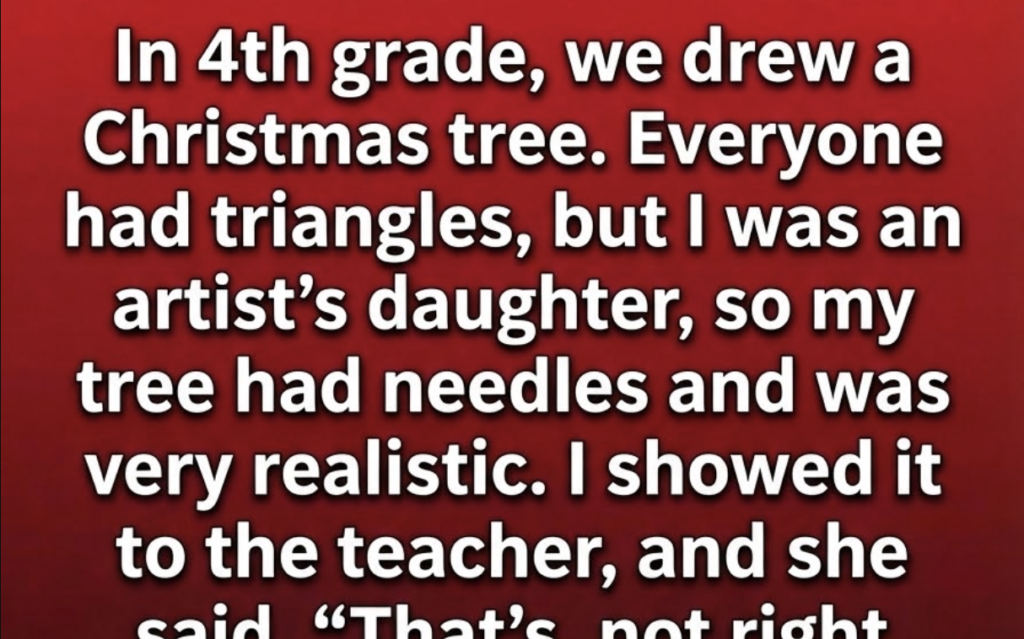
In fourth grade, art class was meant to feel easy and straightforward. The assignment for the day sounded simple enough: draw a Christmas tree. The teacher sketched an example on the board, and most of my classmates followed it closely. Their trees were tidy triangles stacked one on top of another, topped with a star that sat perfectly centered. The room filled with near-identical pages, each one reflecting the same pattern and proportions. I understood what was expected, yet I felt an urge to approach the task differently.
At home, creativity had always been encouraged. Art supplies were part of everyday life, scattered across tables the same way spoons and notebooks were. I had learned early on to observe the world carefully, noticing small irregularities that made things feel real. When I picked up my pencil, I thought about the trees I had actually seen outside. Their branches were uneven. Their shapes leaned slightly. Their needles formed layers of fine lines rather than smooth edges. That is what I drew. My tree was textured, imperfect, and full of small details that felt honest to me. When I finished, I felt a quiet sense of pride.
I walked to the teacher’s desk and handed in my paper, expecting curiosity or perhaps a question about my choices. Her reaction caught me off guard. She frowned, held my drawing next to another student’s page, and said that mine was wrong. There was no explanation beyond that single word. Before I could process it, she reached for her red pen.
She began marking over my work. Branches were reshaped. Lines were flattened. The leaning trunk was corrected. Slowly, my tree was transformed into something far more familiar and predictable. She pointed toward the board and reminded me to look at how the other children had drawn theirs. The message was clear: there was a correct way to do this, and I had missed it.
The classroom suddenly felt smaller. I looked around at the walls lined with matching trees and felt a quiet confusion settle in. I was not angry. I was trying to understand why my version did not belong. The red ink felt heavier than simple correction. It carried the feeling of permission being withdrawn, as though there was less space for my way of seeing things. I stayed quiet, raising my eyebrows slightly as I absorbed the moment.
Then I spoke. My voice was calm, and my question was simple. I asked whether real trees did not all look different from one another. The room went still. The teacher paused, clearly surprised, and the class grew silent. She did not answer right away. After a moment, she moved on to the next desk, leaving my paper behind with its mixture of pencil lines and red marks.
That moment stayed with me long after the class ended. It revealed something school never formally taught: standing apart can feel uncomfortable when sameness is expected. It also showed me that asking questions does not always require boldness or confrontation. Sometimes it is enough to speak thoughtfully and allow others to consider a different perspective.
As the years passed, that drawing remained in my memory. Not because it was exceptional, and not because it followed rules, but because it reflected how I understood the world at that age. I saw variation, texture, and quiet individuality. Over time, I came to realize that creativity rarely fits neatly into predefined shapes. Approval and truth are not the same thing, even when authority suggests otherwise.
The red pen did not remove my viewpoint. It sharpened it. It taught me that being told something is wrong can sometimes become the starting point for understanding who you are. It also taught me that the most meaningful responses do not always involve rebellion or silence. A thoughtful question, asked at the right moment, can gently challenge assumptions and open space for new ways of seeing.
Even now, when I think about creativity, learning, and expression, I return to that classroom. I remember the tree that leaned slightly, the fine lines that formed its needles, and the quiet confidence behind the drawing. That experience continues to remind me that there is more than one valid way to observe the world, and that honoring your perspective begins with trusting it enough to ask questions.