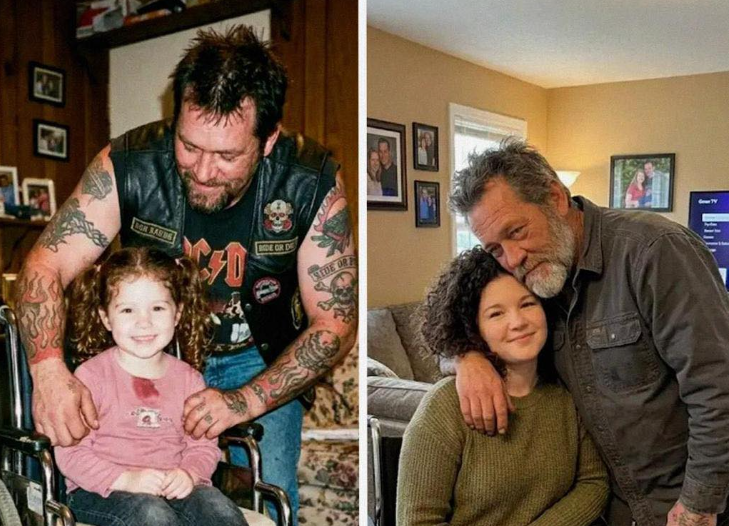
Hannah was twenty-six when her uncle’s funeral ended, and the house settled into a silence unlike anything she had known before. It was not the quiet of an empty room, but something deeper—a stillness that marked the end of a chapter that had shaped her entire life.
As people slowly left and the last voices faded, Mrs. Patel approached her. The older woman held a sealed envelope with trembling hands, her eyes still red from tears.
“Your uncle asked me to give you this after he passed,” she said softly. “And he wanted me to tell you he’s sorry.”
Hannah took the envelope, confusion rising immediately. She couldn’t understand what he meant. Sorry for what?
Her story had always seemed clear. When she was four years old, a car accident took her parents and left her unable to walk. That was the version she had grown up with. That was the truth she carried.
Before that moment, she had faint memories of a different life. Her mother Lena singing in the kitchen, her voice off-key yet filled with warmth. Her father Mark returning home with the familiar scent of motor oil and peppermint gum. There had been small joys—colorful shoes, favorite cups, strong opinions about everything.
Then everything changed.
After the accident, she found herself in a hospital bed while adults discussed her future in careful, distant tones. A social worker stood nearby, offering reassuring words about finding a safe place for her to live.
That was when her uncle Ray entered the room.
He was a man who carried strength in his posture and determination in his voice. Without hesitation, he made a decision that would shape both of their lives. He brought Hannah home, stepping into a role he had never prepared for.
Ray had no experience raising a child, especially one with complex needs. Even so, he learned. He observed, took notes, and adapted. He found ways to support her, often through trial and error. He built ramps, adjusted spaces, and created routines that allowed her to live with dignity and independence.
His methods were not perfect, though they were consistent. He woke during the night to check on her, adjusted her position to keep her comfortable, and spoke to her with reassurance when she felt uncertain. He handled every responsibility with determination, even when exhaustion was visible.
Over time, Hannah’s world became centered around their home. Ray worked to make that space as complete as possible. He adjusted shelves so she could reach them, built tools to support her learning, and found ways to bring small joys into her daily life.
Years passed, shaped by effort and routine. Then, gradually, Ray began to change. He moved more slowly, grew tired more easily, and struggled with tasks that once felt simple. When he finally sought medical help, the diagnosis was serious.
The time that followed moved quickly. Medical equipment filled the house, and the quiet routines they had built began to shift.
The night before he passed, Ray sat beside her and spoke with honesty. He told her she had been the most important part of his life. He encouraged her to keep moving forward, to live fully. Then he apologized.
The meaning of that apology became clear when Hannah opened the letter.
Inside, Ray shared a truth he had kept hidden for years. The night of the accident had not unfolded the way she believed. There had been an argument, strong emotions, and decisions made in a moment of anger. He had known circumstances that might have changed the outcome, yet he had allowed events to continue.
That realization shifted everything.
As she read, she learned not only about that night, but also about the years that followed. Ray described his actions as an effort to make things right in the only way he could. Every choice he made—every adjustment, every sacrifice—was part of that effort.
Hannah sat with the letter for a long time, absorbing what it meant. Her understanding of the past had changed, though her memories of Ray remained.
In the weeks that followed, she began a new chapter. She enrolled in a rehabilitation program, choosing to explore possibilities that had once seemed distant. The process was demanding, requiring patience and persistence.
During one session, supported by a harness, she stood. It lasted only a few moments, though it carried meaning far beyond the action itself. It represented movement, effort, and the continuation of a path that Ray had helped begin.
Her feelings toward him remained complex. Some days, she felt the weight of what had happened. Other days, she remembered the care he had shown—the quiet actions, the consistent presence, the way he had shaped her world.
Over time, she began to understand that forgiveness is not always immediate. It can take form gradually, shaped by reflection and experience.
Ray had lived with his choices and responded through action, dedicating his life to supporting her. His journey had ended, though the path he helped create continued forward.
Now, that path belonged to Hannah.