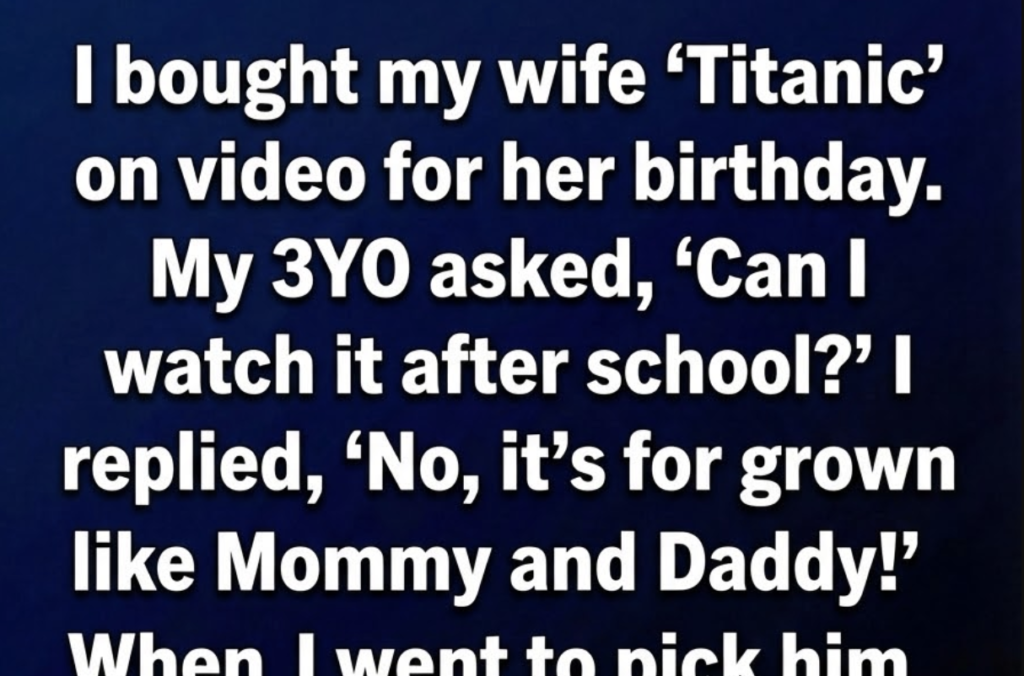
I bought the movie Titanic as a birthday surprise for my wife, wrapping it with care and placing it on the kitchen counter where she would notice it later. It felt like a simple, thoughtful gesture—something familiar and meaningful that we could enjoy together after a long day. The idea was to share a quiet evening, revisiting a story we both remembered from years ago. At the time, it seemed like an ordinary decision, the kind that barely registers amid daily routines.
That same morning, our three-year-old spotted the DVD case almost immediately. His curiosity sparked the moment he saw it resting on the counter. He picked it up, studied the cover, and asked if he could watch it after school. His voice carried genuine excitement, the kind that comes from discovering something new and interesting. Smiling, and without giving the response much thought, I told him it was a movie for grown-ups, something Mommy and Daddy watched together. He nodded slowly, taking in my words with great seriousness, as though he had been entrusted with an important rule about how the world worked.
What I failed to consider was how deeply a young child can reflect on a single sentence. To him, “for grown-ups” carried a weight far beyond my intention. During the day, that idea apparently grew larger and more important with every retelling in his mind. Children have a remarkable way of assigning meaning where details are missing. Without context, imagination fills in the gaps. In his thoughts, the movie transformed into something mysterious and symbolic, a secret ritual belonging exclusively to parents. It was no longer a film about a ship or a love story. It became a marker of adulthood.
Later that afternoon, when I arrived at his school to pick him up, I noticed something unusual right away. The teacher greeted me with a warm expression that hinted at barely contained laughter. Nearby parents smiled in a way that suggested they were sharing in a story I had yet to hear. Before I could ask, the teacher gently explained that my son had been enthusiastically telling everyone about a “special movie” his parents had at home. According to him, children were not allowed to watch it because it belonged only to adults. He shared this information proudly, fully convinced he was passing along something significant.
Hearing it explained that way made the situation both amusing and slightly uncomfortable. To adult ears, his words carried meanings he never intended. To him, it was a simple fact stated with confidence and innocence. The teacher assured me it had all been taken in good humor, though it had certainly become the highlight of the day. As I listened, I felt a mix of embarrassment and admiration for how sincerely he had delivered his message.
That evening, once we were home, I shared the story with my wife. We laughed together, picturing our son explaining his version of events with complete seriousness. The laughter was warm and affectionate, the kind that comes from recognizing how unpredictable parenting can be. It reminded us that children absorb language carefully, even when their understanding follows a different path than our own. Words spoken casually can take on new lives once filtered through a child’s perspective.
The experience offered a quiet lesson. Parenting is filled with moments where intention and interpretation travel separate roads. A phrase meant to be practical can turn into a story retold with great conviction. That night, we watched the movie together as planned, still smiling at the unexpected turn our simple gift had taken. More than anything, the moment became a reminder to speak thoughtfully and to appreciate the humor woven into everyday family life.
Years from now, the memory will likely resurface as one of those stories retold with fondness. It stands as proof that small misunderstandings often become the most memorable moments. Through them, parents learn patience, awareness, and humility. In the end, it was not the movie itself that made the birthday special, but the shared laughter and the reminder that even ordinary days can leave lasting impressions on young minds.