My name is Donna. I’ve been a nurse for thirty-one years, the last twenty-two of them on nights in the ICU at St. Brendan’s.
Nights are their own country. You learn to eat dinner at 2 a.m. You learn which vending machine steals quarters. You learn that the worst news usually comes between three and five, when the body is tired of fighting.
And you learn where to park.
My spot is the first one by the staff entrance, under the security light. I’ve parked there since 2004. Everyone knows it. The security guards wave at my old Camry. Once, when I was out for my knee surgery, somebody put a little sign on the wall that said “RESERVED FOR DONNA’S CAR, GET WELL.”
In September, the hospital got a new administrator. His name was Bradley Kemp. He was thirty-four, wore suits that fit him too well, and said “optimize” in every meeting.
His first memo was about parking.
Staff were to park in the far lot, a quarter mile away, past the loading dock. The near spots were “for leadership and premium visitors.”
I didn’t think he meant my spot. My spot didn’t have a sign. It had a plaque.
Small, brass, about the size of a paperback, screwed into the brick above it. It had been there so long, nobody read it anymore. The rain had turned it green at the edges.
On October 3rd, at 3:10 a.m., I was doing chest compressions on a seventy-year-old man named Mr. Alvarez. We got him back. I sat in the break room afterward with my hands shaking, drinking cold coffee.
At 7:05, I walked outside.
My spot was empty.
There was a tow-company sticker on the brick wall, right under the plaque. And a printed notice in a plastic sleeve:
Vehicle removed per Administrative Policy 14-B. Contact Henderson Towing.
I called. It was $340 to get my car back, cash or card, by noon, or it would be $40 more every day.
I took an Uber to a gravel lot on the edge of town and paid it with the credit card I keep for emergencies.
When I went back that night, Mr. Kemp was in the hallway outside the ICU, talking to our charge nurse.
“Mr. Kemp,” I said. “You towed my car. I was in a code.”
He didn’t even look embarrassed.
“Rules are rules, nurse. That spot is reserved.”
“For who?”
“For leadership.” He smiled. “I’m sure you understand.”
I didn’t argue. I was too tired.
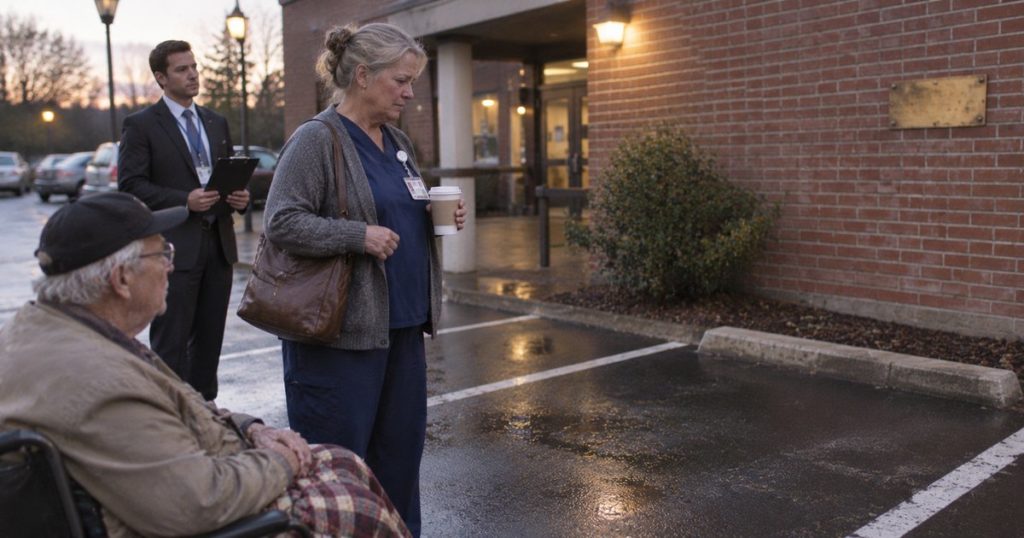
But the next morning, when I came out at seven, there was an old man in a wheelchair sitting in the empty spot, with a plaid blanket on his knees and a thermos in his lap.
He was waiting for someone.
And when Mr. Kemp’s silver Audi pulled in, the old man rolled forward, blocked the car, and pointed up at the little brass plaque.
“Son,” he said. “Before you park there. Read that out loud for me.”
Mr. Kemp got out of his car with his coffee and his lanyard. He looked at the old man the way people look at a shopping cart that’s rolled into the road.
“Sir, this is a reserved space. Can I help you find visitor parking?”
“You can help me by reading,” the old man said. “My eyes aren’t what they were.”
Mr. Kemp sighed. He looked up at the plaque, squinted at the green edges, and read it in a bored voice.
Then he slowed down.
“This space is reserved, for as long as she works at this hospital, for Nurse Donna Pruett, who on the night of February 11, 2004, kept my son alive for forty-one minutes until the surgeon arrived. — Walter E. Hagan, Chairman, Hagan Foundation.”
He stopped reading.
The old man took the cap off his thermos.
“I’m Walter Hagan,” he said. “My foundation paid for the building you’re standing next to.”
February 11, 2004
I remember that night better than I remember my own wedding.
His son, Tommy, was nineteen. He’d hit a patch of black ice on Route 9 and gone into a tree. He came into my unit with a crushed chest and a blood pressure I could barely find.
The trauma surgeon was stuck on the other side of the river, behind a jackknifed truck.
So it was me, a respiratory therapist named Gus, and a second-year resident who was so scared his hands shook.
I don’t remember everything we did. I remember counting out loud. I remember Gus saying, “Donna, he’s still here, he’s still here.” I remember the surgeon finally running through the doors in his ski jacket, snow on his shoulders, and saying, “Who kept this kid alive?”
Forty-one minutes.
Tommy lived. He’s forty-one now. That always felt right to me, somehow.
The plaque
A month after Tommy went home, Mr. Hagan asked the hospital president to put up the plaque. I was embarrassed. I asked them not to.
“You park in the cold at seven in the morning after saving people’s lives,” he said. “The least I can do is give you a closer walk.”
Then I forgot about it. That’s the truth. After a few years, it was just my spot.
Mr. Hagan hadn’t forgotten.
The parking lot
By now, a little crowd had gathered. Two security guards. The day charge nurse. A housekeeper named Rosa, who’d been here longer than me. A couple of residents coming off shift.
Mr. Kemp’s face had gone from pink to white.
“Mr. Hagan,” he said. “I had no idea. Nobody briefed me on the plaque.”
“Nobody had to,” Mr. Hagan said. “It’s written on the wall.”
He poured coffee from his thermos into the little cup and held it out. Not to Mr. Kemp.
To me.
“Tommy saw the tow notice on the hospital’s Facebook page,” he said. “Somebody posted a picture of it. He called me at six this morning. I haven’t heard him that angry since he was a teenager.”
I took the coffee. My hands were shaking again, like after the code.
“I’ll refund the towing fee personally,” Mr. Kemp said quickly. “Today. Plus a gift card.”
“You’ll refund it,” Mr. Hagan agreed. “And you’ll do one more thing.”
Policy 14-B
That afternoon, the hospital president sent out a new memo.
Administrative Policy 14-B was “under review.” Night shift staff, effective immediately, could park in the near lot. All of it. Every spot.
The leadership spaces moved to the far lot, past the loading dock.
The memo didn’t say why. It didn’t have to. By lunch, every nurse in the building knew.
Mr. Kemp came to the ICU that night with a check for $340 and a bakery box of donuts. He stood at the nurses’ station like a kid outside the principal’s office.
“I’m sorry, Ms. Pruett,” he said. “I read a policy. I didn’t read the wall.”
“Most people don’t,” I said. And I took a donut, because I’m not made of stone.
Six a.m.
I still park in my spot. The plaque is still there. Somebody from maintenance polished it, and now the brass shines under the security light like it’s brand new.
Under it, someone added a second sign. Hand-lettered, laminated, a little crooked.
“Also reserved: anyone who stayed when it would have been easier to leave.”
Nobody will say who put it there.
But last week, at six in the morning, I saw Mr. Kemp in the far lot, walking a quarter mile in the rain to the building, carrying his coffee.
He waved at me.
I waved back.
Have you ever had someone remember a kindness you’d almost forgotten? Tell us about it.
Read next
 My New Neighbor Filed a Complaint About the 78-Year-Old Widower’s Blinking Christmas Lights. Then a Retired Navy Radioman Walked Over, Watched Them for a Minute, and Started to Cry
 A Teenage Waitress Paid for My Coffee Every Morning for a Month and Wouldn’t Tell Me Why. Then I Saw Her Car in the Diner Parking Lot at 5 a.m. With Fogged-Up Windows and a Pillow Against the Glass
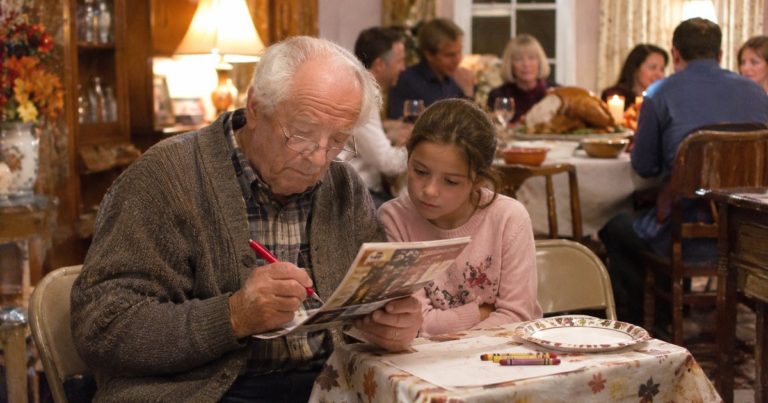 My Son-in-Law Sat My 81-Year-Old Father at the Kids’ Table on Thanksgiving Because “He Can’t Follow the Conversation.” Then Dad Read Trent’s Investment Brochure and Took Out a Red Pen