Every family carries certain rituals that quietly define who they are, and in our home, Sunday dinners were the anchor that held everything in place. No matter how busy life became or how far adulthood pulled us in different directions, those evenings at my mother’s table never changed.
After my father died three years ago, those gatherings took on deeper meaning. For Mom, they were a way to preserve continuity, to keep his presence woven into our lives through familiar meals, shared laughter, and the comfort of knowing that, for a few hours each week, we were still whole.
That is why the message she sent one Sunday afternoon felt so wrong.
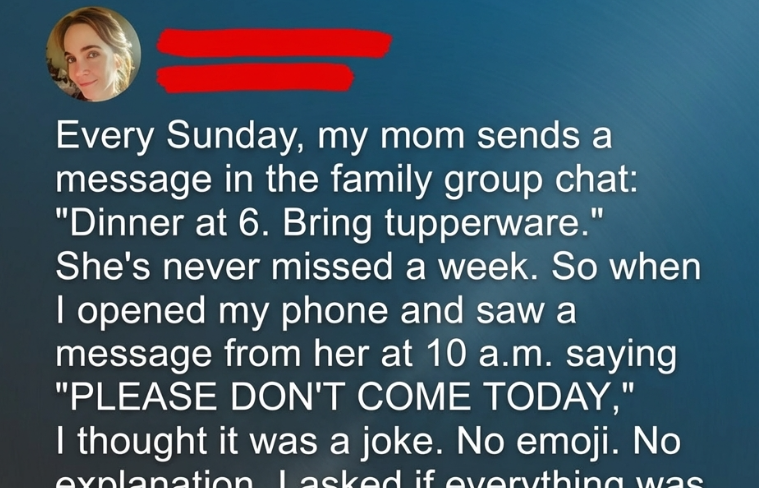
“Please don’t come today.”
There was no explanation. No softening words. No heart emoji or follow-up. My brother and I read it within seconds of each other. We didn’t need to discuss it. The absence of warmth said everything. Something serious had happened. Without responding, we grabbed our jackets, locked our doors, and drove straight to her house, both of us replaying worst-case scenarios in our minds.
When we arrived, the porch light was on, glowing the way it always did when she expected us. That familiar sight should have been reassuring, yet that night it felt heavy. We knocked. Nothing. I pulled out my spare key, stepped inside, and called her name.
The kitchen stopped us both mid-step.
A man sat at the table with his back to us. His build, his posture, the way he leaned slightly forward—it all felt painfully familiar. For a split second, my breath caught. From behind, he looked like our father. My brother froze beside me, clearly seeing the same thing. At the counter, Mom stood slicing carrots in slow, deliberate motions, her face drained of color, her shoulders tense.
She didn’t turn around when she spoke.
“Why didn’t you listen?”
The man slowly turned his chair toward us. His face wasn’t identical, yet the resemblance was undeniable. The same eyes. The same expression around the mouth. The same quiet presence. It felt as though a door had opened to a version of reality we were never meant to see.
Mom placed the knife down and faced us, tears already forming. She took a breath and told us the truth.
The man was James.
Our father’s twin brother.
We had never heard his name before, not once in our entire lives.
She explained that she had known James long before she met our father. In her younger years, they had shared a serious relationship, one she believed would shape her future. Then, without warning or explanation, James vanished. No calls. No letters. No closure. That loss left her shaken and unsure of herself. It was during that period that our father entered her life, offering patience, kindness, and stability when she needed it most. Love grew slowly, then firmly, into the marriage and family we knew.
Years later, she told Dad everything. He listened. He forgave her. What he could not forgive was his brother’s disappearance and the pain it caused. He drew a boundary that never wavered: James was to remain outside their lives. And for decades, he did.
Until now.
James had returned, asking for forgiveness and hoping to know the family he had never been allowed to meet. He spoke little, letting Mom explain while he sat quietly, hands folded, eyes lowered. My brother and I listened, torn between empathy and anger, between curiosity and loyalty.
When Mom finished, the room felt unbearably still.
I spoke first. My voice was steady, though my chest felt tight. We told James that his return had reopened wounds that never needed reopening. We made it clear that our commitment was to the parents who raised us and the life we lived. This wasn’t revenge. It was protection. It was a boundary.
James nodded. He stood, thanked Mom softly, and left without protest.
The moment the door closed, Mom collapsed into sobs. Years of guilt she had carried alone finally surfaced. We held her, reminding her that the life she built was real, that her marriage with Dad was honest and strong, that our childhood had been full of love.
That night looked nothing like our usual Sundays. There was no carefully prepared meal. We ordered pizza, poured tea into mismatched mugs, and sat together until the house felt calm again.
Before we left, Mom sent one final message to the family group chat.
“Dinner next Sunday, 6 p.m. Bring tupperware. And maybe a hug.”
Reading it, I understood something clearly. Families aren’t held together by flawless histories or perfect transparency. They survive because people choose each other, even when the truth is uncomfortable. That night didn’t break us. It reminded us why we stayed.