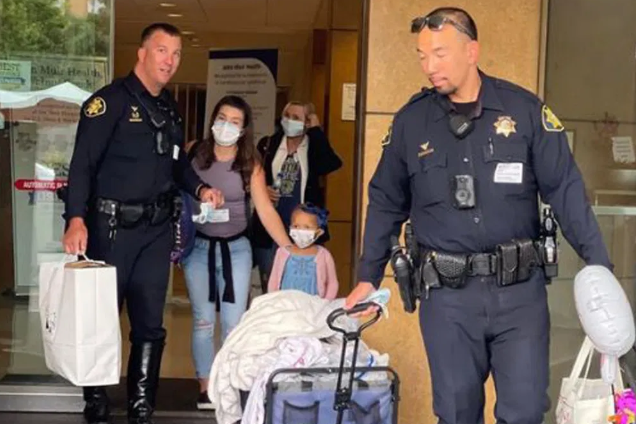
When they finally told us we could leave, I should’ve felt relief.
Instead, I felt numb. My daughter smiled behind her mask, clutching her stuffed bunny and waving to every nurse in sight. But I couldn’t shake the weight in my chest.
We had nowhere to go.
Our rent had lapsed months earlier while I stayed at the hospital with her—day and night—waiting through treatments and test results. Her father had been gone a long time. My job said they “understood,” but the calls stopped two weeks ago. I knew what that meant.
I kept it all hidden. Smiled for her. Brushed her hair back. Let her pick a balloon from the gift shop, even though I knew we couldn’t afford it.
Then, two police officers showed up in the lobby.
For a moment, panic gripped me. I thought it might be about the bills or unfinished paperwork.
But one of the nurses leaned in and whispered, “It’s okay. They’re here to help.”
The officers offered to carry our bags and escort us to a “temporary placement.” I didn’t know what that meant, and I was too exhausted to ask.
We walked out like any other family—wheels squeaking on the hospital floor, nurses waving their goodbyes.
Once outside, one of the officers leaned in and handed me a plain white envelope.
“Wait until you’re in the van to open it,” he said quietly.
Now we’re in the van.
The envelope sits in my lap.
I notice a name written on the corner—his name.
“Mommy,” my daughter Callie tugged on my sleeve. “Can we get ice cream?”
Her voice was so full of hope, so innocent, it nearly undid me. How do you explain to a six-year-old that there’s no money left? That your world is unraveling?
“Maybe later, sweetheart,” I said, forcing a smile. “Let’s just see where we’re going next, okay?”
She nodded and turned her gaze to the window. The city blurred past. Every so often, she’d point at something—a dog trotting by, a mural on a building—and her excitement softened the ache in my chest.
But that envelope…
It felt heavier than it should. Why the secrecy? Why wait until we were inside to open it? And the name—it looked familiar, but I couldn’t quite place it through the fog in my head.
Eventually, the van pulled into a quiet neighborhood. The houses were small but well-kept. Lawns trimmed, flowers in bloom.
We stopped in front of a blue house with white shutters. A woman stood on the porch, arms crossed, watching us approach.
“This is your temporary placement,” one officer said. “Mrs. Harper will take care of you until other arrangements can be made.”
Temporary placement? Was this foster care? A shelter? I didn’t understand. But before I could ask, the officers were already stepping out.
“Wait!” I called out. “What about—”
“Open the envelope,” the younger officer said softly, giving me a knowing look before closing the door.
Callie bounced beside me as Mrs. Harper walked up. She looked to be in her late fifties, silver streaks in her bun. Her eyes softened as she looked at Callie, and she smiled.
“Welcome,” she said, helping us with our things. “Let’s get you settled.”
Inside, the living room was cozy. I sat on the edge of the couch while Callie curled beside me. Mrs. Harper disappeared into the kitchen, leaving us alone.
My fingers trembled as I picked up the envelope. The name on the corner: Derek Monroe.
My breath caught. Derek… it couldn’t be. Could it?
I tore it open, heart racing. Inside was a sheet of paper and a key taped to a note card. The card read:
“This isn’t charity. This is family. Go to 427 Maple Street. Everything will make sense there.”
That was the address of the house we were in.
I stared, confused. Who would send this? Why?
I unfolded the letter. As I read, tears welled up in my eyes.
Derek Monroe—my older brother. We hadn’t spoken in years, not since he moved away after college. Life took us in different directions, and we’d lost touch. I didn’t even know if he still lived nearby.
But the letter said he’d been watching from afar—through mutual friends, social media, whatever it took. When he learned about Callie’s illness and my struggles, he stepped in.
“I may not have been there before,” the letter read, “but I’m here now. This house is mine—paid off and fully furnished. It’s yours for as long as you need. No strings. Just promise me you’ll let me be part of your lives again.”
I pressed the letter to my chest, overwhelmed. I thought he’d forgotten me. But here he was, reaching out when I needed someone most.
Mrs. Harper returned with lemonade and cookies. She set the tray down and looked at me. “You look like you’ve seen a ghost.”
“It’s… a lot,” I said, handing her the letter. As she read, her expression softened.
“He’s a good man,” she said. “Quiet. Keeps to himself. But he has a good heart. He asked me to look after you both.”
Safe. Hopeful. Seen. That’s how I felt in that moment.
In the days that followed, Derek reached out. First with texts, then calls. Then one evening, he knocked on the door—pizza in hand, board games under his arm. Callie immediately took to him, talking nonstop about cartoons and showing him her drawings.
Watching them together filled me with a quiet, aching joy. For so long, I’d been carrying everything on my own. But now, I didn’t have to.
Months passed. Life slowly settled into something resembling normal. Derek helped me land a part-time job at a bookstore. Callie started school again. She made friends. She smiled more.
One evening, as we sat on the porch watching the sunset, Derek turned to me.
“You know this doesn’t change anything, right? You’re still my sister. Always.”
I nodded, eyes stinging with tears. “Thank you,” I whispered. “For everything.”
Life’s still messy. There are hard days ahead. But for the first time in a long time, I feel like I’m standing on solid ground.
If there’s one thing I’ve learned, it’s this: Don’t be afraid to ask for help. And when help finds you, let it in.
Family isn’t just blood—it’s the people who show up when it matters most.
If this story touched you, like and share it. Someone out there might be waiting for a sign that it’s okay to lean on someone, too.