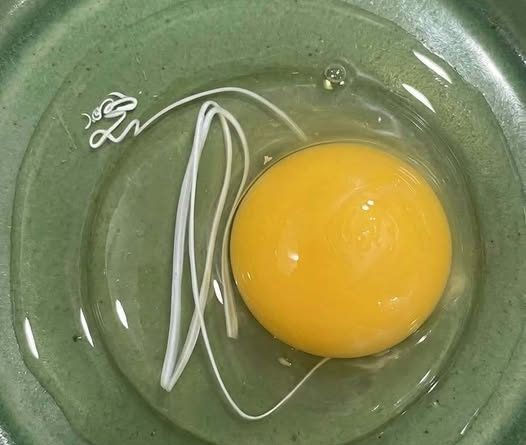
I sat motionless at the kitchen counter, staring into the bowl as a peculiar white strand drifted through the egg white. A wave of unease settled over me immediately. In a time when stories about food contamination and unexpected health risks seem to appear everywhere, my thoughts rushed toward the most alarming possibilities. Was it some type of parasite? Could it be a sign that the egg had gone bad? Had I accidentally brought something unsafe into my kitchen without realizing it?
The longer I studied the strange strand, the more uncomfortable I became. It was not something I could recall seeing before, and that unfamiliar sight made it feel suspicious. The thin white cord seemed oddly out of place, floating quietly inside an otherwise ordinary egg. Every glance at it fueled more questions, and none of the answers I imagined brought any comfort.
Determined to understand what I was looking at, I carefully opened the remaining eggs from the carton one at a time. I examined each egg closely, my concern growing with every inspection. My hands shook slightly as I searched for additional strands hidden inside the shells. I expected to find the same feature again, yet something surprising happened. Every other egg looked completely normal.
Rather than easing my worries, the discovery raised even more questions. Why did this particular egg contain the strange white strand? What made it different from the others? I knew my reaction might have been excessive, yet the feeling persisted. It seemed as though I had encountered something unusual, and I could not ignore the possibility that it meant something was wrong.
Curiosity slowly began to replace fear. Instead of continuing to speculate, I decided to investigate. I took a photograph of the egg and started searching through food safety guides, cooking websites, online discussions, and educational articles written by professionals. I expected to uncover a warning or some explanation related to spoilage. What I found was completely different from what I had imagined.
To my surprise, the answer was remarkably simple.
The mysterious white strand already had a name: the chalaza.
As I continued reading, I learned that the chalaza is a completely natural part of an egg’s structure. These small, twisted strands of protein serve an important biological purpose. Acting like tiny support cords, they help keep the yolk suspended in the center of the egg. Their job is to stabilize the yolk and protect it during normal movement.
The information immediately challenged everything I had assumed.
Far from being a sign of contamination, the chalaza is actually associated with freshness. Experts explained that eggs with more visible chalazae are often fresher than eggs in which the strands are less noticeable. The feature that had alarmed me was not evidence of a problem at all. It was a natural indicator that the egg was in excellent condition.
The realization changed my perspective almost instantly.
Moments earlier, I had been preparing for the possibility that I had discovered something unpleasant or unsafe. Instead, I had uncovered evidence of quality. The very detail that had sparked concern turned out to be a fascinating example of how nature protects and preserves the contents of an egg.
I found myself looking at the bowl with entirely different eyes. The strand that once appeared strange now seemed remarkable. It represented a small but important piece of a natural design that most people rarely notice. Something that had triggered anxiety became an unexpected lesson in biology and food science.
The experience stayed with me long after breakfast.
It reminded me how easily unfamiliar sights can create unnecessary worry. When we encounter something we do not recognize, our minds often rush to explanations based on fear rather than understanding. Many ordinary aspects of daily life can appear alarming when viewed without context.
In this situation, the unusual white strand was never a reason for concern. It was not a warning sign, a defect, or evidence of spoilage. It was a normal part of a fresh egg, performing the role nature intended it to perform.
By the end of my search, the anxiety had disappeared completely. Knowledge had replaced uncertainty, and understanding had taken the place of fear. What started as a stressful moment at the kitchen counter evolved into an educational discovery about something most people encounter regularly without ever noticing.
That simple experience served as a valuable reminder that appearances can sometimes be misleading. A detail that seems troubling at first glance may have a perfectly reasonable explanation waiting to be discovered. In this case, the mysterious white strand floating beside the yolk was not a problem hidden inside my breakfast. It was proof that the egg was fresh and healthy, a quiet example of nature working exactly as intended behind the scenes in one of the most common foods found in kitchens around the world.