
The scene was difficult to forget. A group of rescuers gathered outside a modest home in Sibu, Malaysia, preparing for an unusual and challenging emergency operation. Inside the house lay 33-year-old Sia Chie Herng, a man whose health had deteriorated to the point that he could no longer move on his own. According to reports shared by The Sun, Herng had spent years living a sedentary lifestyle while consuming extremely large quantities of food, including bowls of spicy noodles every day.
For nearly a decade, his daily routine had revolved around eating. Friends and family explained that noodles were his favorite meal, and he often consumed them in extraordinary amounts. Some days he reportedly ate up to 30 bowls, often topped with meat and accompanied by other high-calorie foods. After the noodles, he frequently added milkshakes and ice cream to his meals, creating a pattern of eating that continued for many years.
At first, Herng remained capable of moving slowly around his home with the assistance of a walking frame. His mother later explained that although his weight had increased significantly, he still managed basic movement for a long time. However, the situation began to change in recent days. Gradually, swelling developed in his legs, and his energy levels dropped dramatically.
Over the course of a few days, the problem worsened. Herng began experiencing chest discomfort and found it increasingly difficult to stand. Eventually, he became completely unable to move from his bed. For four days he remained confined to the same spot in the living room, unable to walk or shift position without assistance.
Concerned family members contacted emergency services for help.
When firefighters arrived at the house on Tuesday morning, they quickly realized that the situation required an unusual approach. Herng weighed approximately 320 kilograms, making it impossible for a standard ambulance crew to transport him safely using conventional equipment.
Sarawak Fire and Rescue Department assistant director of operations Farhan Sufyan Borhan described the scene when responders entered the home.
He explained that the team arrived about an hour after receiving the emergency call and found Herng lying in the living room, unable to move. The responders assessed the situation and determined that the ambulance available at the scene could not accommodate his size or weight.
Instead, they called for a larger rescue vehicle.
A five-tonne lorry from the department’s fleet was dispatched to assist with the transport. In order to move Herng from the house to the vehicle, rescuers prepared a large wooden board reinforced with heavy cloth. The board would serve as a makeshift stretcher capable of supporting his weight.
The operation required the coordinated effort of twenty rescuers.
Working together, the team carefully positioned the board beneath Herng and slowly lifted him. The process required patience and constant communication between the responders to ensure safety for both the patient and the team members involved.
Borhan later explained that cases of this nature are rare, and lifting someone of that size presents significant logistical challenges. Despite the difficulty, the rescuers continued working steadily to ensure that Herng could be transported to medical care as quickly as possible.
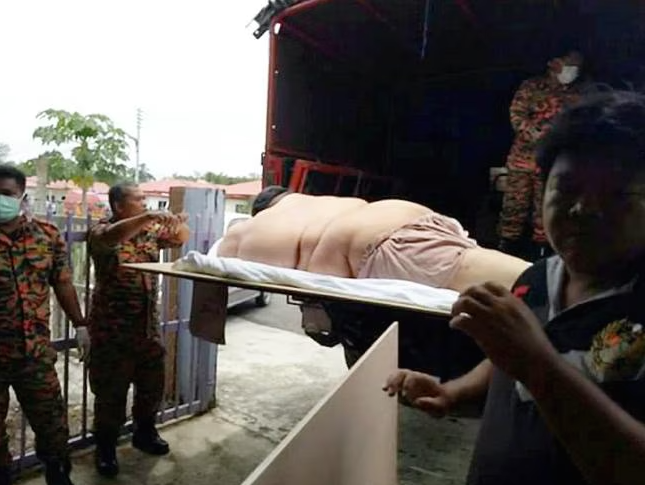
The entire process of moving him from the house to the lorry took more than thirty minutes. Step by step, the team carried the board outside and carefully loaded it into the back of the truck.
Shortly after 1 p.m., the vehicle arrived at the hospital, where medical staff were prepared to receive him.
Doctors immediately began evaluating his condition. Initial reports indicated that Herng was experiencing severe swelling in his legs, which likely contributed to his sudden inability to move. Medical teams continued monitoring his health and running tests to better understand the extent of the complications.
His mother later spoke about the situation, explaining that although his weight had increased significantly over time, he had previously been able to move slowly with the support of a walking frame. However, during the days leading up to the emergency call, his condition worsened rapidly.
According to her, the swelling became severe and his strength declined until he could no longer stand or walk.
Friends also expressed concern and support during the situation. One of Herng’s acquaintances, Afiq Mayang, described him as a friendly person who enjoyed watching sports and movies at home. He also mentioned that Herng had always loved food, particularly noodles.
Some days, Afiq said, Herng would eat 20 or even 30 bowls of noodles in a single day, often adding meat and finishing the meal with ice cream and milkshakes.
Although the circumstances surrounding the rescue attracted attention, many people close to Herng expressed hope that his hospital treatment would help him recover and improve his health moving forward.
For the firefighters and medical staff involved, the incident served as a reminder that emergency response situations can take many different forms. In this case, teamwork and careful coordination allowed rescuers to transport a patient safely despite the challenges.
Now, while doctors continue evaluating his condition, family members and friends remain hopeful that Herng will regain strength and receive the support needed for a healthier future.