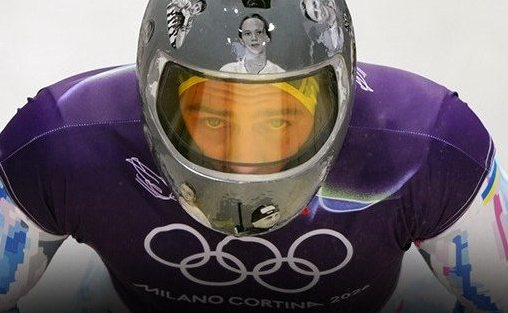
In a dramatic and widely discussed moment at the Milano Cortina 2026 Winter Olympics, Ukrainian skeleton athlete Vladyslav Heraskevych found his Olympic campaign halted before it could begin.
He was disqualified after refusing to remove a custom helmet created to honor fellow Ukrainians killed during Russia’s ongoing war with Ukraine.
The ruling from the International Olympic Committee (IOC) came only minutes before the men’s skeleton competition was scheduled to start on Thursday, February 12, 2026, in Cortina d’Ampezzo — bringing the 27-year-old athlete’s Olympic dream to an abrupt end.
The decision immediately sparked intense debate about the limits of athlete expression, the meaning of neutrality under Rule 50 of the Olympic Charter, and how global sporting institutions navigate remembrance during times of conflict.
A Helmet Designed as a Memorial
Heraskevych described his helmet as a “helmet of remembrance.” It featured more than 20 portraits of Ukrainian athletes, coaches, and children who have died since Russia’s full-scale invasion of Ukraine in 2022.
The images were intended as a tribute — a way to ensure that the faces of those lost would not disappear amid the spectacle of the Olympic Games.
For Heraskevych, the helmet carried deep personal meaning. He explained publicly that it was not intended as a protest or condemnation of any country. Instead, he viewed it as an act of honoring fellow Ukrainians who could no longer represent their nation.
In previous social media posts, he wrote that remembrance mattered more than any medal pursuit, emphasizing dignity and memory above competition.
Even so, IOC officials determined that the visible imagery violated Rule 50 guidelines, which restrict political, religious, or racial demonstrations during Olympic competition.
Negotiations Before the Competition
On the morning of the skeleton event, IOC representatives — including IOC President Kirsty Coventry — met with Heraskevych in attempts to resolve the situation.
According to officials, the organization did not object to the message itself. Instead, they focused on the placement of the imagery during active competition, where uniform and equipment rules are strictly enforced.
Coventry publicly acknowledged the emotional weight of the tribute, calling the message “powerful” and describing it as one of remembrance. However, she emphasized that compliance with competition regulations was required.
Officials proposed alternatives. Among them was wearing a black armband during competition to symbolize mourning. They also suggested displaying the helmet before or after the event, outside the competitive arena.
Heraskevych declined the compromise. He maintained that the helmet was appropriate and respectful, and that removing it would diminish the tribute’s meaning.
Formal Disqualification
Minutes before the men’s skeleton heats were set to begin, the IOC and the International Bobsleigh and Skeleton Federation (IBSF) ruled the helmet non-compliant.
His name was removed from the start list.
In an additional step, Olympic accreditation was withdrawn, making him ineligible to compete further in the Games and removing access to official Olympic zones.
In a brief statement afterward, Heraskevych acknowledged the ruling with visible disappointment. He stated that he understood the IOC’s position, yet remained convinced that honoring those lost was essential.
Leadership Response
IOC President Kirsty Coventry addressed the situation publicly in the days following the incident.
She reiterated that the organization’s intention had been to find a solution allowing Heraskevych to compete while respecting Olympic neutrality rules.
“No one is disagreeing with the messaging,” Coventry said, emphasizing that the challenge centered on its presentation during official competition.
Her comments reflected the broader tension between honoring individual expression and maintaining institutional neutrality within the Games.
Ukrainian and International Reaction
The Ukrainian National Olympic Committee expressed support for Heraskevych, stating that the helmet did not contain political slogans or inflammatory messaging. They described it as a tribute to fallen athletes and members of Ukraine’s sports community.
Observers worldwide debated whether Rule 50 had been applied too rigidly. Some pointed to past Olympic moments where symbolic gestures generated controversy but resulted in varying consequences.
The case quickly drew international attention, fueling discussions across media platforms and social networks about the intersection of sport and global conflict.
Appeal to the Court of Arbitration for Sport
Heraskevych’s legal team announced plans to appeal to the Court of Arbitration for Sport (CAS). The appeal sought reinstatement or permission to compete under supervision while the matter was reviewed.
Given the competition schedule, the case carried urgency.
At the time of reporting, the outcome of the appeal remained uncertain.
Broader Implications
The controversy highlighted a recurring question in international sport: how to balance neutrality with remembrance.
While the Olympic movement promotes unity beyond politics, athletes often carry personal and national experiences that cannot be separated from global events.
For many supporters, the helmet symbolized memory rather than advocacy. For Olympic officials, uniform rules were designed to protect competitive neutrality.
Regardless of perspective, the incident became one of the defining moments of Milano Cortina 2026.
Vladyslav Heraskevych arrived at the Games as a serious medal contender. His exclusion altered the narrative of the competition and underscored how global events shape even the most carefully structured sporting environments.
Whether or not CAS revisits the ruling, the debate surrounding his decision is likely to remain part of the legacy of these Winter Games — a reminder that athletes compete not only with physical strength, but with personal convictions shaped by the world beyond the arena.