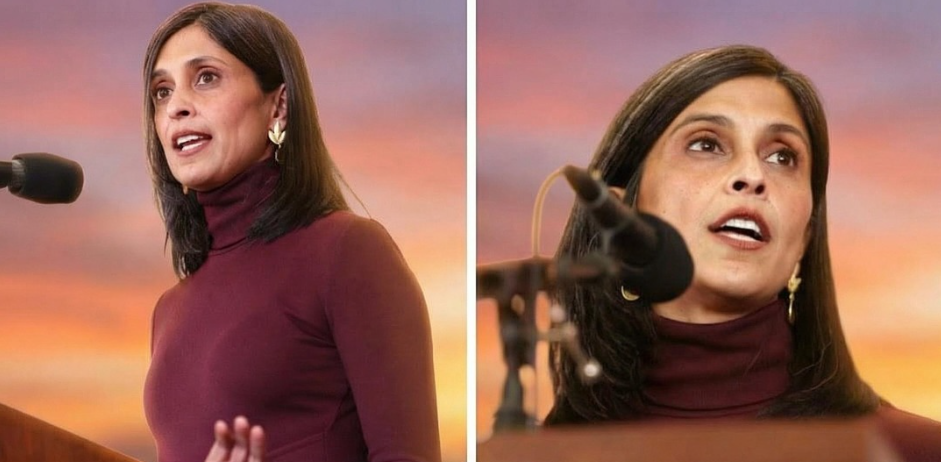
Second Lady Usha Vance has long been recognized for maintaining a composed and reserved public presence. For that reason, her brief remarks to USA Today in December 2025 quickly drew attention. As the wife of Vice President JD Vance, she has rarely spoken publicly about her personal life, choosing instead to keep the focus on her professional work, family responsibilities, and the broader role she occupies in public service.
In recent months, online conversations about her marriage began circulating across social platforms, prompting increased speculation. Rather than remaining silent or allowing assumptions to spread unchecked, Usha chose to respond in a limited but deliberate way. Her comments reflected careful consideration, offering insight into how she manages public curiosity while maintaining firm personal boundaries.
A significant portion of the online discussion centered on occasions when she appeared in public without her wedding ring. Some observers assigned meaning to the detail, interpreting it as a possible signal of marital issues. Addressing this directly, Usha explained that the absence of the ring was tied to practicality rather than symbolism. She shared that she sometimes leaves it off following activities such as exercising or showering, describing the habit as part of an ordinary routine.
Her explanation highlighted how easily routine actions can be elevated into narratives once they enter the public eye. What might otherwise pass unnoticed in a private life can quickly become a topic of widespread interpretation when attached to a political figure. Usha’s response underscored this reality without expressing frustration or defensiveness.
She also reflected on the broader culture of online commentary, acknowledging that families connected to public office often live under near-constant observation. Small visual details, she noted, are frequently examined and reinterpreted, with assumptions built upon limited information. Her remarks conveyed an understanding of this environment, paired with an apparent ability to maintain perspective.
Throughout her comments, Usha displayed a calm tone that suggested emotional distance from the speculation itself. Rather than reacting to each rumor, she appeared focused on preserving her sense of balance. Her approach indicated that she does not allow online discussions to dictate her emotional well-being or sense of identity.
Although her statements were concise, they carried a clear message about boundaries and perception. Not every visible detail holds deeper meaning, and public assumptions often fail to reflect private reality. Her words resonated with readers who recognized the pressure placed on political families in an era defined by constant digital scrutiny.
Some interpreted her response as a sign of confidence and self-assurance, noting her ability to address speculation without amplifying it. Others felt that her limited engagement left room for continued discussion, a reality that often follows any public acknowledgment of personal topics. Even so, her measured tone reinforced a consistent pattern in how she navigates public life.
Usha Vance has historically chosen dignity and restraint over visibility, and this moment aligned with that pattern. By responding without elaboration or emotional language, she maintained control of the narrative while declining to invite further intrusion. Her comments reflected an understanding that silence and brevity can sometimes communicate more effectively than extended explanation.
In a media environment driven by rapid interpretation and continuous commentary, her message served as a reminder that personal moments are not automatically public statements. Through clarity and composure, she demonstrated how it is possible to acknowledge curiosity without surrendering privacy. For many observers, her response illustrated a deliberate choice to remain grounded, even amid heightened attention.
As discussions continue online, Usha Vance’s remarks stand as an example of navigating public interest with intention. Her words reinforced the idea that visibility does not require full access, and that maintaining personal boundaries remains possible, even at the highest levels of public life.