Few sights are as wrenching as a creature, born to roam without boundaries, confined by the weight of captivity. For wild horses—embodiments of raw energy and boundless grace—the torment of heavy chains encircling their legs feels like a profound violation of their very essence.
In certain rural pockets of Romania, some farmers employ the practice of binding horses’ front or hind legs with chains, convinced it prevents them from straying. This method restricts the horses’ ability to run, graze freely, or even move with ease, leaving their instincts yearning for open spaces while their bodies remain tethered by cold, unyielding metal.
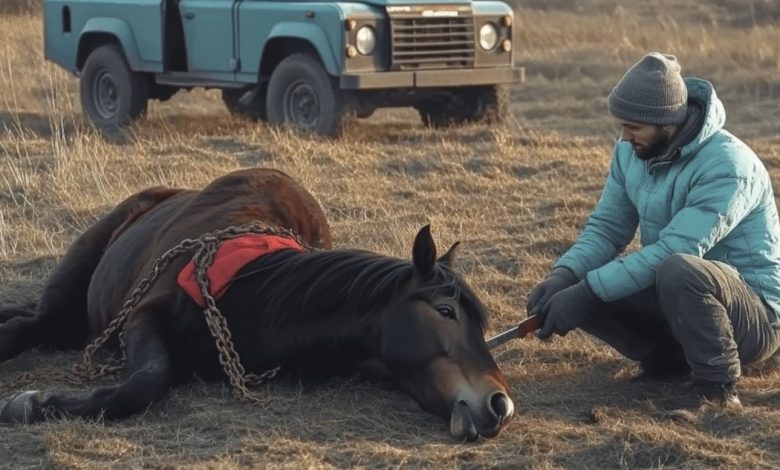
Dr. Ovidiu Rosu, a compassionate veterinarian renowned across the Danube Delta for his tireless dedication to healing injured and neglected wildlife, had long heard murmurs of such harsh practices. Yet, on a chilly morning, as he ventured into a secluded marshland path, he stumbled upon a sight that stirred both fury and sorrow: a majestic wild stallion, its once-shimmering coat matted with dirt and sweat, stood quivering under the burden of rusted chains cutting into its flesh.
No matter how gently Ovidiu approached—his voice soft, his hand extended with care—the horse could scarcely move. Each attempt to shift its weight sent sharp pangs through its legs, with traces of blood marking where the metal had bitten too deeply into tender skin. Its eyes, typically radiant with pride, now reflected a haze of fear and exhaustion.
Ovidiu’s resolve hardened. There was no time to delay. He reached for his worn leather satchel, pulling out heavy-duty wire cutters, pliers, and bandages. In a low, steady voice, he murmured, “Hold on, boy… I’m here for you.” Step by cautious step, he drew nearer, his calm presence masking the urgency racing through him.
Using a handful of crisp apples he always carried for such moments, Ovidiu enticed the horse to lower its massive head, easing its taut muscles. Slowly, the stallion sank to the damp grass, wary but too drained to resist, keeping one watchful eye on the veterinarian.
With the horse resting, its breathing heavy with relief, Ovidiu began his work. He donned thick gloves and carefully started to separate the rusted chain links. The task demanded patience: the chains were stubborn, their rust unyielding. Every so often, Ovidiu paused to stroke the horse’s trembling shoulder or whisper, “We’re almost done.”
Time stretched on, minutes blending into an hour. In the soft morning light, the marsh grew quiet, as if even the distant cries of waterfowl hushed in reverence. Then, with a decisive snap of the cutters, one chain fell away. Ovidiu repeated the process on the other leg, and soon the remaining chains dropped to the earth. The stallion was free.
For a moment, the horse remained still, its eyes blinking as if unsure of the newfound lightness around its ankles. It nudged a fallen chain with its muzzle, testing this unfamiliar freedom. Then, with a surge of strength, it rose—hesitant at first, then with growing assurance.
What followed was a moment of pure wonder. The stallion lifted its head, stretching its neck toward Ovidiu. In a tender gesture of trust, it pressed its muzzle against his shoulder, a silent expression of gratitude. Ovidiu stood motionless, his eyes glistening with tears, overwhelmed by the bond forged with one of nature’s proudest creatures.
Seconds later, the stallion broke into a gallop, its mane flowing wildly as it vanished into the misty horizon—revived, liberated, and whole once more.
No creature, wild or tame, should endure the weight of chains. Share this story if the stallion’s triumphant freedom and quiet “thank you” stirred your heart. Let it remind us all: acts of compassion and courage can transform lives—human and animal alike—in ways that ripple far beyond what we imagine.