This is one of those “it happened so fast” moments, but it’s turning into a massive fight at home and now I don’t know if I totally messed up.
I was out with my 5-year-old son, Wes, grabbing breakfast at this local café we go to every Saturday. It’s a chill spot; he always gets pancakes, we color, nothing elaborate. That day, two police officers walked in and sat a few tables over. Wes got incredibly excited. He’s into uniforms, badges, trucks—all the usual little-kid fascinations. He kept whispering, “Mommy, it’s the real police!”
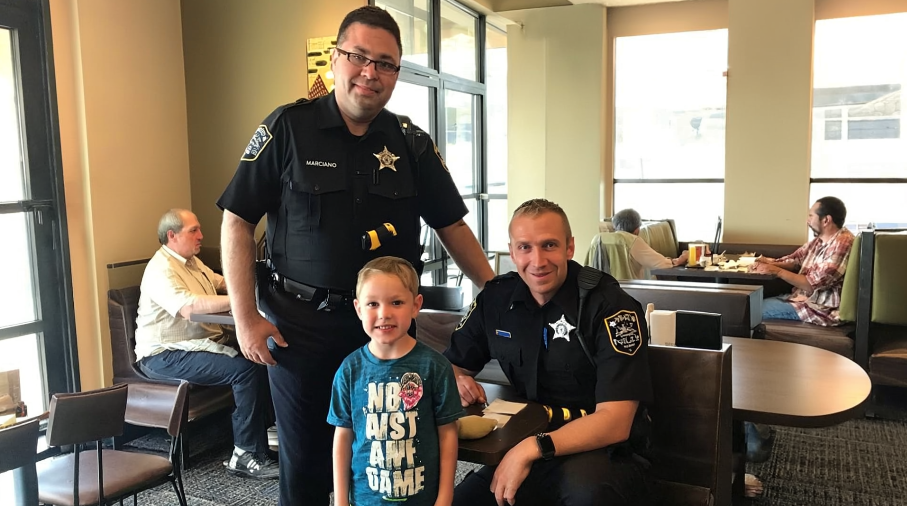
One of the officers smiled at him, waved, and eventually came over. He was exceptionally friendly. Wes was simply beaming. The officer even gave him a sticker badge, and the other one asked if Wes wanted a picture. Wes looked up at me with these giant hopeful eyes, and I agreed.
I took the photo. It was a sweet moment. Harmless, right?
Well… not according to his dad.
Later that night, I sent him the picture. We’re separated, co-parenting, usually quite civil. But this time? He became furious. He said I was “indoctrinating our son” and “parading him around for PR,” whatever that means. He’s very vocal about police brutality and systemic issues—he’s participated in protests, community work, the whole deal. I respect his stance, and I’ve never tried to diminish his views.
However, I honestly didn’t perceive this as political. It was two kind officers making a kid smile. That was all. But now he’s demanding I delete the photo, not show it to Wes again, and even stated we need to “revisit” our custody agreement if I’m going to keep “ignoring boundaries.”
I told him he was overreacting—and then he hit me with: “If a Nazi gave Wes a sticker and smiled, would you let him pose too?”
And now I’m sitting here wondering if I’ve been naive. Because then something happened that made me question everything.
A few days after the argument, Wes kept asking to see the photo. I had removed it from my phone after the disagreement, attempting to maintain peace. But he remembered. “Where’s the picture with the policemen, Mommy?” he asked, his lip trembling slightly. I simply told him it was gone and that perhaps we’d take more pictures some other time.
That night, I wept in the bathroom. I felt deeply conflicted. On one hand, I understand my ex’s perspective. He’s experienced things I haven’t, lived through situations I cannot fully relate to. But I also witnessed my little boy’s happiness. Pure, innocent joy. Was I supposed to suppress that simply to adhere to political consistency?
The next weekend, another event occurred.
We were at the park when Wes tripped over a rock and skinned his knee quite badly. I rushed to assist him, and simultaneously, a man nearby ran over. He had a medical kit in his car, he stated. He wore a uniform—another police officer. Off-duty, he was simply there with his dog. He cleaned Wes’s knee, applied a bandage, and even offered him a popsicle from his cooler. Wes ceased crying as he enjoyed a cherry-flavored one.
It did not feel like a political statement. It felt like kindness.
But of course, when I told Wes’s dad, he rolled his eyes and said, “Of course a cop offered help. That’s the narrative they favor—good guy in uniform, saving the day.”
That was when I began to notice something. My ex was not merely upset about the photo. He was upset that I had not automatically aligned with his viewpoint. He was upset that I had allowed my own judgment to guide my actions.
I asked him, gently, “Can we discuss this without escalating it into a custody issue?” He shook his head and muttered something about me being “part of the problem.”
The next morning, I contacted his sister. She and I have consistently maintained a positive relationship, and I needed an impartial listener. She sighed and said, “He means well. But sometimes, he forgets that activism is not the same as parenting. You are not a poor mother for allowing your child to experience childhood.”
That resonated deeply.
A few nights later, Wes and I were engaged in bedtime stories when he inquired, “Are police bad guys?” I froze. I asked him why he posed the question, and he replied, “Daddy says they hurt people. But the ones I met were nice.”
I found myself without an immediate answer.
I explained to him, “Some police officers act improperly, just as some individuals in every profession do. However, many strive to help. It is complex.”
He nodded slowly and then whispered, “Can I still appreciate the sticker?”
And that was my decision. I would not erase a pleasant memory to prove a point. However, I would not disregard the deeper implications either.
So I did something that surprised even me—I invited my ex to dinner.
Only us, after Wes was asleep. He was suspicious but accepted.
When he arrived, I had printed the photograph of Wes with the officers. I slid it across the table.
“I am not attempting to disrespect your views,” I stated. “But this is our son. He was happy in this moment. That is all I witnessed.”
He looked at the photo. He remained silent for a while. Then, finally, he said, “You do not comprehend what this signifies for me.”
“I do not,” I admitted. “But I wish to. Not at the expense of confusing or shaming our child for experiencing happiness.”
That was the turning point.
He then spoke openly.
He recounted an incident from when he was 17 and was stopped by police walking home from school. How they searched him, physically pushed him, verbally assaulted him. How no one believed him when he filed a complaint. How he still experiences tension when he sees flashing lights in his rearview mirror.
I listened intently. I genuinely listened. And I wept.
Then I shared my own perspective on the moment in the café. The joy on Wes’s face. How the officers reminded me of the compassionate individuals I’ve also encountered. I was not attempting to invalidate his pain; I simply desired both aspects of the truth to coexist.
He finally sighed and said, “You are not incorrect. Yet neither am I.”
And that marked the turning point.
We agreed to begin teaching Wes about both sides, in a manner appropriate for his age. We would allow him to appreciate the sticker. But we would also educate him about fairness, justice, and respect. We read books together with him—some about law enforcement, some about civil rights pioneers. We framed it as a matter of values, not opposing factions.
However, an unexpected development occurred.
A few months later, Wes’s preschool organized a “Community Helpers” week. They invited firefighters, nurses, and yes—police officers. One of the officers who participated was the very one from the café.
He recognized Wes and greeted him. Wes ran over and proudly introduced him to his teacher.
Yet this time, something else transpired.
The teacher later recounted that Wes had stood up during circle time and stated, “Some police are kind, but some act improperly. That is why we must treat everyone with fairness and compassion.”
He expressed this without fear. Without anger. Only truth.
And a profound silence settled over the room.
A small child, grasping a concept that most adults struggle with.
I sent a video of it to his dad. He remained largely silent initially. However, later that night, he texted me: “He possesses more wisdom than both of us at times.”
We are not flawless. We still hold differing views. But now we engage in dialogue. We listen. We strive.
And as for the photograph? It now resides in a scrapbook we created for Wes, positioned alongside pictures of him at a protest, holding a peace sign.
Both memories, side by side.
Because that is the reality of life. Messy. Complex. Human.
So… was I mistaken?
I do not believe so. I believe I acted in a way that felt right in the moment. And perhaps what matters more is what we do after those moments—how we converse, how we grow, and how we raise our children to perceive the world with both eyes open.
If this narrative resonated with you, share it. Perhaps it will offer insight to someone navigating similar challenges.